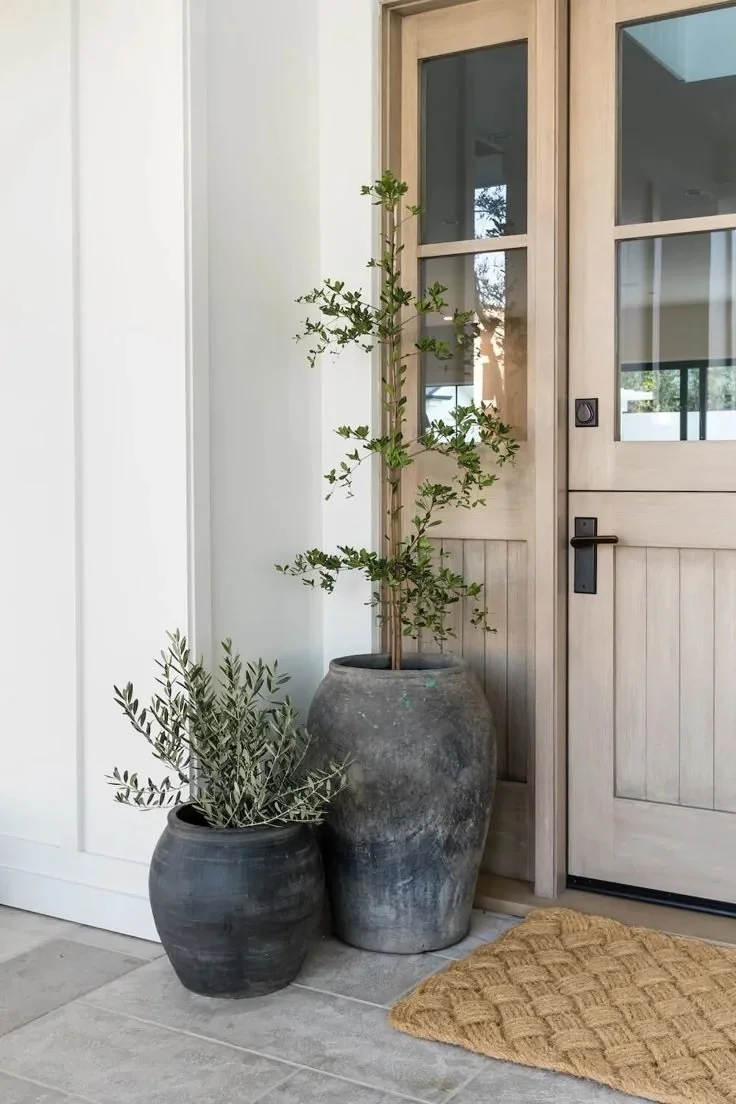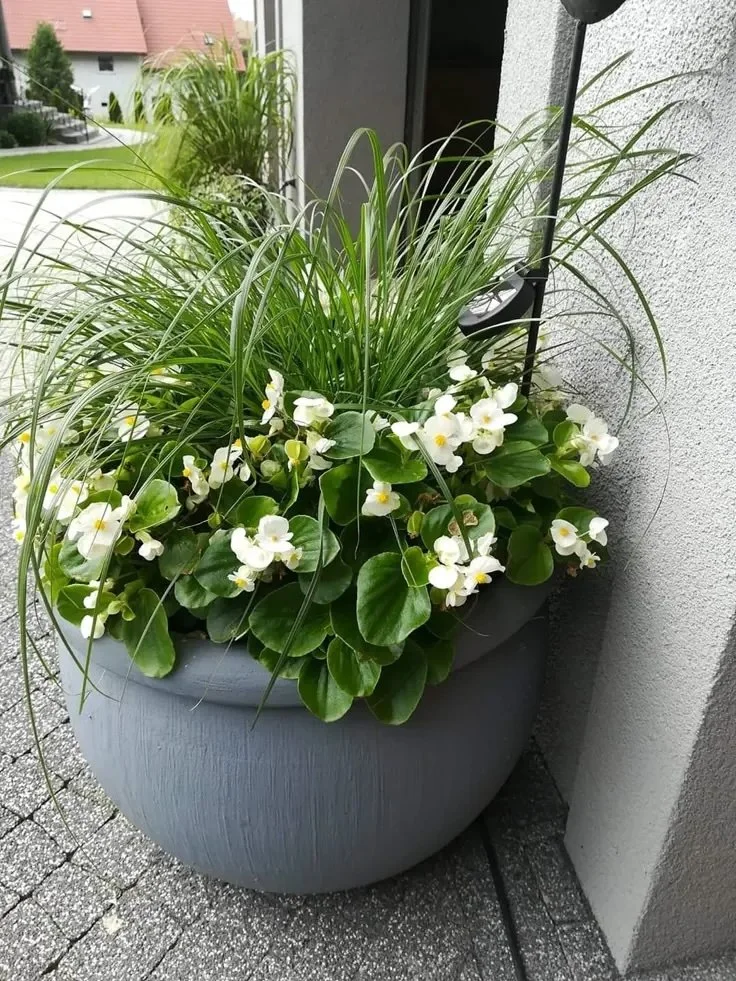
​

ASHLINA KAPOSTA

Interiors. Lifestyle. Blissful Living.
  • About
  • Blog
  • CATEGORIES
    • HOME DECOR
    • SELF CARE
    • FEMININE ENERGY
    • FENG SHUI
    • BLOGGING
    • ENTREPRENEURSHIP
    • FASHION
    • ORGANIZING
    • SPIRITUALITY
    • GIFT GUIDES
    • MANIFESTATION
    • ASTROLOGY
    • MOTHERHOOD
    • WELLNESS
    • NAIL INSPO
  • SHOP
  • COURSES
  • SERVICES
    • COACHING
    • Home Consultation
    • BIRTH CHART READING
  • My work
    • BOOKS
    • PODCAST
    • Press
    • ISTA MAGAZINE
    • Interiors
    • Styling
  • CONTACT
  • About
  • Blog
    • HOME DECOR
    • SELF CARE
    • FEMININE ENERGY
    • FENG SHUI
    • BLOGGING
    • ENTREPRENEURSHIP
    • FASHION
    • ORGANIZING
    • SPIRITUALITY
    • GIFT GUIDES
    • MANIFESTATION
    • ASTROLOGY
    • MOTHERHOOD
    • WELLNESS
    • NAIL INSPO
  • SHOP
  • COURSES
    • COACHING
    • Home Consultation
    • BIRTH CHART READING
    • BOOKS
    • PODCAST
    • Press
    • ISTA MAGAZINE
    • Interiors
    • Styling
  • CONTACT

Blog

Ashlina - Lifestyle Blog

  • All
  • 10 things
  • blogging
  • christmas
  • domestic bliss
  • entertaining
  • entreprenueress
  • fab finds
  • fabric
  • fashion
  • fashionising
  • feminine energy
  • feng shui
  • fragrance
  • holidays
  • interior decorating
  • interior design
  • jewelry
  • lifestyle
  • my home
  • organization
  • PODCAST
  • restaurants
  • self care
  • self help
  • shopping
  • traveling
  • wellness

The Ultimate Guide to Orchid Care: How to Grow Orchids Indoors & Keep Them Blooming

ashlina kaposta August 13, 2026

Everything you need to know about caring for orchids indoors, from watering and sunlight to repotting, fertilizing, troubleshooting, and even the meaning of orchids in your home.

Orchids have always been one of my favorite flowers.

There is just something about an orchid that makes a home feel instantly more beautiful. They have this effortless, elegant quality that makes even the simplest room feel a little more special.

I have always loved having orchids around my home, but I'll admit something:

I have always loved orchids more than I actually knew how to care for them.

That changed recently when family of mine gave me six stunning orchids.

They had been taking over their home, and they were getting a little tired of caring for them, so they asked if I wanted to take them. Of course I said yes.

Now I suddenly have six orchids living throughout my home, and several of them are clearly outgrowing the pots they're in.

Which means I have officially entered my orchid-mom era.

The only problem?

I realized very quickly that I didn't actually know as much about orchid care as I thought I did. So I decided to learn.

I've been researching how to properly water orchids, how much light they need, what those crazy roots growing outside the pots actually mean, when to repot them, how to get them to bloom again, and how to keep them healthy long-term.

And because I know I'm probably not the only person who has brought home a gorgeous orchid and then immediately thought, Okay...now what?, I decided to put everything I'm learning into one place.

This is my ultimate beginner's guide to orchid care.

I'll be updating this post as my six orchids grow, get repotted, and hopefully start blooming again.

And because I love thinking about our homes as more than just beautiful spaces, I've also included something I find fascinating toward the end of this guide:

the symbolism of orchids and how orchids can be used in Feng Shui.Because apparently these beautiful little plants aren't just pretty.They're meaningful, too.
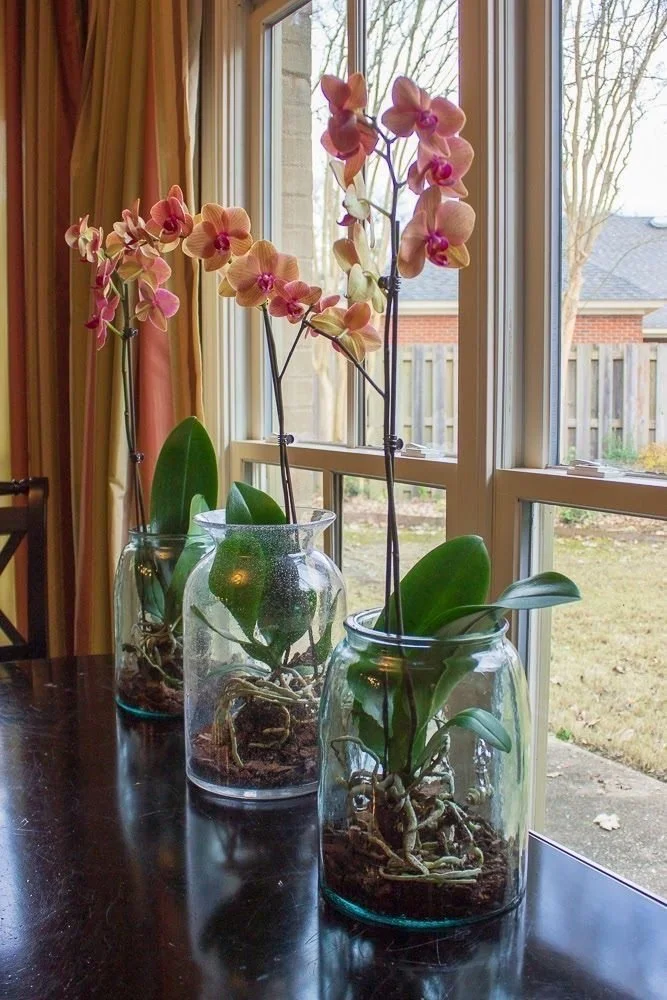
orchid vases

image source

Table of Contents

  1. My Story: How I Ended Up With Six Orchids

  2. What Kind of Orchid Do You Have?

  3. How to Care for Orchids Indoors

  4. How Much Light Do Orchids Need?

  5. How Often Should You Water an Orchid?

  6. How to Tell When Your Orchid Needs Water

  7. Should You Mist an Orchid?

  8. How Much Humidity Do Orchids Need?

  9. What Kind of Pot Does an Orchid Need?

  10. Understanding Orchid Roots

  11. When Should You Repot an Orchid?

  12. How to Repot an Orchid

  13. What Kind of Soil Does an Orchid Need?

  14. How Do You Know If Orchid Roots Are Healthy?

  15. How to Fertilize Orchids

  16. How Do You Get an Orchid to Bloom Again?

  17. Why Are My Orchid Leaves Turning Yellow?

  18. Why Are My Orchid Leaves Wrinkled?

  19. Why Are My Orchid Roots Turning Brown?

  20. Common Orchid Problems & What They Mean

  21. Should You Cut Orchid Roots?

  22. Can You Put an Orchid in a Decorative Pot?

  23. How Long Do Orchids Live?

  24. Orchid Care Through the Seasons

  25. The Meaning of Orchids: What Orchids Symbolize

  26. Orchids & Feng Shui: Where to Place Orchids in Your Home

1. My Story: How I Ended Up With Six Orchids

Let's start with the reason I'm writing this guide in the first place. My in-laws had six orchids that had basically taken over their home. Rather than continue trying to keep up with them, they decided to give them to me. And since orchids are one of my favorite flowers, I happily took all six. I brought them home and started looking around at them more closely. And several were clearly becoming too large for the containers they were in.

That's when I realized that loving orchids and actually knowing how to care for orchids are two very different things.

So I decided to learn. And honestly, the more I've learned about orchids, the more fascinated I've become.

They aren't quite like other houseplants like my monsteras, their roots behave differently, their watering needs are different. They don't necessarily need to be planted in traditional soil. And when their flowers fall off, it doesn't mean the plant is dying.

In fact, an orchid without flowers can still be incredibly healthy.

So now I'm on a little mission to see what happens when I give these six orchids the right environment and a little more attention.

I'm going to repot the ones that need it, move them around my home to find their ideal spots, and hopefully watch them all bloom again.

I'll be documenting the process here because I think there's something really fun about learning alongside your plants.

And if you're also learning how to care for orchids, you're invited to learn with me.

2. What Kind of Orchid Do You Have?

Before you start caring for your orchid, it's helpful to know what kind you actually have.

There are thousands of orchid species and hybrids, and their growing requirements can be very different.

But if you've purchased an orchid from a grocery store, garden center, florist, or big-box store, there's a good chance you have a Phalaenopsis orchid, commonly called a moth orchid.

Phalaenopsis orchids are one of the most popular orchids for growing indoors and are generally considered one of the more beginner-friendly types.

They typically have:

  • Broad, glossy green leaves

  • Long flower spikes

  • Large, butterfly-shaped flowers

  • Thick roots

  • Long-lasting blooms

If you have the classic orchid that you see everywhere around Valentine's Day, Mother's Day, and in grocery-store floral departments, there's a good chance it's a Phalaenopsis.

That's the type of orchid this guide primarily focuses on.

If you have a Cattleya, Dendrobium, Oncidium, Vanda, Paphiopedilum, or another variety, some of the advice here may need to be adjusted for that specific orchid.

3. How to Care for Orchids Indoors

The good news is that orchid care isn't nearly as complicated as it looks.

For a typical indoor Phalaenopsis orchid, the basics come down to:

Light + water + humidity + airflow + proper potting medium + occasional fertilizer.

The biggest mistake beginners make is treating an orchid like an ordinary houseplant.

Orchids don't generally want to sit in traditional potting soil with wet roots.

Many commonly grown orchids are epiphytes, meaning they naturally grow on trees rather than in the ground.

Their roots are designed to receive both moisture and air.

So your goal isn't simply to keep your orchid "wet."

Your goal is to create an environment where the roots receive the right amount of moisture without staying waterlogged.

Once you understand that, orchid care starts to make much more sense.

4. How Much Light Do Orchids Need?

Light is one of the most important parts of orchid care.

Phalaenopsis orchids generally prefer bright, indirect light.

An east-facing window is often an excellent location because it provides bright morning light without the harshest afternoon sun.

A shaded south- or west-facing window can also work.

Think:

Bright room. Filtered light. No scorching afternoon sun.

Good locations include:

  • Near an east-facing window

  • A few feet from a bright south-facing window

  • Near a west-facing window with filtered light

  • A bright kitchen

  • A sunny bathroom

  • A bright living room

Avoid putting an orchid directly against extremely hot glass where intense afternoon sunlight can scorch the leaves.

How can you tell if your orchid is getting enough light?

Look at the leaves.

Healthy Phalaenopsis leaves are generally a medium to light green. Very dark green leaves can indicate insufficient light. Yellowing, bleached, or scorched-looking leaves can indicate too much intense light or another problem.

And if your orchid produces beautiful leaves but refuses to bloom, inadequate light is one of the first things I'd investigate.

5. How Often Should You Water an Orchid?

This is probably the biggest orchid-care question of all.

And the answer isn't, "Every Sunday." There isn't one universal watering schedule that works for every orchid.

How quickly an orchid dries depends on:

  • Temperature

  • Humidity

  • Light

  • Air circulation

  • Pot size

  • Potting medium

  • Season

  • The plant itself

Instead of watering according to the calendar, learn to read your orchid. For Phalaenopsis, you want to water thoroughly and then allow the growing medium to become nearly dry before watering again.

Don't keep the roots constantly soaking wet. But don't allow the plant to stay completely bone-dry for extended periods either. Your home environment will determine how frequently that balance occurs.

6. How to Tell When Your Orchid Needs Water

There are several easy ways to tell.

Look at the roots

This is one of the best things about growing orchids in clear pots.

You can actually see what's happening underneath the plant.

Healthy, hydrated roots are often green.

Roots that have dried out can appear silvery or gray.

Roots that are brown, black, soft, or mushy may be damaged or rotting.

Feel the pot

Pick up the orchid.

A freshly watered orchid will feel heavier. As the growing medium dries, the pot becomes lighter. Eventually, you'll start recognizing the difference without even thinking about it.

Check the growing medium

Look at the bark or moss.

Does it still look damp?

Does it feel moist?

Is it beginning to dry?

You can also use a wooden skewer or chopstick to help check moisture deeper inside the pot.

The biggest lesson:

Don't water your orchid simply because it's Tuesday.

Water because your orchid actually needs water.

7. Should You Mist an Orchid?

Misting is one of those orchid-care topics that can get confusing.

Yes, misting can temporarily increase moisture around the plant. But misting isn't a replacement for properly watering the roots. Orchids absorb most of their water through their roots, so the roots need to be your primary focus.

If your home is dry, increasing the humidity of the room can be more effective than constantly misting the leaves. And there's one thing I would be especially careful about:

Don't allow water to sit in the crown of the orchid.

The crown is the central area where the leaves emerge. Water trapped there can increase the risk of crown rot. If water gets into the crown, gently remove it.

8. How Much Humidity Do Orchids Need?

Orchids generally appreciate humidity because many come from tropical or subtropical environments.

For Phalaenopsis, a humidity level around 50–80% is commonly recommended. But you don't necessarily need to turn your house into a greenhouse.

If your orchid is growing well, producing healthy leaves and roots, and the growing medium is drying appropriately, you may not need to do anything special.

If your home is especially dry, a humidifier can help.

A small humidity tray can also be used, but make sure the orchid itself isn't sitting directly in water.

And remember:

Humidity and airflow need to work together.

A humid room with stagnant air isn't ideal. Good air movement helps keep foliage dry and can reduce the conditions that contribute to fungal and bacterial problems.

9. What Kind of Pot Does an Orchid Need?

Have you ever wondered why orchids are so often sold in clear plastic pots? It's not just because they are cheap. There's actually a very practical reason. Clear pots allow you to see the roots and with orchids, the roots tell you a lot.

A good orchid pot should have:

  • Excellent drainage

  • Plenty of airflow

  • Appropriate space for the root system

  • A potting medium designed for orchids

You can absolutely put that functional nursery pot inside a beautiful decorative planter.

That's actually one of my favorite ways to display orchids.

You get the healthy growing environment of a practical orchid pot while still getting the beautiful interior-design moment of a decorative planter.

10. Understanding Orchid Roots

If you're new to orchids, the roots might be the strangest thing about them.

They can grow:

  • Down into the pot

  • Up through the potting medium

  • Over the edge

  • Around the outside

  • Completely outside the pot

And that's okay.

Orchid roots are not supposed to look like the roots of a typical houseplant. Many orchids naturally grow attached to trees, so their roots are adapted to being exposed to the air. Those roots growing outside the pot are called aerial roots. And unless they're dead or diseased, you generally don't need to cut them.

In fact, I think one of the most important mindset shifts when caring for orchids is this: Stop trying to make your orchid look like a conventional houseplant. Let it be an orchid.

11. When Should You Repot an Orchid?

This is especially relevant to me right now because several of my six orchids are clearly outgrowing their pots.

But here's something important:

An orchid doesn't necessarily need a new pot just because roots are growing outside of it.

Aerial roots are normal. Instead, look at the entire plant.

You may want to repot when:

  • The potting medium is breaking down

  • The bark has decomposed

  • The growing medium stays wet for too long

  • The plant has become unstable

  • There are many damaged or rotting roots

  • The root system has genuinely outgrown the container

  • The plant needs fresh growing medium

Phalaenopsis are commonly repotted about every one to three years, depending on the condition of the growing medium and the plant.

If the orchid is in bloom and otherwise healthy, you can often wait until after flowering unless there's an urgent problem with the roots or medium.

12. How to Repot an Orchid

Repotting an orchid looks intimidating the first time.

But once you understand what you're doing, it's surprisingly straightforward.

What you'll need:

  • A clean orchid pot

  • Fresh orchid potting medium

  • Clean scissors or pruning shears

  • Your orchid

  • A clean work surface

Step 1: Remove the orchid

Gently remove the orchid from its existing container.

If the roots are attached to the pot, don't yank them.

Work slowly.

Step 2: Remove the old growing medium

Gently loosen the bark, moss, or other growing medium from around the roots.

This is your opportunity to inspect what's actually happening inside the pot.

Step 3: Inspect the roots

Look for healthy, firm roots.

Remove roots that are:

  • Soft

  • Mushy

  • Collapsed

  • Completely dead

  • Severely damaged

Always use clean cutting tools.

Step 4: Choose the new pot

Don't automatically choose the biggest pot you can find.

An appropriately sized pot is usually better than giving the orchid a huge amount of extra space.

Step 5: Add fresh orchid medium

Put a small amount of fresh orchid mix into the bottom of the pot.

Step 6: Position the orchid

Place the orchid into the pot and gently arrange the healthy roots.

Step 7: Add more growing medium

Gently work the new medium around the roots.

Don't pack it down like traditional soil.

The roots need airflow.

Step 8: Keep the crown above the medium

The central stem where the leaves emerge should remain above the growing medium.

Don't bury the crown.

And then you're done.

Your orchid has a fresh home.

13. What Kind of Soil Does an Orchid Need?

The short answer:

Usually, not regular soil.

This is one of the biggest beginner orchid-care mistakes.

Orchids such as Phalaenopsis are commonly grown in a porous, airy medium rather than ordinary houseplant soil.

Common orchid mixes can contain:

  • Orchid bark

  • Sphagnum moss

  • Perlite

  • Other coarse materials

The exact mixture can vary based on your environment and watering habits.

The goal is to create a growing environment that provides moisture while still allowing air to reach the roots.

Think:

Moist, but not suffocated.

14. How Do You Know If Orchid Roots Are Healthy?

Learning to read orchid roots will make you a much more confident orchid owner.

Green roots

Often indicate hydrated, active roots.

Silver or gray roots

Often indicate that the roots have dried and are ready for water.

Brown or black roots

May indicate dead or damaged roots, particularly if they are soft or mushy.

Firm roots

Generally indicate healthier tissue.

Soft, mushy roots

Are a warning sign and may indicate rot.

One of the most important things to remember is that a sad-looking orchid isn't necessarily thirsty.

Sometimes a plant has wrinkled leaves because its roots have been damaged and can no longer absorb water properly.

So before you simply give it more water:

Look at the roots.

15. How to Fertilize Orchids

Orchids benefit from regular nutrition during active growth.

Use an orchid fertilizer or another appropriate balanced fertilizer, and always follow the dilution instructions on the product.

Many orchid growers prefer a diluted fertilizer applied regularly rather than extremely strong applications.

The important thing is not to overdo it.

More fertilizer does not automatically mean more flowers.

Your priorities should be:

  1. Healthy roots

  2. Appropriate light

  3. Proper watering

  4. Good growing medium

  5. Appropriate nutrition

Fertilizer is there to support healthy growth — not compensate for poor growing conditions.

16. How Do You Get an Orchid to Bloom Again?

This is the part everyone wants to know.

You bought an orchid.

It was covered in gorgeous flowers.

Then the flowers fell off.

And suddenly you're staring at a green plant wondering:

Is it dead?

No. Please don't throw it away.The flowers falling off is often simply the end of that particular flowering cycle. Your orchid is still alive.

To encourage future blooming, focus on the basics:

  • Give it adequate light

  • Keep the roots healthy

  • Water appropriately

  • Fertilize appropriately

  • Maintain suitable temperatures

  • Give it time

Some Phalaenopsis orchids can rebloom from existing flower spikes, while others may produce a new spike.

If a flower spike is still green, you don't necessarily need to cut it off immediately.

If it has completely turned brown and dried out, it can be removed.

A flowerless orchid is still an orchid.

The leaves and roots you're growing today may be what eventually produces tomorrow's flowers.

17. Why Are My Orchid Leaves Turning Yellow?

One yellow leaf isn't automatically an emergency. Older leaves naturally age and eventually turn yellow. But if several leaves are suddenly yellowing, it's worth investigating.

Possible causes include:

  • Overwatering

  • Root problems

  • Too much intense sunlight

  • Too little light

  • Nutritional issues

  • Natural aging

Start by looking at the roots.

Then evaluate how wet the growing medium is staying and how much light the orchid receives. Don't automatically assume that yellow leaves mean you need to add more water.

18. Why Are My Orchid Leaves Wrinkled?

Wrinkled or limp leaves can indicate that the plant isn't receiving enough usable water. But again, don't immediately grab the watering can. Check the roots first.

If the roots are healthy but the plant is drying too quickly, it may need more consistent watering or a better humidity environment.

If the roots are damaged or rotting, the orchid may not be able to absorb enough water even if the pot is wet.

This is why orchid care is so much about observation. The symptom isn't always the cause.

19. Why Are My Orchid Roots Turning Brown?

Brown roots can mean different things depending on their texture and condition. The bigger warning sign is soft, mushy, collapsing tissue. That's when you should suspect root rot or severe root damage.

If you discover rotten roots during repotting, remove the damaged sections using clean scissors and repot the orchid into fresh, appropriate growing medium.

The goal is to preserve the healthy roots and give them a clean environment in which to recover.
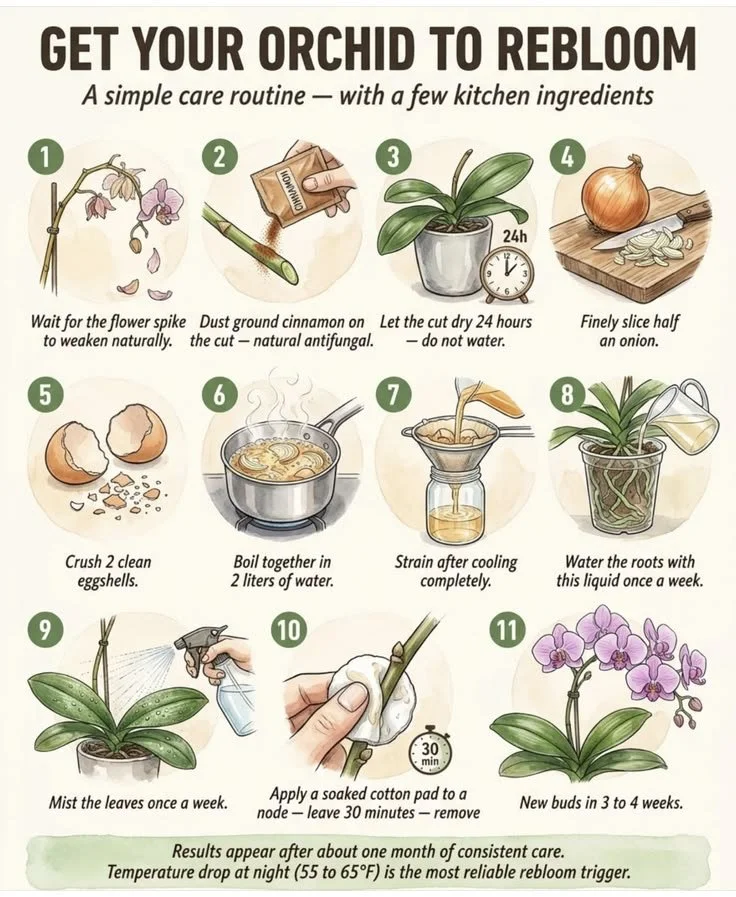
how to get your orchid to rebloom

image source

20. Common Orchid Problems & What They Mean

Yellow leaves

Possible causes: Aging, overwatering, root problems, excessive light, or other environmental stress.

Check: Roots, moisture, and light.

Wrinkled leaves

Possible causes: Dehydration or damaged roots.

Check: Root health before increasing watering.

Brown or mushy roots

Possible cause: Root rot.

Check: Remove damaged roots and repot into fresh, airy medium.

No flowers

Possible causes: Insufficient light, stress, normal time between flowering cycles, or immature growth.

Check: Light, roots, watering, nutrition, and patience.

Flowers falling off

Possible causes: Normal end of bloom, environmental changes, temperature fluctuations, or plant stress.

Check: Continue normal care and observe the plant.

Roots growing outside the pot

Possible cause: Normal orchid growth.

Check: Usually nothing. Healthy aerial roots don't need to be cut simply because they're outside the pot.

Water collecting in the crown

Potential problem: Crown rot.

Check: Gently remove standing water and avoid leaving the crown wet.

21. Should You Cut Orchid Roots?

Only cut roots that are dead, damaged, or rotting.

Don't cut a healthy aerial root just because it looks strange.

I know this can be difficult when you're trying to make your orchid look neat and pretty.

But orchids aren't meant to be perfectly contained.

Those wild roots are part of the plant.

Let them grow.

In fact, I think they're one of the most beautiful parts of an orchid once you understand what you're looking at.

22. Can You Put an Orchid in a Decorative Pot?

Absolutely.

And this is one of my favorite ways to style orchids around the house.

Keep the orchid in a functional nursery or orchid pot with proper drainage, then place that container inside a decorative pot.

That way you can have:

Healthy roots + beautiful home decor.

Just remember to empty any water that collects in the decorative container after watering.

You never want the orchid sitting in standing water.

And this is where orchids really shine as decor.

They can sit on:

  • Coffee tables

  • Nightstands

  • Bathroom counters

  • Kitchen islands

  • Entryway tables

  • Bookshelves

  • Home office desks

  • Dining tables

They're living decor.

And unlike a bouquet of cut flowers, the plant can continue growing long after the original flowers are gone.

23. How Long Do Orchids Live?

With proper care, orchids can live for many years.

That is one of the reasons I think they're such a wonderful houseplant.

They're not meant to be enjoyed for a few weeks and then discarded when the flowers disappear.

The flowers are only one part of the life of the plant.

An orchid can spend one season blooming, another season growing roots and leaves, and another preparing to bloom again.

Which means your orchid can become something you care for and watch change over time.

And I love that.

24. Orchid Care Through the Seasons

Your orchid's needs can change throughout the year.

Spring Orchid Care

Spring is a great time to:

  • Inspect the roots

  • Evaluate the growing medium

  • Repot if necessary

  • Increase watering as growth increases

  • Begin or increase fertilizing

  • Reevaluate the amount of light your orchid receives

Summer Orchid Care

In warmer months, your orchid may dry out more quickly.

Pay attention to:

  • Watering frequency

  • Humidity

  • Air movement

  • Heat

  • Direct sunlight

A bright, hot window can be much more intense during summer.

Fall Orchid Care

As temperatures and daylight change, watch how quickly the orchid dries.

Your watering frequency may need to change.

Fall can also be an important time for some Phalaenopsis orchids because cooler nighttime temperatures can help initiate flower spikes.

Winter Orchid Care

Indoor heating can make the air significantly drier.

Watch the roots and potting medium rather than sticking to a rigid watering schedule.

And don't panic if growth slows down.

Your orchid doesn't have to bloom constantly to be healthy.

25. The Meaning of Orchids: What Orchids Symbolize

This is where my orchid obsession gets a little more interesting.

Because orchids aren't just beautiful.

They have a long history of symbolism across different cultures.

Orchids are commonly associated with:

  • Beauty

  • Love

  • Grace

  • Elegance

  • Refinement

  • Fertility

  • Friendship

  • Patience

  • Longevity

  • Strength

  • Abundance

In Chinese culture, the orchid is one of the Four Gentlemen of traditional art and symbolism, alongside the plum blossom, bamboo, and chrysanthemum.

These plants have historically been associated with virtues and qualities of cultivated character.

And I think the symbolism of the orchid is particularly beautiful.

Because orchids don't bloom constantly.

They have seasons.

They require patience.

Their growth isn't always obvious.

Sometimes you're looking at nothing but roots and leaves.

And then suddenly...

they bloom.

Maybe that's part of why I love them so much.

They feel like a little reminder that just because you aren't visibly blooming doesn't mean nothing is happening.

Sometimes you're growing roots.

Sometimes you're strengthening.

Sometimes you're preparing.

And sometimes, after a season of quiet growth, you bloom again.

What Different Orchid Colors Symbolize

While meanings vary by tradition, color is often given additional symbolic significance.

Purple orchids are commonly associated with admiration, refinement, luxury, and abundance.

Pink orchids are often connected with love, romance, femininity, and affection.

Yellow orchids can symbolize friendship, happiness, warmth, and joy.

Red orchids are associated with passion, desire, vitality, and strength.

White orchids are often associated with beauty, elegance, innocence, and purity.

I love the idea of choosing an orchid not just because you love its color, but because you love what that color represents to you.

Maybe you choose a pink orchid for your bedroom because you want to cultivate more romance.

Maybe you choose purple for your office because you're creating a season of expansion and abundance.

Maybe you choose white because you're creating a calm, beautiful sanctuary.

The meaning becomes part of the ritual.

26. Orchids & Feng Shui: Where to Place Orchids in Your Home

If you love Feng Shui, orchids are especially interesting because they're associated with beauty, harmony, growth, and positive energy.

In Feng Shui, living plants are often used to bring the energy of nature and growth into a home.

And an orchid brings something particularly beautiful to that idea because it combines living growth with flowers.

It's not just green.

It blooms.

It's not just decorative.

It's alive.

And that makes an orchid a beautiful symbolic addition to a home where you're intentionally creating a particular energy.

Orchids for Love & Relationships

Orchids are traditionally associated with love, beauty, fertility, and relationships.

In the traditional Feng Shui bagua, the southwest area is associated with relationships and partnership.

That makes an orchid a beautiful symbolic choice for this area if you're intentionally working with traditional Feng Shui principles.

You can also place orchids in a bedroom or another space that feels connected to love, romance, intimacy, or partnership.

And I especially love the idea of placing a beautiful pink orchid somewhere you get ready each morning.

It turns the plant into a reminder:

Beauty isn't something you wait to experience. It's something you create.

Orchids for Abundance & Success

Purple orchids are especially beautiful when you're thinking about abundance, admiration, refinement, and success.

A purple orchid can make a gorgeous addition to:

  • A home office

  • A creative workspace

  • A reading area

  • A place where you journal or plan

  • A room dedicated to your work or business

And there's something beautiful about having a living plant near your workspace.

It becomes a visual reminder of growth.

Orchids in the Bedroom

The bedroom is one of my favorite places for an orchid because orchids naturally bring a sense of beauty and softness to the room.

A pink or white orchid can be especially beautiful here.

Think of it less as "I'm putting a plant in my bedroom for a specific magical outcome" and more as:

I'm intentionally surrounding myself with symbols of love, beauty, and growth.

That's the part of Feng Shui I find most beautiful.

Your environment becomes a reflection of what you're cultivating.

Orchids in the Bathroom

Bathrooms can be wonderful places for orchids if they receive enough natural light.

The humidity can also be helpful.

A beautiful orchid beside a bathtub, on a bathroom vanity, or near a bright window can make the entire room feel like a little spa.

And symbolically, I love the combination of:

orchid + water + beauty ritual.

It's a natural fit for a space where you're already caring for yourself.

Orchids in the Entryway

An orchid can also make a beautiful statement in an entryway.

It's the first thing you see when you walk into your home.

Instead of simply decorating the entryway, you can think about what you want to feel when you arrive home.

Peace.

Beauty.

Abundance.

Warmth.

Love.

Choose an orchid that represents the energy you want to welcome.

The Most Important Feng Shui Orchid Rule

Here's something I think is even more important than the exact location:

Keep your orchid healthy.

A vibrant, thriving plant represents growth and vitality.

A neglected, dying plant doesn't create the same feeling.

So before worrying about whether your orchid is in the "perfect" Feng Shui corner, take care of the plant.

Water it.

Give it light.

Repot it when it needs it.

Remove dead growth.

Pay attention.

In other words:

The best Feng Shui orchid is a healthy orchid.

And maybe that's the perfect connection between Feng Shui and everything we've talked about in this guide.

You don't create a beautiful home simply by putting beautiful things in it.

You create a beautiful home by caring for what lives inside it.

My Six-Orchid Experiment

Now comes the part I'm most excited about.

I have six orchids.

And I'm going to see what happens when I really learn how to care for them.

I'm going to experiment with their placement around my home.

I'm going to repot the ones that need it.

I'm going to learn how each one grows.

I'm going to photograph the roots.

I'm going to watch for new leaves and flower spikes.

And I'm hoping to eventually see all six of them blooming again.

I'm especially curious about how different rooms in my home affect them.

Maybe one will love a bright window.

Maybe another will thrive in the humidity of the bathroom.

Maybe one will become the centerpiece of my dining room.

And maybe I'll discover that one particular orchid has a completely different personality from the others.

I'll be documenting the process here, so consider this the beginning of my orchid experiment.

And if you've been thinking about buying an orchid but have been intimidated by them, I hope this makes you feel a little more confident.

Because I'm learning right alongside you.

My Simple Orchid Care Routine

Now that I have six orchids, I don't want caring for them to become complicated.

My goal is to make orchid care something I naturally incorporate into my home routine.

Once a week, I check:

  • The leaves

  • The roots

  • The potting medium

  • The weight of the pot

  • The amount of light

  • New growth

  • Flower spikes

  • Signs of pests or disease

When the orchid needs water:

I water it thoroughly and allow the excess water to drain completely.

Every few weeks:

I take a closer look at the roots, leaves, and overall condition of the plant.

When necessary:

I repot, prune damaged roots, refresh the growing medium, or adjust its location.

And that's it.

I don't want to obsess over them.

I just want to pay attention.

Because the more I've learned about orchids, the more I've realized that successful orchid care isn't necessarily about doing more.

It's about noticing more.

Frequently Asked Questions About Orchid Care

How often should you water an orchid?

There isn't one universal schedule. Water when the growing medium is approaching dryness, then water thoroughly and allow excess water to drain.

How much sunlight does an orchid need?

Phalaenopsis orchids generally prefer bright, indirect light. An east-facing window is often ideal, while shaded south- or west-facing windows can also work.

Can orchids grow indoors?

Yes. Phalaenopsis orchids are particularly well suited to indoor environments when given adequate light, appropriate watering, good drainage, humidity, and airflow.

Should orchids be planted in soil?

Most commonly grown epiphytic orchids should not be planted in ordinary houseplant soil. They need a porous, airy orchid-growing medium.

Why are my orchid roots growing outside the pot?

Those are aerial roots, and they are a normal part of orchid growth. Healthy aerial roots generally don't need to be cut.

How do I get my orchid to bloom again?

Give it adequate light, maintain healthy roots, water appropriately, provide appropriate nutrition, and be patient. Orchids often need time between flowering cycles.

Should I cut the orchid stem after the flowers fall?

Not necessarily. A green flower spike may continue producing growth. A completely brown and dried flower spike can be removed.

What is the best pot for an orchid?

A pot with excellent drainage and good airflow is ideal. Clear plastic pots are especially useful because they allow you to monitor the roots.

How often should I repot an orchid?

Phalaenopsis are commonly repotted approximately every one to three years, depending on the condition of the growing medium and the plant's roots.

How long do orchids live?

With proper care, orchids can live for many years and may flower repeatedly throughout their lives.

Can I keep an orchid in a decorative pot?

Yes. Keep the orchid in a pot with appropriate drainage and use the decorative pot as an outer container. Don't allow water to collect around the roots.

Are orchids good Feng Shui plants?

Orchids are commonly used symbolically in Feng Shui and are associated with beauty, harmony, growth, love, and abundance. The most important thing is to keep the plant healthy and thriving.

Final Thoughts

When I first brought home my six orchids, I thought my biggest challenge was going to be figuring out how to keep them alive.

Now I'm realizing that the more interesting part is learning how to understand them.

The roots tell a story.

The leaves tell a story.

The flowers tell a story.

Even the periods when there are no flowers tell a story.

And maybe that's why orchids have become even more meaningful to me now that I'm actually learning how to care for them.

They remind me that growth isn't always visible.

Sometimes you're blooming.

Sometimes you're growing roots.

Sometimes you're resting.

And sometimes you're preparing for your next season.

You don't have to be in bloom all the time to be growing.

So yes, I'm going to do my best to keep these six orchids alive.

I'm going to repot them, move them around my home, learn their rhythms, and hopefully watch them bloom again.

But I'm also going to enjoy the process.

Because maybe that's what having plants in your home is really about.

Not just decorating your space.

Caring for something. Watching something grow. And creating a home that feels alive.

And if my six orchids have taught me anything already, it's that sometimes the most beautiful blooms come after a season of simply growing roots.

you may also like:

🌹 The Ultimate Guide to Caring for and Growing Your Monstera Deliciosa

🌹 44 things to do on a Sunday for a great week

🌹 How to start an herb garden at home

🌹 21 small backyard flower garden ideas

Please feel free to email me at ashlina@thedecorista.com if you have any questions!  I’m always happy to help with decorating, life advice or even picking out a specific perfume!  Have an amazing day!!

Also, check out my Amazon shop HERE to shop all my favorite things, tips and tricks. You can also download the free LIKETOKNOW.IT app and follow me HERE.

STAY IN THE KNOW:  Don’t forget to sign up for my exclusive Love Letters for STYLE TIPS, LIFE ADVICE, COSMIC TEA, AND MUCH MORE!

As always, thank you so much for stopping by today, I truly appreciate all of you! xo, Ashlina

FOLLOW ALONG: Instagram | Pinterest | Shop Amazon | You Tube

Blog
45+ budget friendly DIY halloween decorating ideas.jpg
September 1, 2026
45+ Easy and Budget Friendly DIY Halloween Decorating Ideas
September 1, 2026
Read more →
September 1, 2026
33+ Mocha Brown Nail Ideas: The Ultimate Chocolate Fall Manicure Trend You Need to Try in 2026
August 31, 2026
33+ Mocha Brown Nail Ideas: The Ultimate Chocolate Fall Manicure Trend You Need to Try in 2026
August 31, 2026
Read more →
August 31, 2026
30 blissful things to do to romanticize your fall.jpg
August 31, 2026
Fall Bucket List: 30 blissful things to do this Fall
August 31, 2026
Read more →
August 31, 2026
15 best spiritual books every woman must read.jpg
August 26, 2026
My 15 Favorite Spiritual Awakening Books for Women Who Are Evolving
August 26, 2026
Read more →
August 26, 2026
the ultimate guide to caring for orhids and how to make them last.jpg
August 13, 2026
The Ultimate Guide to Orchid Care: How to Grow Orchids Indoors & Keep Them Blooming
August 13, 2026
Read more →
August 13, 2026
how to take better notes to become a better thinker.jpg
August 11, 2026
How to Take Better Notes: A simple habit that will make you think better & why it matters for women
August 11, 2026
Read more →
August 11, 2026
35 COZY + ROMANTIC AT HOME DATE NIGHT IDEAS TO DO THIS FALL.jpg
August 10, 2026
40 Cozy + Romantic At-Home Fall Date Night Ideas for Couples (2026 Guide)
August 10, 2026
Read more →
August 10, 2026
how to make your energy expensive.jpg
August 10, 2026
How to Make Your Energy Expensive: 7 Ways to Practice the Joy of Missing Out {podcast ep. 395}
August 10, 2026
Read more →
August 10, 2026
everything you need to know about lions gate portal.jpg
August 8, 2026
The Hot Girl's Guide to the Lion's Gate Portal: Everything You Need to Know
August 8, 2026
Read more →
August 8, 2026
ARE YOU MANIFESTING FROM FEAR OR FAITH.jpg
August 5, 2026
Are You Manifesting From Fear or Faith? Here's How to Tell {podcast ep. 394}
August 5, 2026
Read more →
August 5, 2026
the ultimate guide to morning pages.jpg
August 5, 2026
Morning Pages: The Complete Guide to This Life-Changing Journaling Habit (+ How to Actually Stick With It)
August 5, 2026
Read more →
August 5, 2026
How to plan a DIY wellness retreat
August 3, 2026
How to Plan an Affordable Wellness Retreat at Home Step-By-Step
August 3, 2026
Read more →
August 3, 2026
23+ cozy fall inspired living room ideas you can recreate effortlessly.jpg
July 21, 2026
23 Cozy Fall inspired living room decorating ideas for a small home
July 21, 2026
Read more →
July 21, 2026
how to create a cozy bedroom tips for better sleep.jpg
July 21, 2026
Cozy Bedroom Sleep Sanctuary: 21 Budget Friendly Essentials for Better Sleep After 40
July 21, 2026
Read more →
July 21, 2026
how to find your online business niche when you have too many interests.jpg
July 16, 2026
How to Find Your Online Business Niche When You Have Too Many Interests {podcast ep. 391}
July 16, 2026
Read more →
July 16, 2026
55 everyday items to bedazzle that make life better.jpg
July 14, 2026
55 Random Things to Bedazzle: Easy DIY Guide & Genius Ideas for Everyday Items
July 14, 2026
Read more →
July 14, 2026
23+ STYLISH FALL OUTFIT IDEAS WITH HATS copy.jpg
July 14, 2026
23+ Effortless Fall Fashion Outfit Ideas With Hats
July 14, 2026
Read more →
July 14, 2026
19 charming french cottage bathroom decor ideas.png
July 13, 2026
French Cottage Bathroom Ideas: 19 Charming Ways to Get the Look (Even on a Budget)
July 13, 2026
Read more →
July 13, 2026
Guide to Leo season .jpg
July 13, 2026
Leo Season: The Hot Girls Guide to Thriving With Fire, Confidence & Creativity for all 12 signs
July 13, 2026
Read more →
July 13, 2026
20 walking essentials that make 10k steps so much easier
July 12, 2026
How I Fell in Love With Walking After 40 (+ 20 Essentials That Make 10,000 Steps So Much Easier)
July 12, 2026
Read more →
July 12, 2026
HOW TO SCRIPT AND MANIFEST WITH SCRIPTING.jpg
July 11, 2026
The Ultimate Guide to Scripting for Manifestation: Write Your Dream Reality Into Existence
July 11, 2026
Read more →
July 11, 2026
20 genius small laundry room decorating ideas.jpg
July 10, 2026
20+ Genius Small Laundry Room Decor & Organization Ideas
July 10, 2026
Read more →
July 10, 2026
12 best books on manifesting money and expanding wealth for women.jpg
July 8, 2026
The 12 Best Books on Manifesting Money + Expanding Wealth for Women
July 8, 2026
Read more →
July 8, 2026
12 DELICIOUS HIGH PROTEIN BREAKFAST IDEAS FOR WOMEN.jpg
July 7, 2026
12 Most Delicious High-Protein, Low-Calorie Breakfast Ideas for Women I found on Pinterest
July 7, 2026
Read more →
July 7, 2026
35+ BEAUTIFUL FRONT DOOR PLANTER IDEAS YOU WILL WANT TO RECREATE.jpg
July 7, 2026
35+ Stunning Front Door Planter Ideas (Genius Tips, Tricks & DIY Know-How)
July 7, 2026
Read more →
July 7, 2026
35+ Inspiring Halloween Entryway Decorating Ideas You Will Want To Copy
July 1, 2026
35+ Inspiring Halloween Entryway Decorating Ideas You Will Want To Copy
July 1, 2026
Read more →
July 1, 2026
How to host the ultimate stress-free Friendsgiving dinner party (20+ brilliant ideas)
June 30, 2026
How to host the ultimate stress-free Friendsgiving dinner party (20+ brilliant ideas)
June 30, 2026
Read more →
June 30, 2026
21+ delicious friendsgiving food ideas that are crowdpleasers.jpg
June 28, 2026
21 Easy & Crowd-Pleasing Friendsgiving Food Ideas Everyone Will Love
June 28, 2026
Read more →
June 28, 2026
19+ creative wall above the sofa decor ideas.jpg
June 25, 2026
How to decorate the wall above your sofa ( 19+ Chic & Creative Ideas You Must See )
June 25, 2026
Read more →
June 25, 2026
50+ beautiful beach vacation nail ideas you will want to screenshot.jpg
June 24, 2026
50+ Beautiful Beach Vacation Nail Ideas You'll Want to Screenshot
June 24, 2026
Read more →
June 24, 2026
Tags plants
Comment

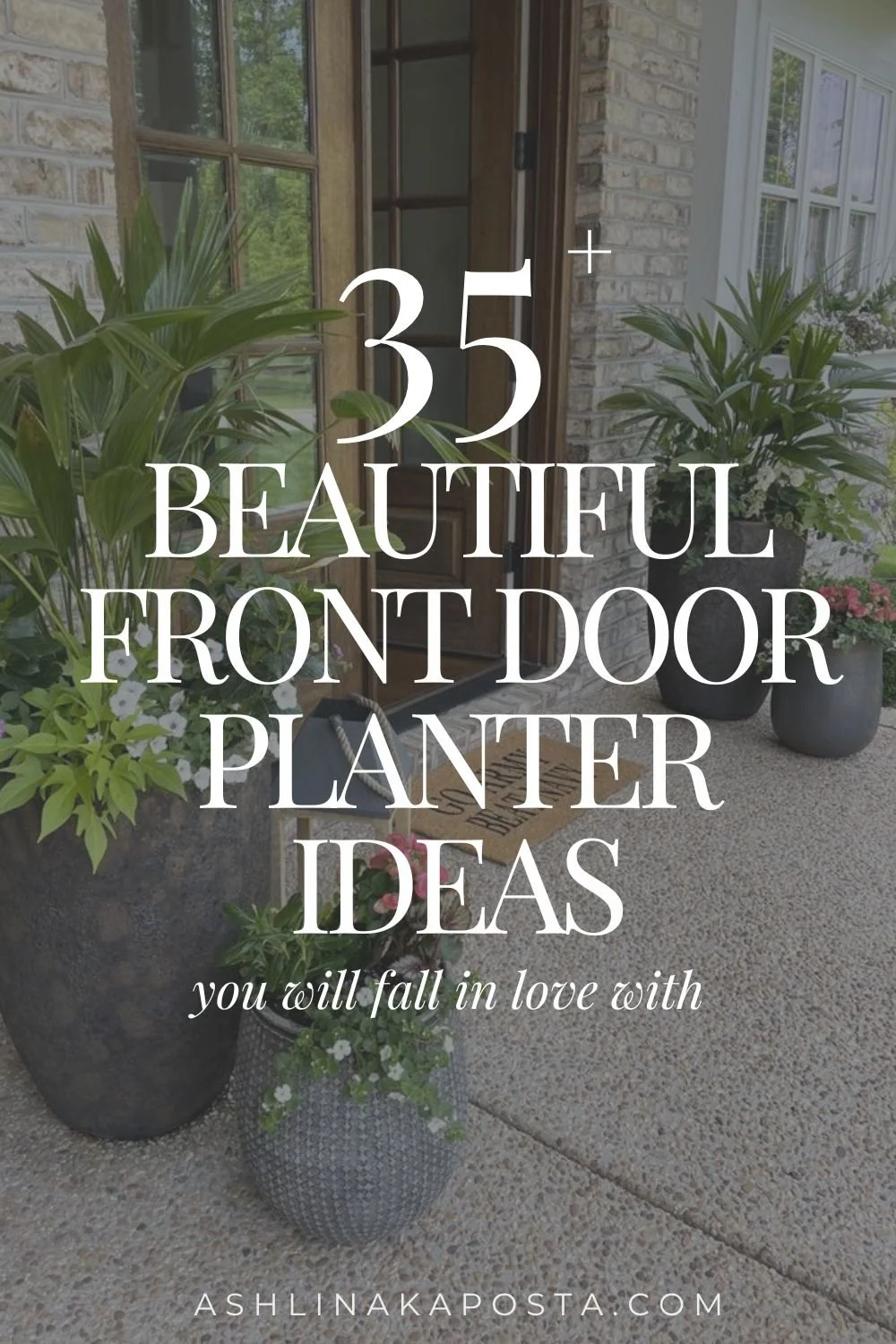
35+ Stunning Front Door Planter Ideas (Genius Tips, Tricks & DIY Know-How)

ashlina kaposta July 7, 2026

I'll admit it — I've killed more front porch plants than I'd like to count. A gorgeous hanging fern that turned crispy in a week because I had no idea my porch faced west and got blasted with afternoon sun. A "matching pair" of planters that never actually matched because one side of my door gets shade all day and the other doesn't. It took some trial, a lot of error, and more than a few sad, droopy plants before I finally figured out what actually works.

A pair of chic front door planters is king. That's exactly why I put this guide together. Your front door is the first thing you see pulling into the driveway and the first thing your guests see before they even ring the bell — it deserves better than a guessing game. Whether you're drawn to lush, real greenery or you'd rather set it and forget it with a beautiful faux arrangement, I wanted to lay out everything I wish someone had told me from the start: how to actually read your light and direction, the honest pros and cons of real vs. faux, how to build your own planters if you're the DIY type, what to plant so they never look sparse, and more than 35 real ideas to steal for your own entryway.

Grab a coffee, scroll through, and pull out whatever fits your porch, your light, and your style. Let's make that front door the best part of coming home.

Table of Contents:

  • Why Front Door Planters Matter

  • Figure Out Your Direction & Light Exposure

  • Best Plants for Sunny Front Doors

  • Best Plants for Shady Front Doors

  • Real Plants vs. Faux Plants: Which Is Right for You?

  • Best Faux Plants for Sun vs. Shade

  • How to Build Your Own Planters (DIY Basics)

  • What to Put in Your Planters (So They Never Look Empty)

  • 35+ Genius Front Door Planter Ideas

  • Maintenance Tips to Keep Planters Looking Fresh

  • FAQ

Why Front Door Planters Matter

Planters flanking your entry do more than hold dirt — they frame your door, add color and texture, and instantly boost curb appeal. Real estate agents often point to entryway landscaping as one of the cheapest, highest-impact upgrades a homeowner can make before selling, and the same logic applies if you're just trying to make your house feel more like home every time you walk up to it.

A pair of well-chosen planters can:

  • Draw the eye toward your front door

  • Add color that complements (or contrasts) your exterior paint

  • Soften hard architectural lines like concrete steps or brick facades

  • Signal the season — think mums in fall, evergreens in winter, tulips in spring

  • Make a rental or starter home feel finished without any permanent landscaping

Shop front door planters

Before you run out and buy the first planter you see, though, it pays to think through a few basics.

Related Reading: How to recreate a European Summer in your backyard

Step 1: Figure Out Your Direction & Light Exposure

This is the step most people skip — and it's the reason so many front door planters end up leggy, sunburned, or dead within a month. Before choosing plants, figure out which way your front door actually faces and how much sun it gets.

How to determine your direction:

  1. Use the compass app on your phone (most phones have one built in) and stand facing away from your front door, looking out at the street.

  2. Note the direction: north, south, east, or west (or a blend, like southeast).

  3. Watch the light for a full day if you can — actual sun exposure often differs from what the compass alone suggests, thanks to trees, roof overhangs, or neighboring buildings.

What each direction typically means for planters:

  • South-facing doors get the most consistent, intense sun all day. Great for sun-loving plants like geraniums, succulents, lantana, and marigolds. Soil dries out fast, so plan on more frequent watering or self-watering planters.

  • North-facing doors get the least direct sun and stay shadier and cooler. Choose shade-tolerant plants like ferns, hostas, begonias, and impatiens. Faux arrangements also do exceptionally well here since low light limits real-plant options.

  • East-facing doors get gentle morning sun and shade in the afternoon — one of the easiest exposures to work with. Most annuals, perennials, and even some vegetables thrive here.

  • West-facing doors get hot, intense afternoon sun, which can scorch delicate plants. Look for heat-tolerant options like ornamental grasses, succulents, and vinca.

A quick light-exposure test: if you're not sure how "full sun" or "part shade" your entry really is, track it for a day. Fewer than 3 hours of direct sun = shade. 3–6 hours = part sun/part shade. 6+ hours = full sun. Match your plant tags to what you observe, not just to the compass direction alone, since overhangs and trees change everything.

Best Plants for Sunny Front Doors (6+ Hours of Direct Sun)

  • Geraniums — classic, nearly foolproof, and reliably long-blooming all season.

  • Lantana — heat- and drought-tolerant, with nonstop color even through the hottest weeks.

  • Marigolds — cheerful, fast-growing, and a natural pest deterrent for nearby plants.

  • Succulents & sedum — store water in their leaves, so they shrug off scorching sun and missed waterings.

  • Petunias — classic spiller/filler with huge color range, though they like consistent watering in full sun.

  • Ornamental grasses — add height and movement, and most varieties actually prefer strong sun.

  • Vinca (annual periwinkle) — thrives in heat where other annuals wilt.

  • Sunpatiens — a sun-tolerant cousin of shade-loving impatiens, bred specifically for full sun.

Sun planter tips:

  • Soil in full sun dries out fast — water more often (sometimes daily in peak summer) and consider a self-watering insert.

  • A layer of mulch on top of the soil helps slow evaporation.

  • Darker-colored planters absorb more heat, which can stress roots — go with a lighter material or glaze if your entry already runs hot.

Best Plants for Shady Front Doors (Under 3 Hours of Direct Sun)

  • Ferns (Boston, autumn, or foxtail) — lush texture and classic shade-loving structure.

  • Hostas — bold, broad leaves that fill space fast and come in dozens of variegated patterns.

  • Begonias — reliable color in low light, with wax and rex varieties both doing well in containers.

  • Impatiens — one of the most dependable shade bloomers for consistent color.

  • Coleus — grown for foliage, not flowers, with color patterns that rival any bloom.

  • English ivy — a dependable, low-fuss trailing "spiller" for shade.

  • Caladiums — dramatic, heart-shaped leaves in pink, white, and green for a tropical shade look.

  • Peace lily (in milder climates or as a seasonal annual) — glossy foliage and occasional white blooms even in low light.

Shade planter tips:

  • Shade soil stays wetter longer, so make sure drainage is solid to avoid root rot.

  • Plants still need some light to thrive — deep, all-day shade may do best with a faux arrangement instead of fighting for real growth.

  • Lighter, brighter foliage colors (chartreuse, white variegation) tend to "pop" more in low light than dark greens.


Real Plants vs. Faux Plants: Which Is Right for You?

This is one of the biggest decisions you'll make for your entryway, and there's no universally "right" answer — it depends on your light, your schedule, and your climate.

Real Plants

Pros:

  • Fragrance and natural texture that faux can't replicate

  • Growth and change through the seasons feels alive and dynamic

  • Generally better for the environment and can support pollinators

Cons:

  • Require regular watering, feeding, and deadheading

  • Vulnerable to frost, drought, pests, and neglect while traveling

  • Need replacing or swapping seasonally in most climates

Best for: homeowners who enjoy gardening, have consistent light, and don't mind a watering routine (even a simple one).

Faux Plants

Pros:

  • Zero watering, zero dying, zero guesswork about light exposure

  • Perfect for low-light entries (north-facing doors, covered porches, deep overhangs)

  • Great for vacation homes, rentals, or anyone who travels often

  • Modern faux materials (UV-resistant outdoor silk and plastic) hold up to sun and rain far better than older artificial plants did

Cons:

  • Upfront cost can be higher than a few packs of annuals

  • Can look dull or dusty if not occasionally wiped down

  • Some people find them less satisfying than tending real greenery

Best for: shady entries, busy households, second homes, or anyone who wants a "done once, done right" planter that looks the same in July and January.

The hybrid trick: a lot of designers actually mix real and faux in the same planter — a faux "spiller" or filler for consistent shape, paired with a real seasonal plant tucked in the center. You get year-round structure with a pop of real, living color.

How to Build Your Own Planters (DIY Basics)

Building your own planters is more approachable than it looks, and it lets you customize the size and style to fit your exact doorway. Here's a simple framework:

1. Choose your material.

  • Cedar or redwood — naturally rot-resistant, classic look, ages beautifully.

  • Composite/PVC — weatherproof, zero maintenance, mimics wood.

  • Concrete or hypertufa — heavy, modern, great for wind-prone porches.

  • Metal (galvanized or corten steel) — industrial-farmhouse look, ages into a warm patina over time.

2. Get the dimensions right. A good rule of thumb: planters should be roughly one-third the height of your front door, and wide enough that they read as substantial rather than an afterthought. For most standard doors, that's around 16–24 inches wide and 18–30 inches tall.

3. Basic box-planter build (beginner-friendly):

  • Cut four side panels and a bottom panel from your chosen wood.

  • Drill drainage holes in the bottom (spaced every 4–6 inches).

  • Assemble the box with exterior wood screws, reinforcing corners with L-brackets.

  • Line the interior with landscape fabric to slow rot without blocking drainage.

  • Seal the exterior with an outdoor wood stain or sealant, and let it cure fully before planting.

4. Don't skip drainage. No matter what you build, drainage is the single most important factor in whether your planter thrives or turns into a swamp. Add a layer of gravel or broken pottery at the bottom before adding soil, and never let a planter sit in standing water on a saucer.

5. Consider a planter liner or insert. If you want to change up your look seasonally without rebuilding, use a removable plastic insert inside your wood or metal planter — it protects the structure and makes seasonal swaps effortless.

What to Put in Your Planters (So They Never Look Empty)

The classic formula professional designers use is thriller, filler, spiller:

  • Thriller — a tall, upright plant that anchors the center or back of the planter (ornamental grass, a small evergreen, a topiary, or a dracaena).

  • Filler — mounding plants that fill the middle space and add volume (petunias, begonias, coleus, geraniums).

  • Spiller — trailing plants that cascade over the edge and soften the planter's lines (sweet potato vine, ivy, trailing lobelia, or creeping jenny).

This one formula instantly makes almost any planter look professionally designed, and it works whether you're doing real plants, faux, or a mix.

Other ways to fill space without buying more plants:

  • Add a layer of decorative mulch, moss, or pea gravel on top of the soil for a finished look and to hide bare dirt.

  • Tuck in seasonal accents like small pumpkins, pinecones, birch branches, or twinkle lights for holidays.

  • Use height variation — an odd number of plants (3 or 5) at different heights reads as more intentional than one flat row.

  • Repeat a color or shape from your door or house trim somewhere in the arrangement to tie the whole look together.

Choosing the Right Planter Shape & Style for Your Door

Beyond material and size, the shape of your planter changes the whole feel of your entry:

  • Tall and narrow planters draw the eye upward and work well flanking a shorter door or a covered porch with limited floor depth.

  • Wide and low planters ground a taller doorway and suit modern or ranch-style homes.

  • Round urns soften angular architecture like brick or stucco.

  • Square or rectangular boxes complement clean-lined, craftsman, or modern facades.

It also helps to match your planter's style to your door's own personality rather than fighting against it. A glossy black modern door tends to look best with simple, geometric planters and restrained greenery, while a painted cottage-style door can carry more pattern, color, and texture without feeling busy. If you're not sure where to start, take a photo of your entry and hold up a few planter options on your phone (or sketch simple shapes over it) — it's a fast, free way to preview scale before you buy or build anything.

35+ Genius Front Door Planter Ideas

01 | Tall Aged Stone Urns with Layered Tropical Greenery

planters with greenery

image source

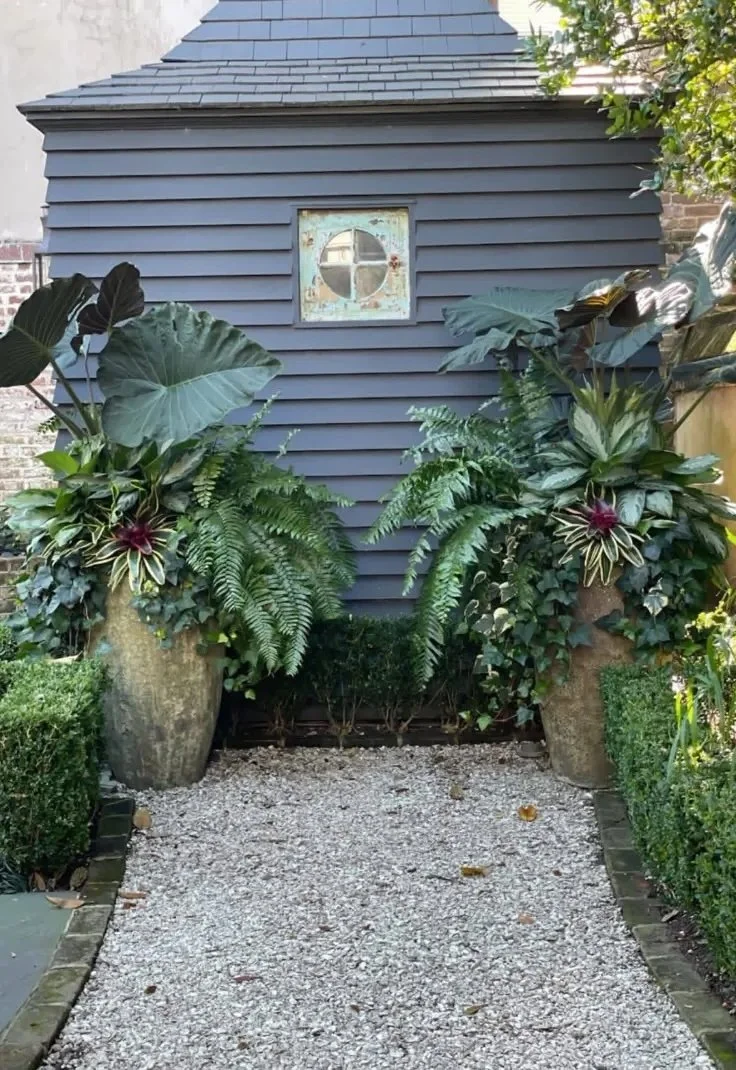
For a jaw-dropping entrance, skip small pots and think tall and architectural instead. Oversized weathered stone or cast-concrete urns planted with dramatic elephant ears, ferns, and trailing ivy create a lush, almost gallery-like frame around a path, gate, or doorway.

Tuck a bromeliad or two in near the base for an unexpected pop of color against all that green. This look thrives in part shade — the big, soft-leafed tropicals can scorch in harsh, all-day sun — and pairs beautifully with a gravel or stone path and low boxwood hedges to keep the eye moving toward the door.

02 | Tall Black Planters with Faux Succulent & Trailing Greenery

Faux Succulent Planter Drop Ins

Westcove Treasures

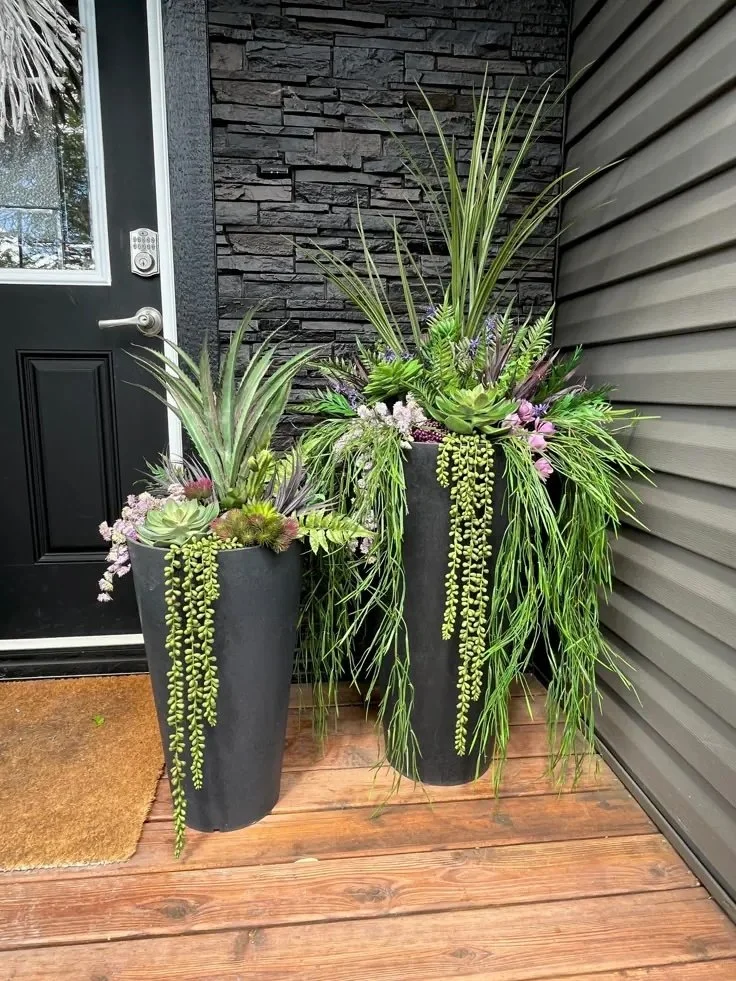
This is faux succulents done right — no one would guess these lush arrangements of echeveria, string of pearls, and wispy ornamental grass never need a drop of water. Tall, matte black planters give the whole look height and drama against a dark stone or siding backdrop, while trailing "string of pearls" and ferns spill dramatically over the sides.

The best part: you don't have to build this from scratch. Etsy shops sell ready-made faux succulent urn fillers and drop-ins sized to fit tall planters like these, so you can get this exact layered look in an afternoon with zero watering schedule required — perfect for a porch that gets tricky light or an owner who travels a lot.

03 | Single Statement Planter with Faux Succulents & Wispy Grasses

image source

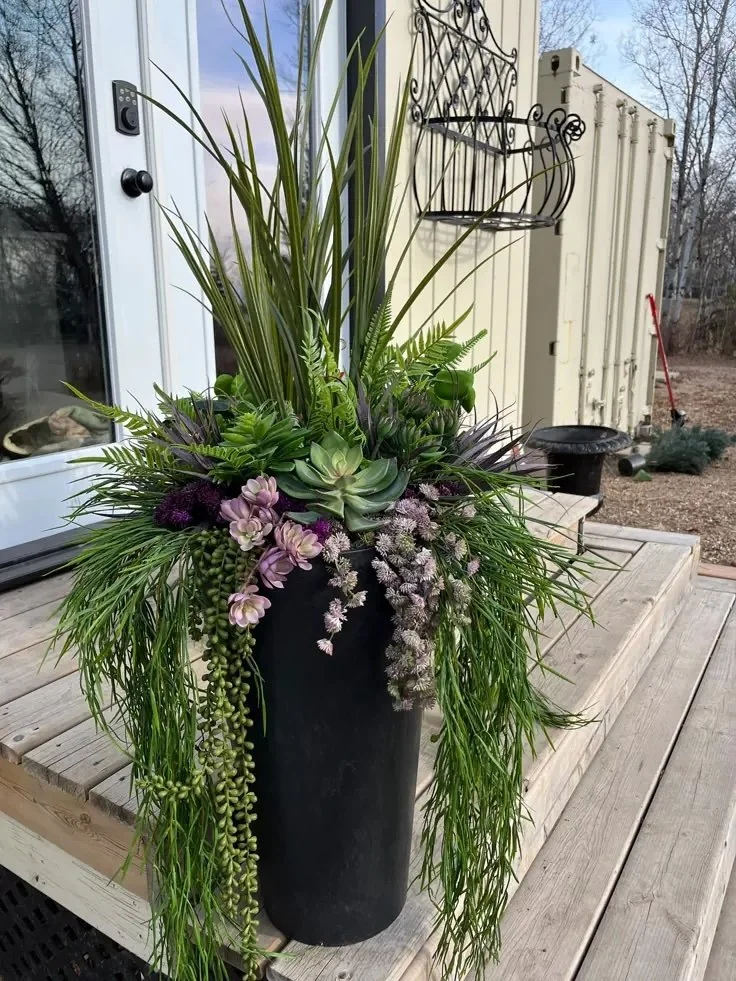
You don't need a matching pair to make an impact — one oversized, overflowing planter can carry an entire entry on its own. This arrangement builds height with tall faux grass blades and ferns, then fills out with echeveria, sedum, and mauve-toned florals for a softer, moodier palette than typical greens-only succulent mixes.

Trailing string of pearls and burgundy accents cascade down the sides, softening the planter's straight edges. Because it's all faux, it holds this exact shape and color through every season — no fading blooms, no reshaping required, just a quick dusting now and then.

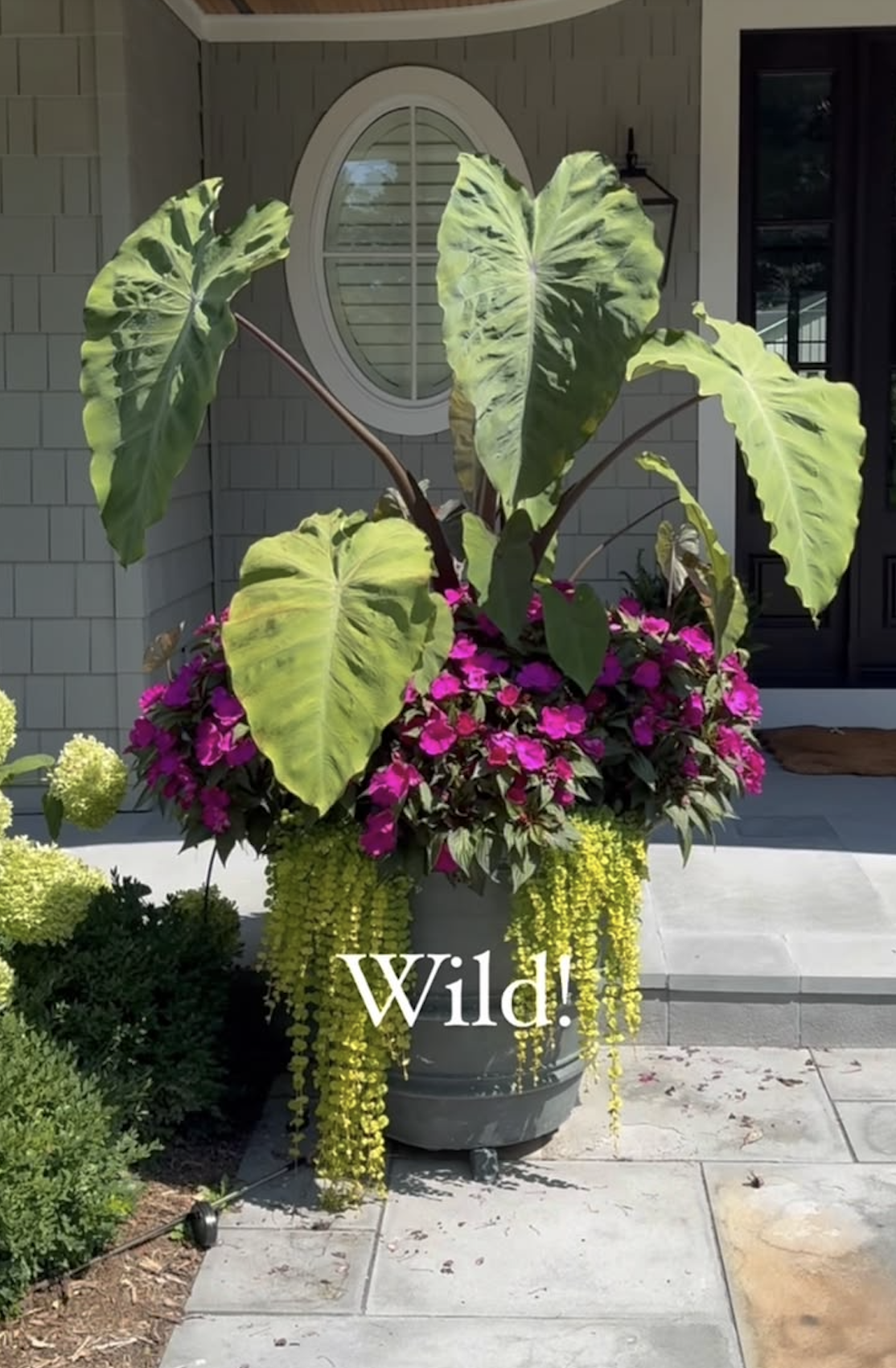
04 | Elephant Ear Planter with Purple Sunpatiens & Trailing Creeping Jenny

@athomewithcyro

A single oversized planter goes big and bright with 'Coffee Cups' Colocasia as the dramatic centerpiece — its cupped, chartreuse-green leaves hold up beautifully in full sun, unlike many elephant ears that need shade. Compact purple sunpatiens fill in around the base with nonstop hot-pink color all summer, even in strong sun, while chartreuse creeping jenny spills over the rim in long, trailing chains for movement and contrast. It's a color-drenched, jungly look that makes a serious statement next to a neutral-toned house.

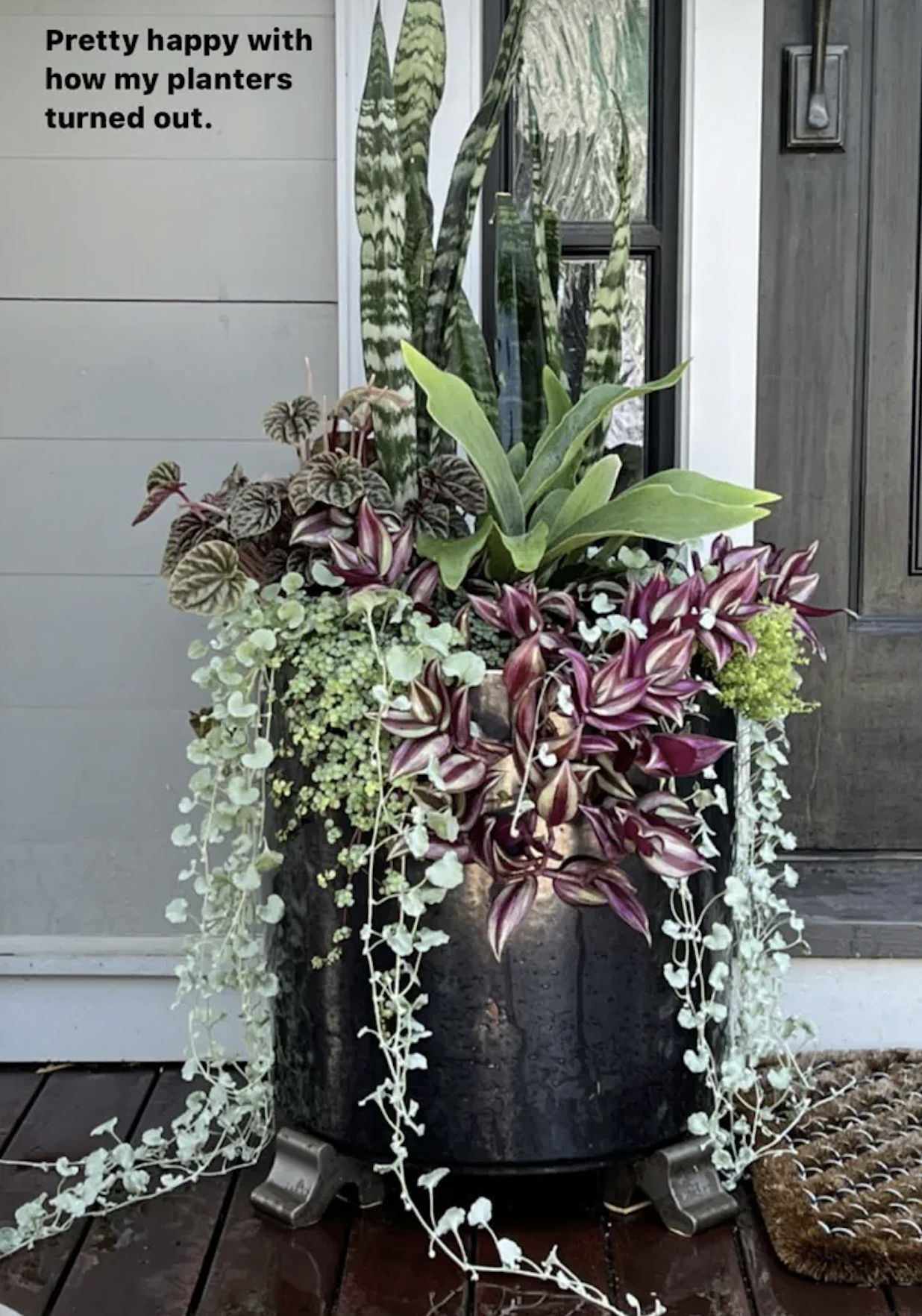
05 | Moody Mixed Foliage Planter with Snake Plant, Wandering Jew & Trailing Vines

45+ Genius Front Door Planter Ideas (Plus Tips, Tricks & DIY Know-How)

@urbancottagehome

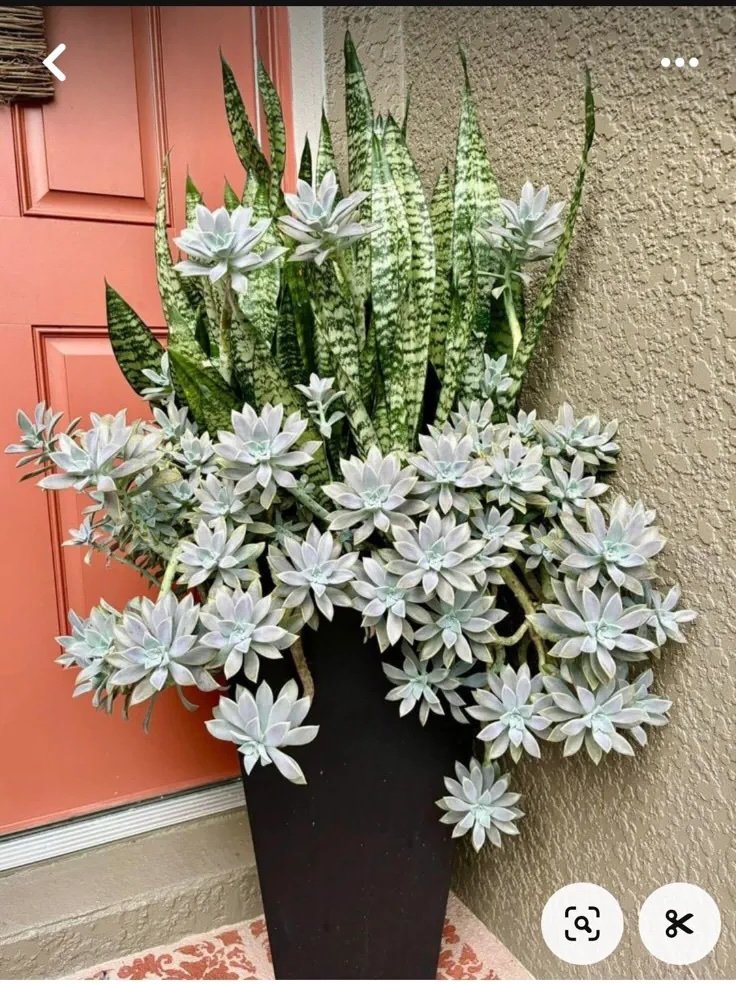
This is what happens when you layer texture instead of just color. Tall snake plant spikes shoot up through the center for height and structure, while a pale, silvery mother-in-law's tongue variety softens the look just below. The real showstopper is the wine-and-cream striped wandering jew (Tradescantia zebrina) tumbling over the front — it adds a rich, moody color you don't often see in a planter.

String of pearls and dichondra 'Silver Falls' spill down both sides in long, delicate trails, and a few tucked-in peperomia leaves round out the mix. It's proof that a planter doesn't need a single bloom to feel lush and finished — foliage alone, layered thoughtfully by height and texture, can carry the whole look.

06 | White Caladium & Impatiens Window Boxes

window planters

image source

For a soft, romantic look that reads as effortlessly elegant, pair white/silver-variegated caladiums with white impatiens and a few upright grass-like spikes for height. The pale, almost ghostly caladium leaves practically glow against dark shutters or deep-colored trim, while the white impatiens fill in low and dense for a full, cottage-garden softness.

This palette works especially well in bright shade or filtered light, since caladiums can scorch in harsh, direct sun — making it a great fit for window boxes tucked under an overhang or shaded by a balcony. Keep it monochrome (whites, silvers, and greens only) for the most elevated, classic version of this look.

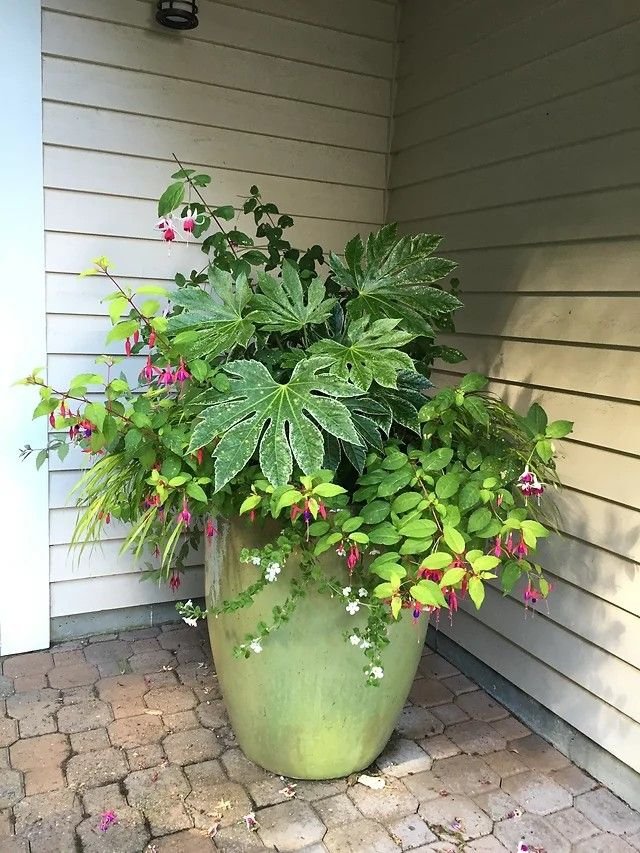
07 | Fatsia & Fuchsia Corner Planter

large green planter

image source

For a shaded corner or covered porch, this arrangement leans on bold foliage first and delicate flowers second. Fatsia japonica (Japanese aralia) anchors the center with huge, glossy, star-shaped leaves that give instant fullness and structure — one plant does the work of three.

Trailing fuchsia weaves through and cascades over the edges, dangling its distinctive pink-and-purple blooms like little earrings, while a bit of variegated ivy and trailing bacopa fill in the lower edges with white flowers. It's a soft, cottage-meets-woodland look that thrives in bright shade or morning-sun-only spots where flashier sun-lovers would struggle.

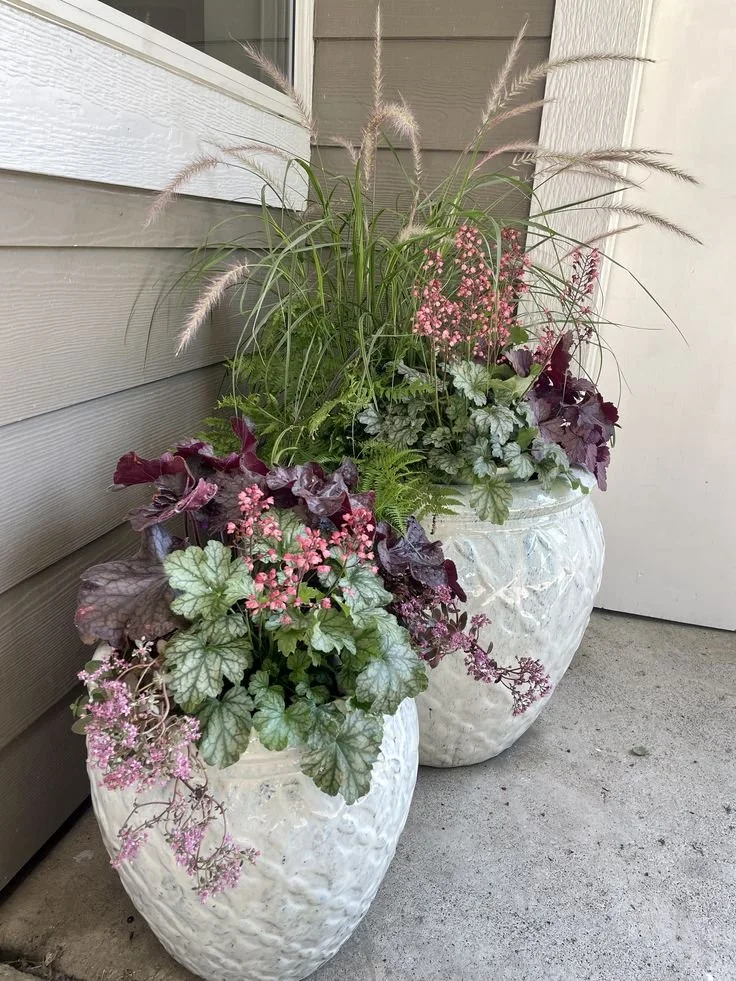
08 | Textured Stone Urns with Purple Fountain Grass & Coral Heuchera

double planters purple plants

image source

Here, two heavily-textured, hand-carved-look stone urns lean into fall color without a single mum in sight. Purple fountain grass shoots up tall and airy for the "thriller," its feathery plumes catching the light beautifully. Below it, deep burgundy heuchera (coral bells) provides rich, ruffled foliage color that holds all season — not just for a few weeks like a bloom would — while coral bell flower spikes in soft pink add a delicate pop against all that dark purple.

Trailing sprigs of tiny pink flowers cascade over the rugged stone edges to soften the whole look. It's an especially good combo for anyone who wants a planter that reads as "fall" through color and texture rather than pumpkins and mums.

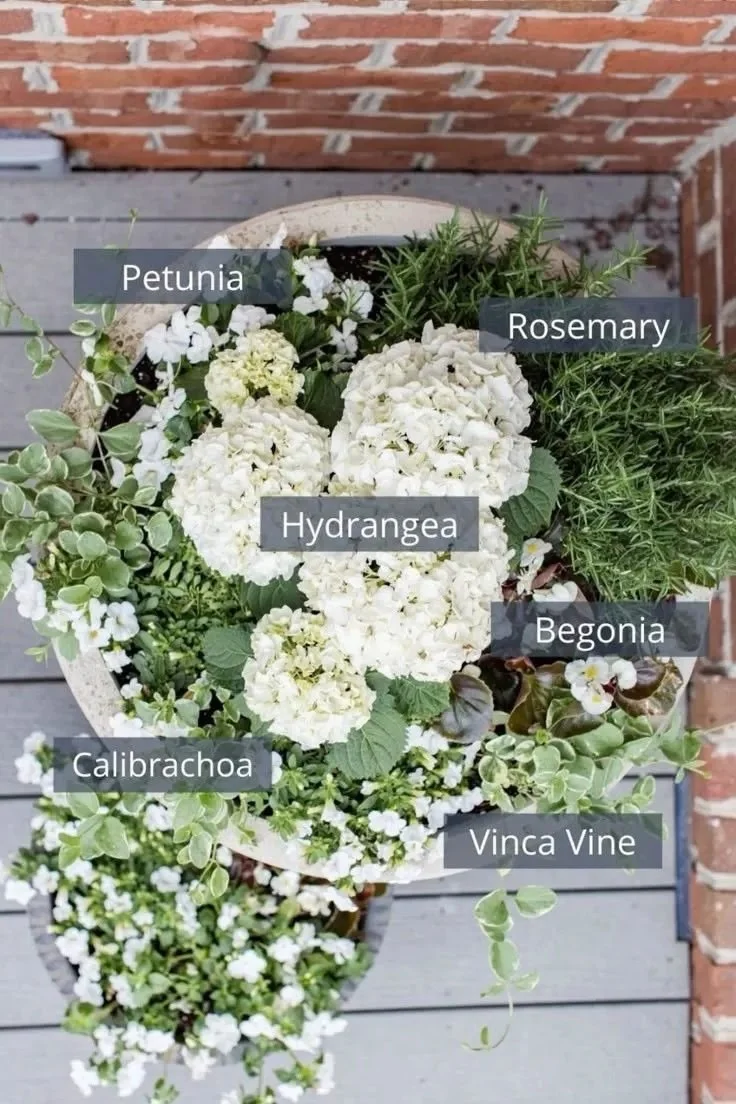
09 | All-White Container with Hydrangea, Rosemary & Trailing Vinca

container ideas

image source

This is a masterclass in an all-white, monochromatic planter — proof that you don't need a rainbow of color to make a big impact. Three hydrangea blooms anchor the center as the star of the show, surrounded by white petunias and calibrachoa for nonstop smaller blooms that fill every gap.

Hydrangeas are very sensitive, so be mindful planting these. Rosemary adds upright, fragrant texture on one side (bonus: you can snip it for cooking), while begonia tucks in low with soft foliage and blooms. Trailing vinca vine spills over the edge to soften the rim. Because it's all white and green, this combo works with literally any house color and reads as classic and elevated rather than trendy.

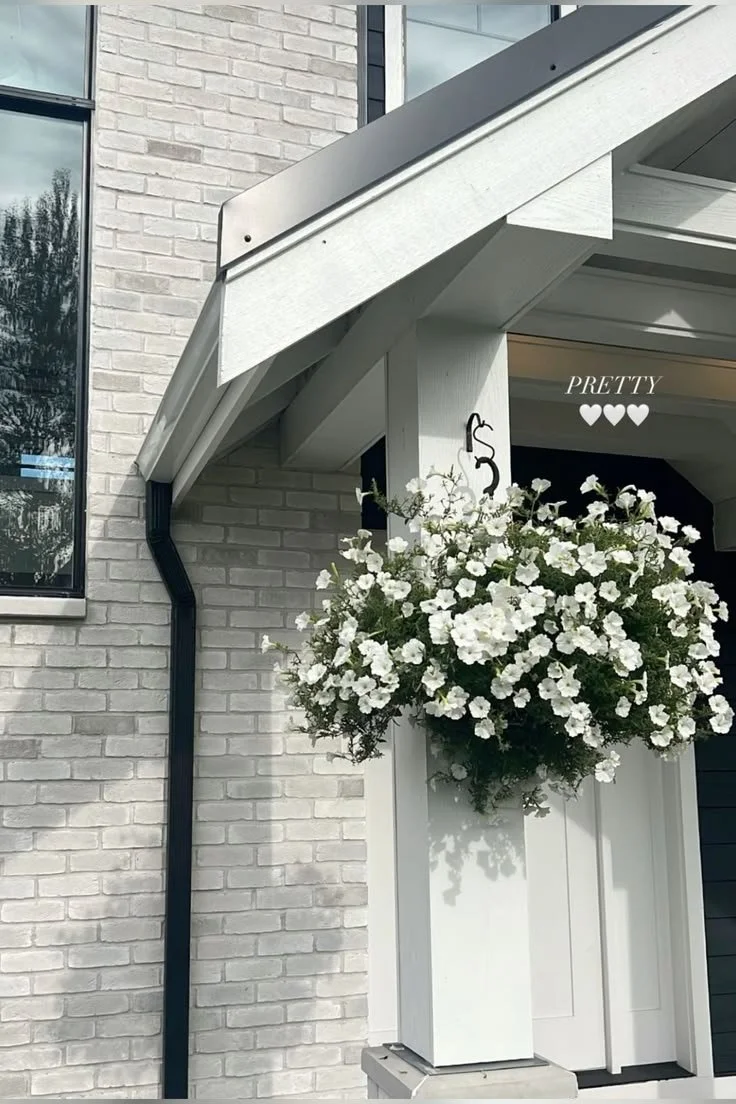
10 | Overflowing White Petunia Hanging Basket

hanging planter

image source

Sometimes the simplest idea is the most striking one. A single hanging basket, packed full of white petunias (likely a wave or supertunia variety bred to mound and cascade), grows so full it nearly hides the basket entirely. Hung from a porch beam or column bracket, it fills the vertical space above the door without taking up an inch of floor room — perfect for a covered porch that gets bright, filtered light. The trick to this look is starting with a large basket and a generous number of plants, then feeding regularly through the season so it fills out this dramatically rather than staying sparse and small.

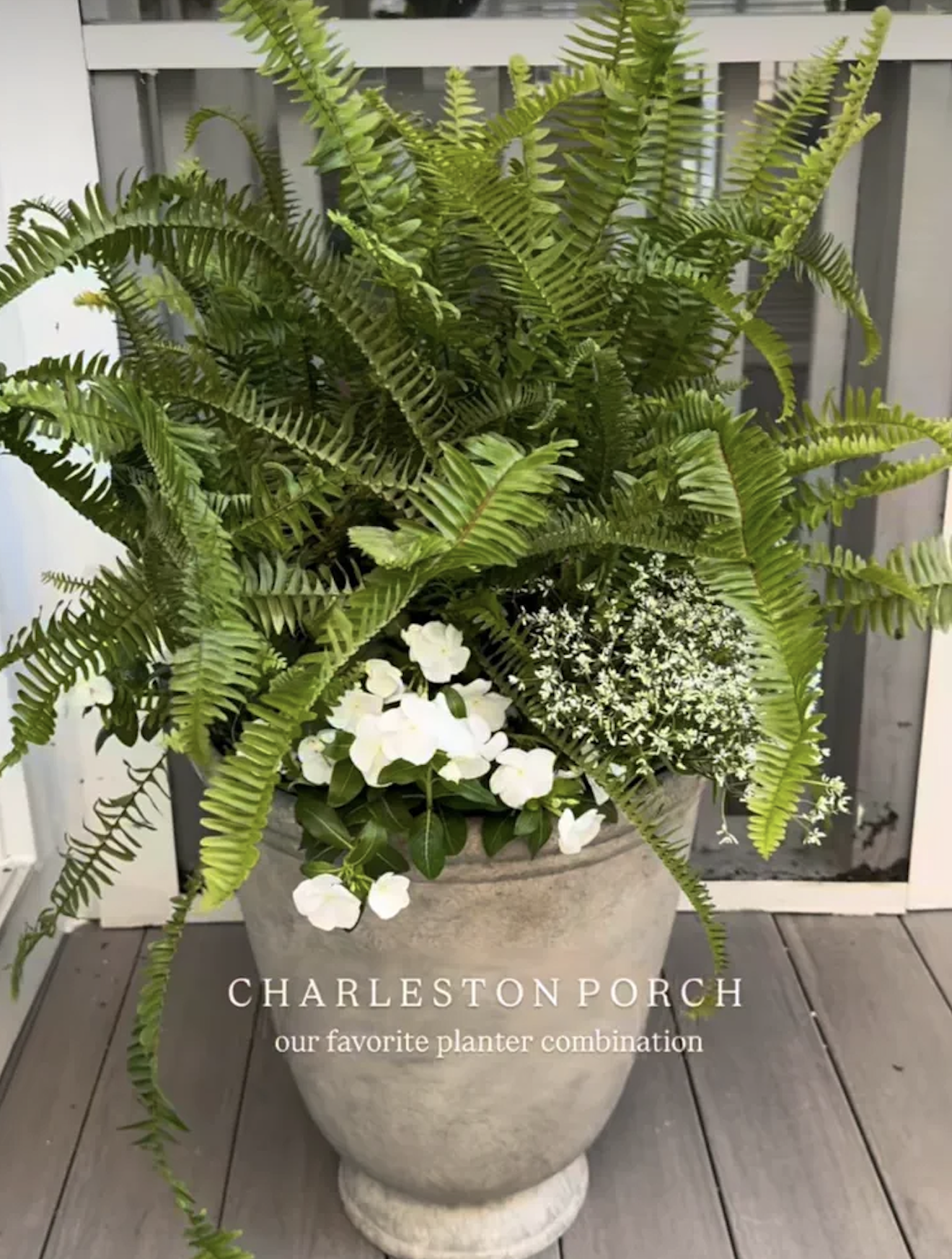
11 | Charleston Porch Fern & White Impatiens Urn

45+ Genius Front Door Planter Ideas (Plus Tips, Tricks & DIY Know-How)

@thecoastaloak

This one leans entirely on lush, oversized Boston ferns for volume — no other plant fills a big stone urn faster or fuller. White impatiens tuck in at the base for soft color, while a wispy, small-flowered filler (likely euphorbia or baby's breath-style diamond frost) adds airy texture without competing with the ferns. It's a shade-loving combination through and through, perfect for a covered Southern porch with filtered light and high humidity, and it captures that soft, romantic, old-Charleston look with just three plants — proof that a great planter doesn't need to be complicated to feel lush and finished.

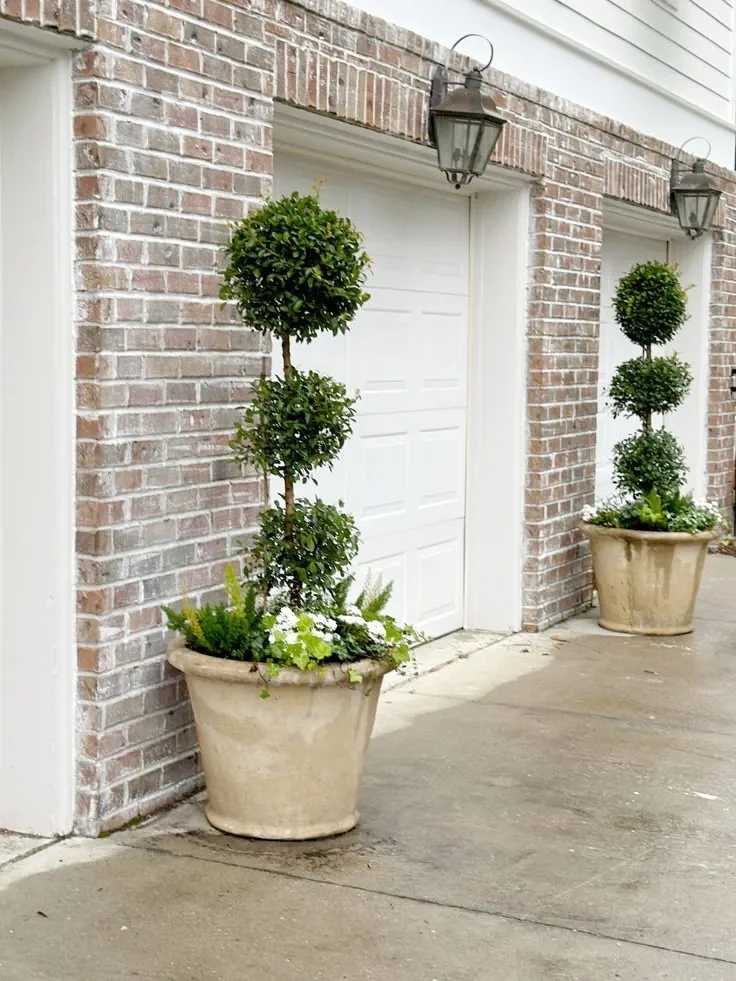
12 | Triple-Ball Eugenia (Wax Leaf Privet) Topiaries

The Coastal Oak

These triple-ball topiaries bring instant architecture and formality to a garage or entry wall, and they work especially well repeated down a row for a tailored, symmetrical rhythm. Eugenia (also called wax leaf privet) is a favorite for this shape because its small, glossy leaves clip into tight, clean spheres and hold their form well between trims.

At the base, a simple underplanting of fern, sweet alyssum, and white flowers softens the formal topiary shape without stealing its spotlight. This look does best in a sunny to partly sunny spot, since eugenia needs good light to stay dense and full rather than getting leggy.

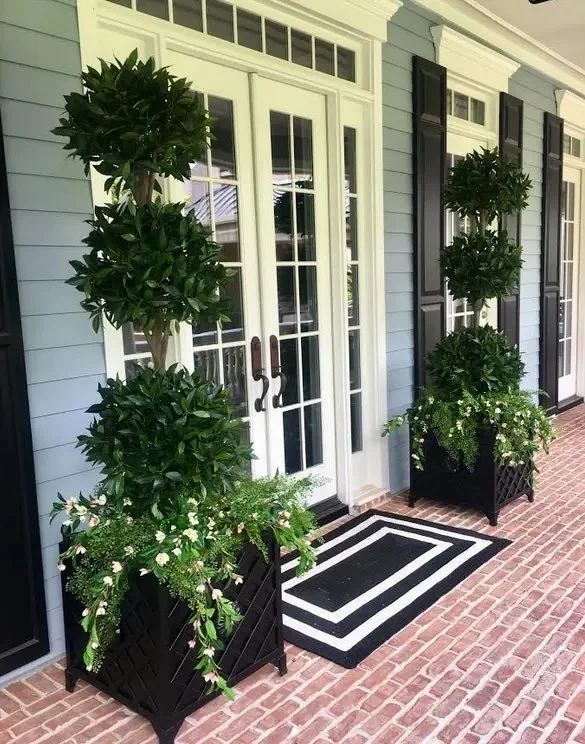
13 | Double-Ball Bay Laurel Topiaries in Black Lattice Planters

topiary planters

image source

Here, tall double-ball topiaries (likely bay laurel or a similar clipped evergreen) bring serious height and drama, while black square lattice planters ground the look with a crisp, graphic edge. The dark planter color makes the greenery pop against light-painted siding, and it echoes black shutters or trim beautifully for a cohesive, pulled-together exterior.

At the base, soft trailing florals and ferns spill out of the lattice openings, softening what could otherwise feel too formal or stiff. This pairs particularly well flanking French doors or a wide entry, where the height carries visually from a distance.

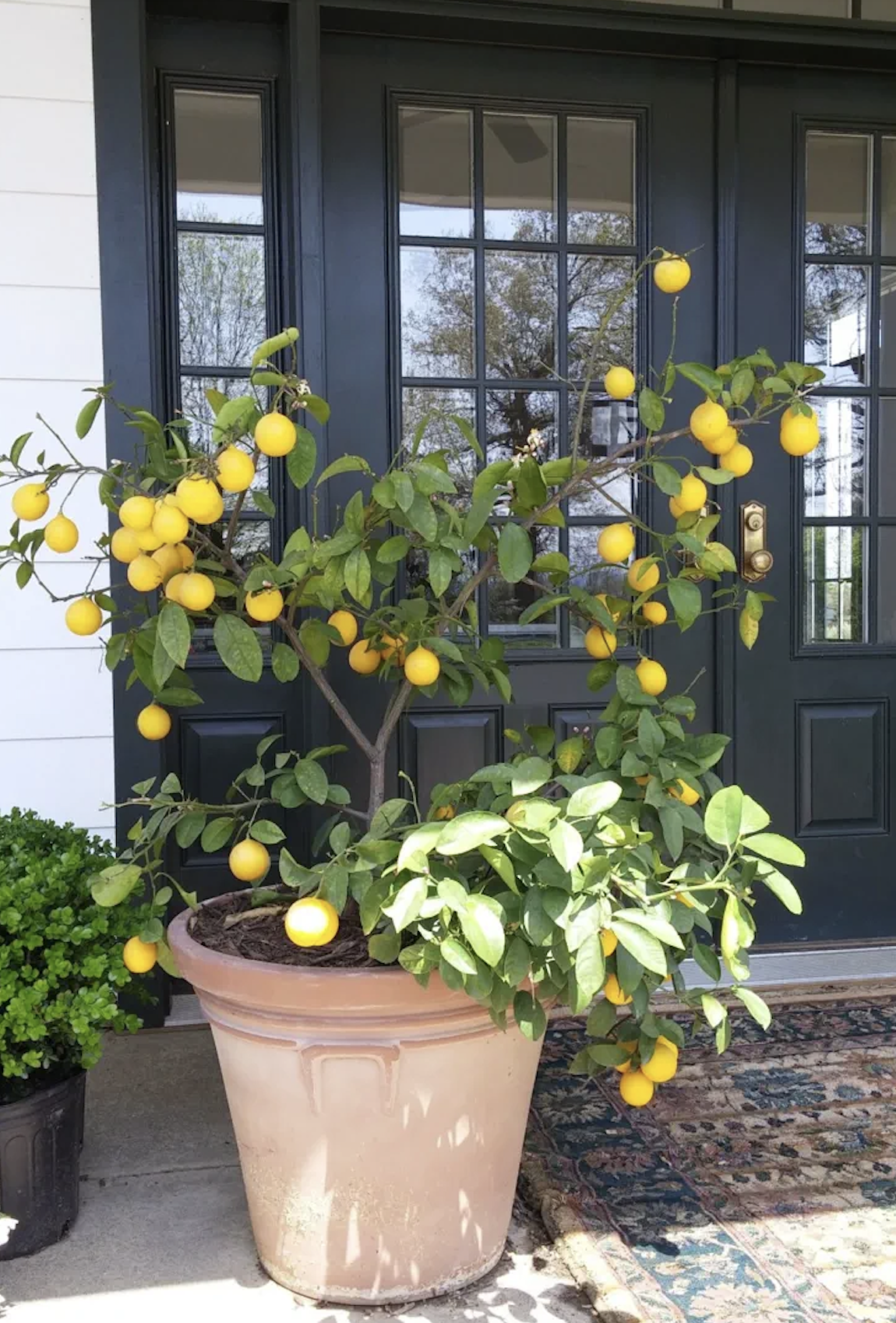
14 | A Potted Meyer Lemon Tree, Loaded with Fruit

45+ Stunning Front Door Planter Ideas (Genius Tips, Tricks & DIY Know-How)

image source

Skip the flowers entirely and go with a fruiting citrus tree instead — a container-grown Meyer lemon (or calamondin orange) planted in a large terra cotta pot makes a genuinely show-stopping front door feature, dripping with bright yellow fruit against dark door and window trim. Citrus trees do best in full sun and a large pot with excellent drainage, and in colder climates they need to come indoors before the first frost since most varieties aren't cold-hardy. It's a planter idea that doubles as a (very fragrant, very photogenic) bonus harvest.

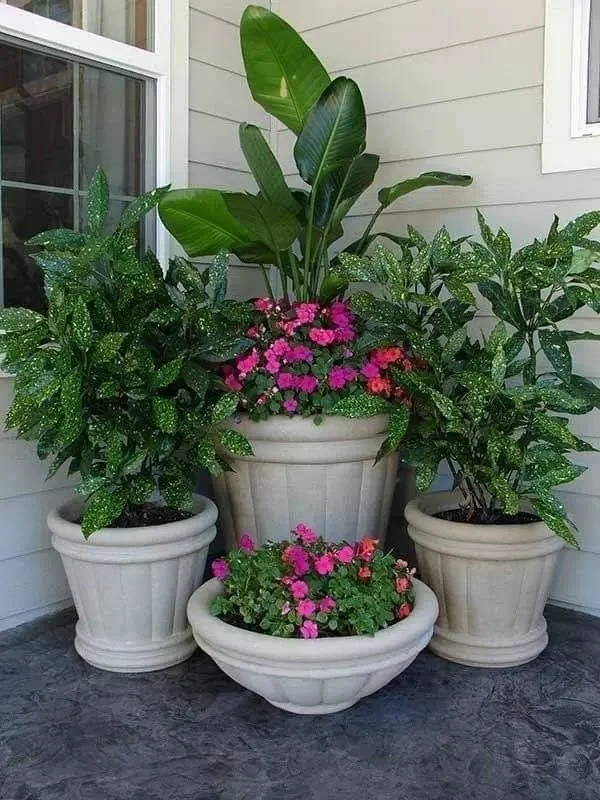
15 | Grouped Planters with Bird of Paradise, Speckled Croton & Bright Impatiens

front porch pots

image source

Instead of one hero planter, this look clusters four matching stone-toned pots at staggered heights for a full, layered corner display. A bird of paradise takes the tallest spot with its dramatic banana-like leaves, flanked by two bushy gold-dust croton plants prized for their speckled, glittery-looking foliage.

Hot pink and coral impatiens fill in the lower pots and spill over the shallow bowl planter up front, tying the whole grouping together with color. It's an easy way to add serious volume and height to a corner without needing one giant planter — just cluster a few different sizes and heights together, all in the same pot material for cohesion.

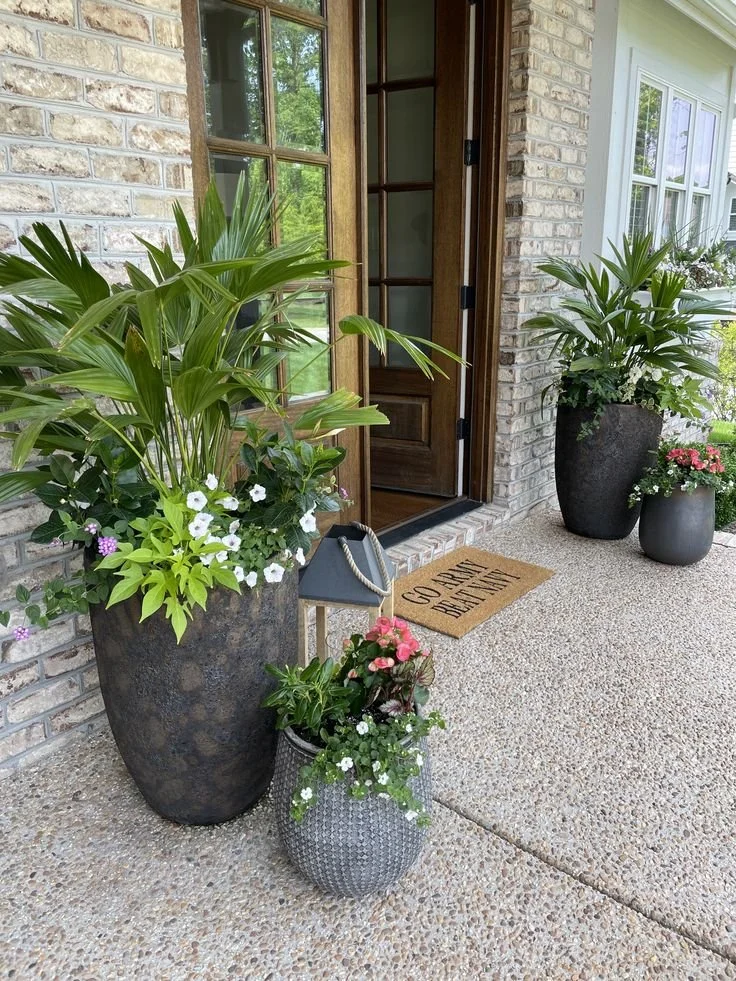
16 | Layered Palm Planters with White Petunias & Trailing Vinca

front door planters

image source

This entry uses varied planter heights and a mix of textured containers — smooth bronze urns, a woven-look ceramic pot — to build a full, collected look at the door without anything matching perfectly. Parlor or bamboo palm fronds arch gracefully overhead for height, while white petunias and vinca vine fill the base and spill over the pot's edge in soft, trailing mounds.

A smaller accent pot with pink begonias and white bacopa adds a low pop of color at ground level. It's proof that palms aren't just for pool decks — in the right pot, they read as elegant and welcoming at a front entrance too.

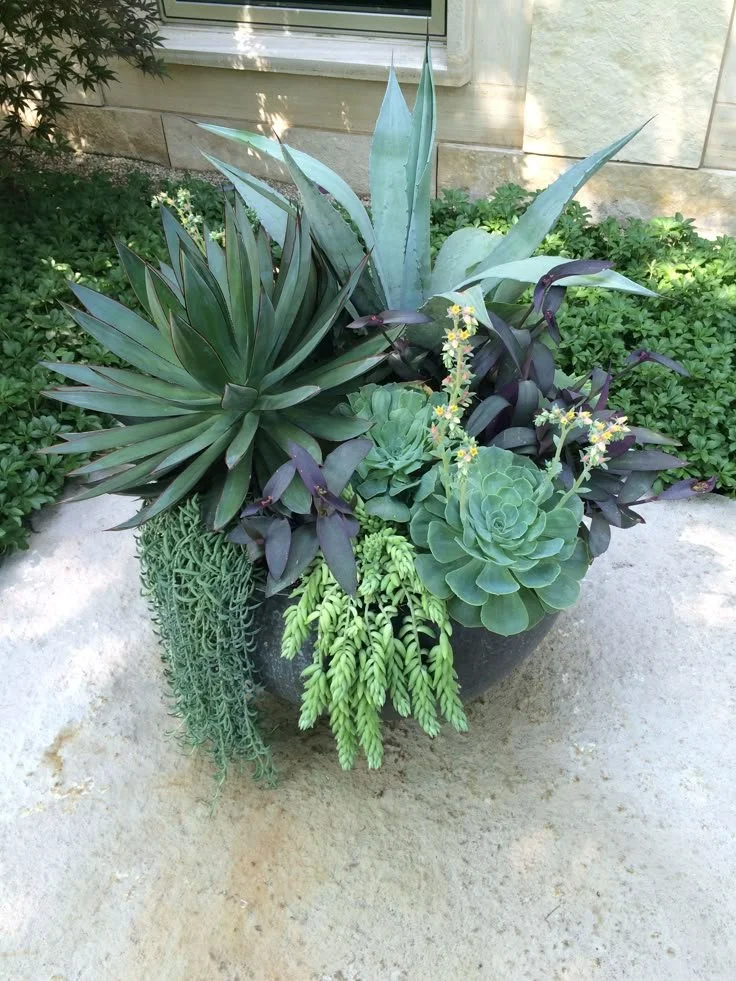
17 | Sculptural Agave & Succulent Bowl Planter

Aranjament suculente

image source

This one's a masterclass in mixing succulent shapes and textures in a single wide, dark bowl planter. Spiky blue-green agave (both a broad "octopus" variety and a narrower upright type) provides architectural drama at the back, while echeveria rosettes and purple tradescantia add rounder, softer contrast in the center.

Burro's tail and string of bananas trail dramatically over the front edge, and delicate yellow flower spikes add an unexpected pop of bloom color throughout. Because true succulents like these store water in their leaves, this planter is remarkably drought-tolerant and ideal for a hot, sunny entry where you want texture and structure over traditional blooms.

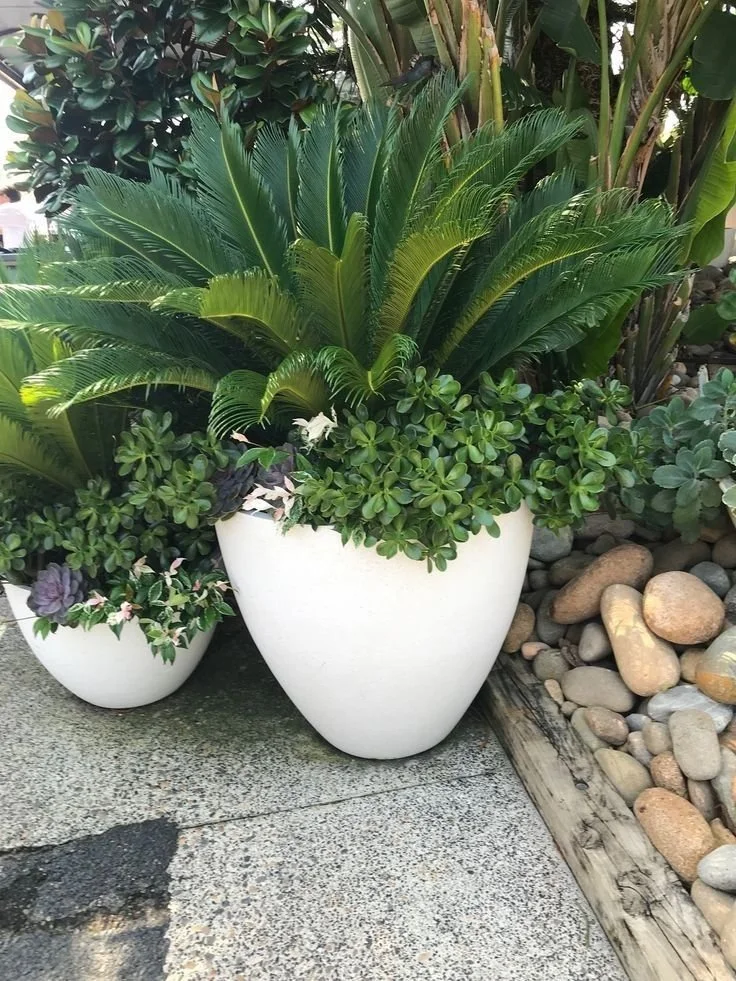
18 | White Bullet Planters with Sago Palm & Jade Plant

palm planters

image source

Round, tapered white planters give this pairing a modern, sculptural base, while a sago palm fans out overhead with its stiff, symmetrical fronds for serious architectural presence. Underneath, a full mound of jade plant fills the pot with rounded, glossy leaves — a nice soft contrast to the sago's sharp texture — with a touch of dark echeveria and trailing white blooms tucked into the smaller companion pot. Because both sago palm and jade are quite drought-tolerant, this combo holds up well in a sunny spot with infrequent watering, making it a great low-fuss choice for a modern entry.

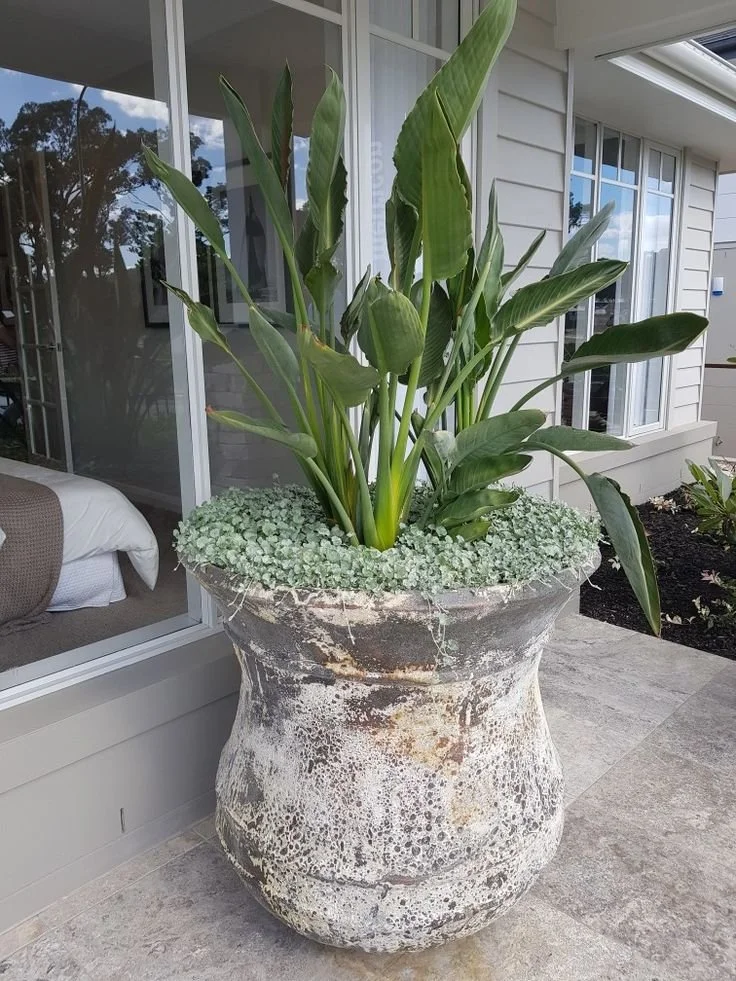
19 | Bird of Paradise in a Weathered Stone Urn

45+ Stunning Front Door Planter Ideas (Genius Tips, Tricks & DIY Know-How)

image source

A single, statuesque bird of paradise stands as the sole focal plant here, its tall paddle-shaped leaves and emerging flower stalk needing no supporting cast to make an impact. A dense skirt of silvery dichondra 'Silver Falls' rings the base, softening the transition into the pot and adding a cool, textural contrast to the deep green foliage above.

The real star, though, might be the planter itself — a heavily weathered, almost ceramic-glazed urn with an aged, mottled finish that adds instant character and history to an otherwise brand-new home. This combo needs a good amount of sun and works best where the plant has room to arch and spread without crowding a doorway.

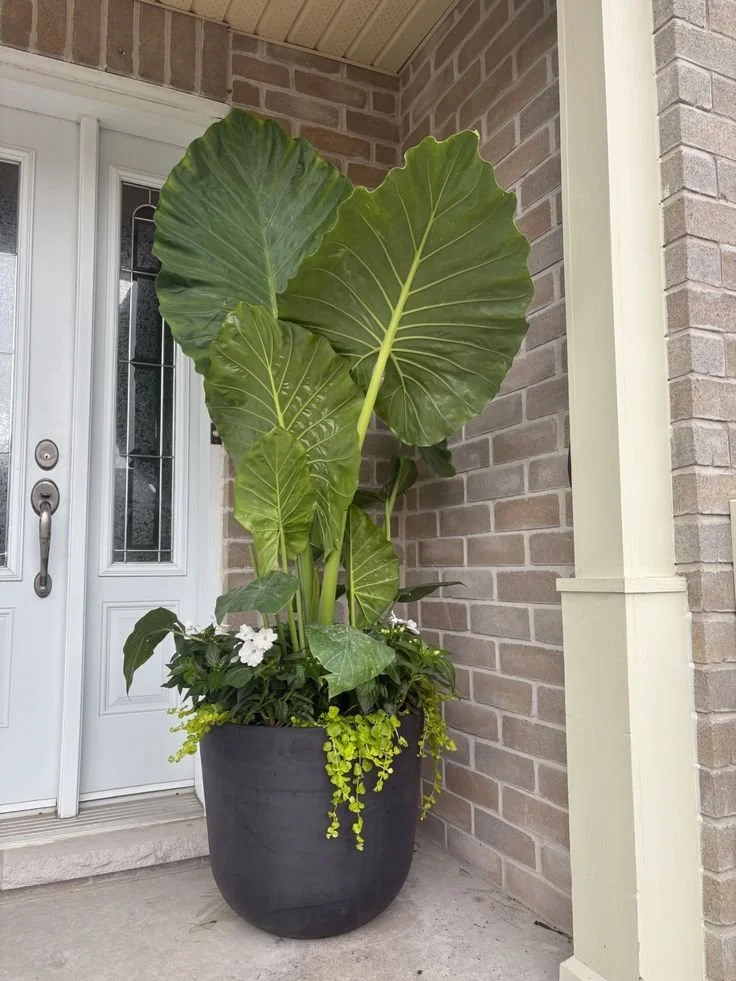
20 | Giant Elephant Ear Corner Planter with White Blooms & Creeping Jenny

elephant ears container

@pepiniere_locas

This one goes big with a single dramatic elephant ear variety, its leaves growing nearly as large as umbrellas and doing all the visual heavy lifting on their own. A simple black rounded planter keeps the focus on the foliage rather than competing with it. White sun-loving vinca or periwinkle tucks in around the base for a touch of contrast color, while golden creeping jenny trails down the front in bright chartreuse chains, picking up the light against the dark pot. It's an easy formula to steal: one big leafy showstopper, a little white bloom filler, and one trailing spiller — no more than three plant types needed for major impact.

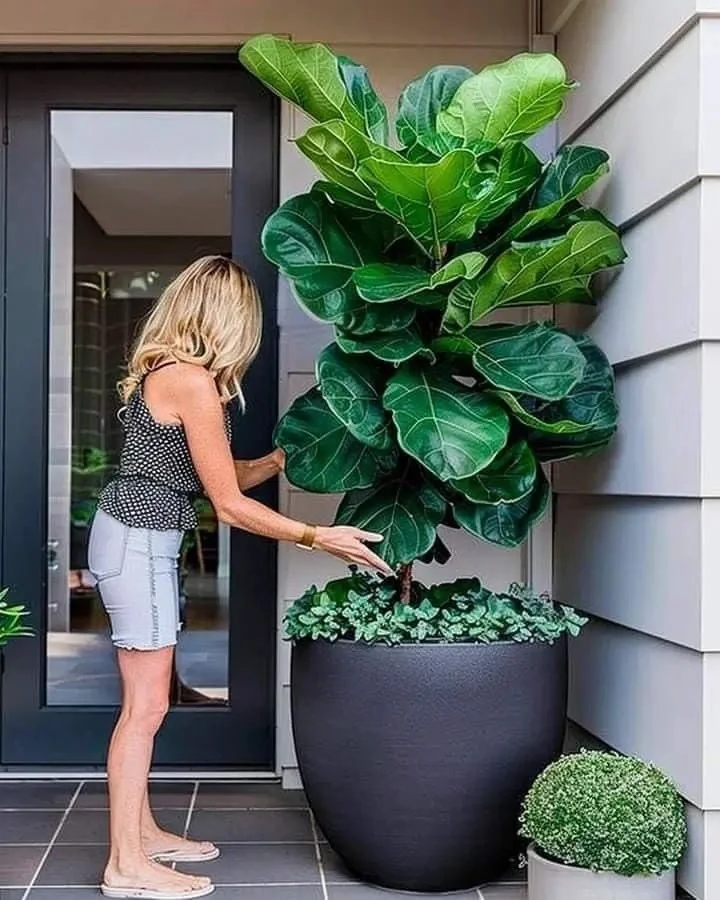
21 | Fiddle Leaf Fig Tree in an Oversized Black Planter

fiddle leaf container

image source

For serious height and a bold, glossy-leaved silhouette, a fiddle leaf fig tree makes an unforgettable entry statement. Its large, ruffled leaves create dramatic scale against a doorway, especially when planted in a rounded black planter that lets the deep green foliage stand out against light-colored siding. A dense underplanting of small trailing greenery fills the base and softens the transition into the pot.

Fiddle leaf figs prefer bright, indirect light and consistent watering, and in most climates they'll need to be brought indoors before the first frost — but for a covered porch in the growing season, it's hard to beat this kind of dramatic, jungly presence.

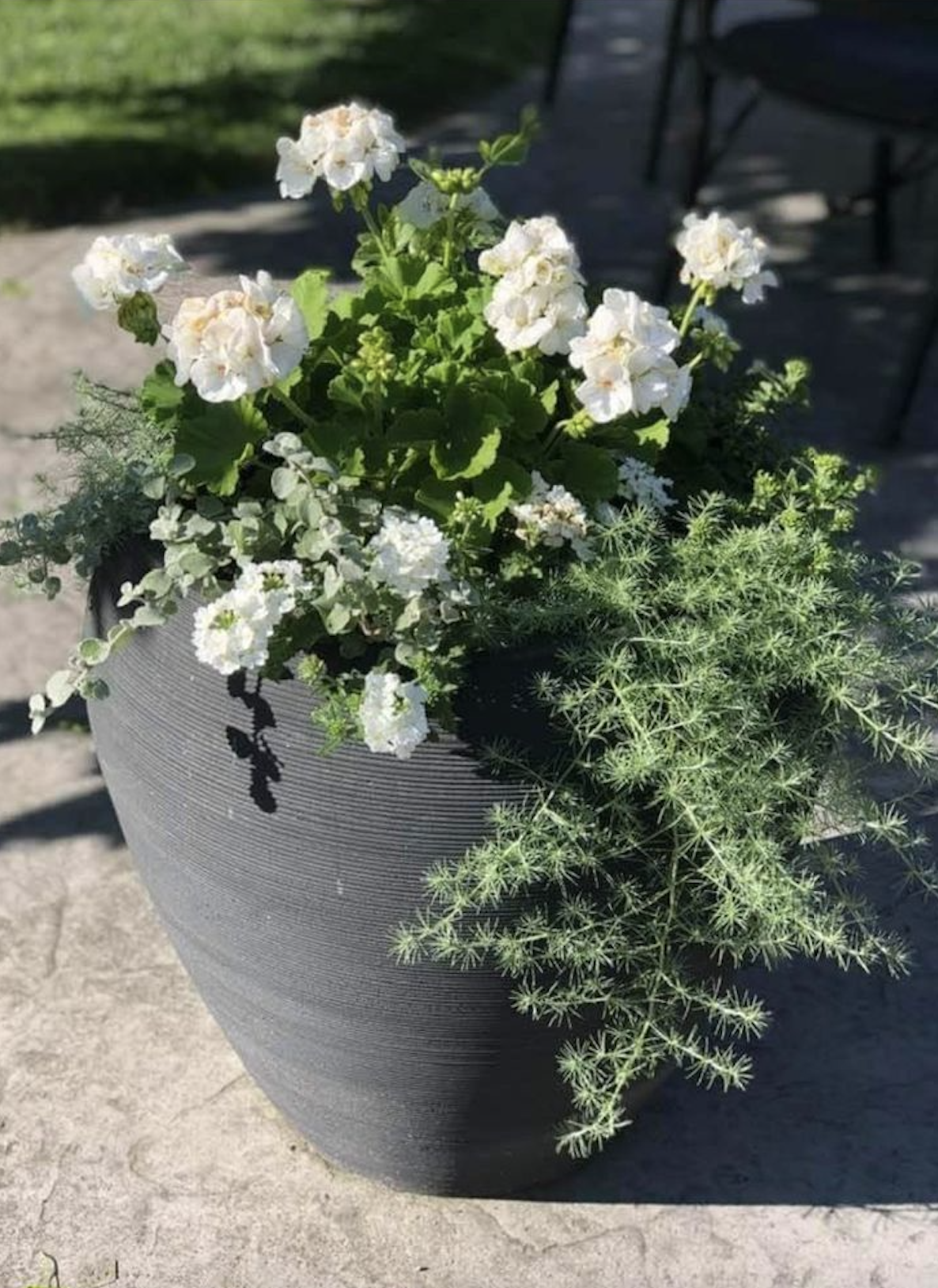
22 | White Geranium & Feathery Foliage Planter

image source

This planter pairs classic white geraniums with a mix of delicate, textured foliage that keeps it from feeling flat or one-note. Frothy, needle-like asparagus fern spills over one side in soft, silvery-green sprays, while trailing dichondra and a touch of licorice plant add rounder, silvery leaves on the other.

White verbena tucks in low for extra small blooms among the greenery. It's an easy, sun-loving combination for anyone who wants flowers but doesn't want a planter that feels overly "busy" — the monochrome palette keeps everything feeling calm and cohesive despite the mix of five different plants.

23 | Tall Black Planter with Mandevilla, Geranium & Ivy — Plus a Lantern

Lantern added to top of planter_ White flowers, geranium, mandevillia, and ivy.jpeg

image source

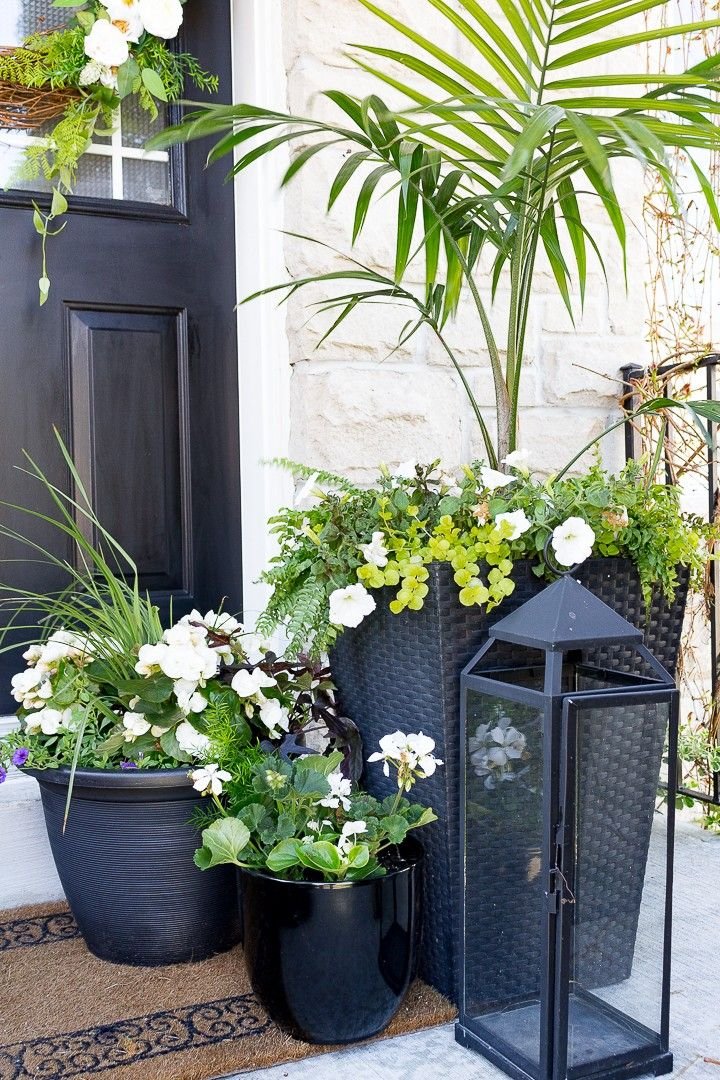
This one's a clever trick worth stealing on its own: a decorative lantern is tucked directly into the planter alongside the plants, adding height and a warm evening glow without needing a separate stand. White mandevilla vine climbs and trails with its trumpet-shaped blooms, geraniums fill in with classic rounded flower clusters, and trailing ivy softens the edges of the tall, textured black planter. It's a great pick for a covered entry with good light, and the built-in lantern means this planter doubles as both daytime greenery and nighttime ambiance.

24 | Mixed Faux Fern & White Floral Planters with a Layered Entry

45+ Stunning Front Door Planter Ideas (Genius Tips, Tricks & DIY Know-How)

image source

Here, two planter styles repeat on either side of the door — tall black tapered planters holding lush faux ferns, paired with rounded gray planters holding faux white-flowering shrubs (like gardenia or camellia) — creating rhythm without requiring an exact matched set. It's a great example of building a full entry look rather than just a planter: a soft eucalyptus wreath on the door echoes the greenery below, while a layered doormat-over-rug combo grounds the whole space visually. Since everything here reads as faux, it's an easy, all-season way to get lush, coordinated greenery with zero maintenance.

25 | Round Sphere Planter with Snake Plant & Multi-Color Echeveria

Lily the Plant Lady

This one packs an incredible amount of variety into a single spherical white planter. Tall, variegated snake plant spikes shoot up dramatically from the center, giving the whole arrangement height without needing a "thriller" plant of a different genus. Around the base, echeveria in shades of purple, blue-green, and jade cluster together for a rosette-heavy, jewel-toned effect, while string of pearls cascades down over the rim in long beaded strands. Set into a bed of river rock instead of mulch or soil, it reads as an almost sculptural, low-maintenance art piece rather than a traditional planter — and since it's all succulents, it needs very little water even in full sun.

26 | Shade-Loving Foliage Bowl on an Iron Plant Stand

green container planter

image source

This is a great example of low-light plants doing serious visual work. A peace lily rises from the center with elegant white blooms and glossy green leaves, backed by feathery Boston fern for airy texture. Variegated pothos trails and tumbles over the front in creamy, marbled patterns, while long, grass-like variegated liriope (or spider plant) spills dramatically over both sides in graceful white-and-green blades.

Set in a simple terra cotta bowl on an ornate iron stand, the whole arrangement is lifted up to eye level near the door — a nice trick for a bowl-shaped planter that would otherwise sit low and get lost. Every plant here tolerates shade well, making this a great formula for a covered, low-light entry.

27 | Snake Plant with Cascading Ghost Plant (Graptopetalum)

image source

Tall, variegated snake plant spikes provide vertical structure at the back, while an abundant, cascading mass of pale, star-shaped ghost plant (graptopetalum) succulents spills out and over the sides in nearly every direction — turning a single tall black planter into a dramatic, oversized bouquet.

The dusty blue-green, almost lavender-tinted rosettes read as soft and ethereal, which makes for a striking contrast against a bold-colored door like this coral one. Since both plants are extremely drought-tolerant, this combination is ideal for a hot, sunny entry where you want maximum visual impact with minimal watering.

28 | Bird of Paradise Underplanted with a Mixed Succulent Garden

35+ Stunning Front Door Planter Ideas (Genius Tips, Tricks & DIY Know-How)

image source

Broad, glossy bird of paradise leaves tower overhead for serious height and drama, while the base of the pot becomes its own lush succulent display — purple echeveria rosettes, chartreuse sedum, blue-gray sedum, and jade plant all cluster together in a rich mix of colors and textures, with trailing burro's tail cascading down the front.

Set in a rounded, weathered stone bowl planter, the combination reads as both tropical and desert-inspired at once, proving that a single "thriller" plant paired with a diverse, colorful succulent base can carry an entire corner without needing any traditional flowers at all.

29 | Perennial Garden Bowl with Coneflower, Smokebush & Hydrangea

35+ Stunning Front Door Planter Ideas (Genius Tips, Tricks & DIY Know-How)

Matt Muscarella for terrain

Rather than typical annuals, this wide stone bowl planter is filled almost like a mini garden bed. Tall pink coneflower (echinacea) blooms rise above deep purple smokebush or ninebark foliage, while soft pink panicle hydrangea blooms add fullness in the middle. At the base, ornamental grass, fern, and silvery dusty miller add texture variety, with trailing licorice plant spilling over one side.

Because many of these are perennial rather than seasonal annuals, this combination can come back year after year in the right climate, making it a great option for someone who wants a planter that feels more like a garden than a typical container arrangement.

30 | Branching Dracaena Tree in a Large Weathered Urn

Karen Fabian Designs

A tall, multi-branched dracaena (song of India or similar variety) provides sculptural height with its spiky, sunlit foliage fanning out at the ends of curving trunks — almost like a mini specimen tree. At the base, a bold aeonium rosette adds a pop of rounded texture, while trailing silver dichondra cascades dramatically down the sides of a large, heavily weathered ceramic urn, nearly covering the pot itself.

Grouped with additional succulents planted directly in the ground around the base, this look blurs the line between container gardening and landscaping — a great approach if you have planting bed space right next to your entry and want the potted piece to feel integrated rather than separate.

31 | Grouped Black Planters with Palm, Geraniums & a Floor Lantern

classic container planters

Craftberry Bush

This entry builds depth by clustering multiple black planters — a tall woven basket-weave pot, a rounded classic pot, and a smaller glossy one — at varying heights and textures. A parlor palm arches gracefully overhead from the tallest planter, underplanted with white petunias and trailing golden creeping jenny. The shorter pots fill in with white geraniums, ferns, and ornamental grass for volume at eye level.

A tall black lantern stands alongside the planters like a fourth "container," echoing their dark color and adding evening light without taking up planting space. It's proof that varying your pot heights, shapes, and textures — while keeping the color palette consistent — creates a much more layered, professional look than a single matched pair.

32 | Matte Black Planters on Metal Stands with Trailing Vine Curtains

35+ Stunning Front Door Planter Ideas (Genius Tips, Tricks & DIY Know-How)

image source

These sculptural matte black planters, each elevated on slim black metal legs, use height and negative space as much as the plants themselves — the open leg design lets you see through and under the arrangement rather than it reading as one solid mass. Ornamental grass tufts out from the top of the tallest pot, while dense, trailing vine (like creeping fig or a similar small-leaved climber) cascades dramatically down every side in a near-curtain effect, almost obscuring the planters underneath. It's an especially good option for a modern or contemporary entry where you want serious greenery volume without a bulky, heavy-looking planter taking up floor space.

33 | Cluster of Small Mismatched Pots Around a Porch Chair

cute mini front door planters

Rather than one or two big planters, this entry uses several small pots — a white ceramic bowl, a simple black pot, and galvanized metal containers — clustered loosely around a cozy porch chair. A tall potted palm anchors the seating area with height, while smaller pots of lavender, dusty miller, trailing grasses, and mixed purple and white blooms fill in at different levels around the deck. It's a great approach for a compact porch or a budget-friendly start, since you can build the collection gradually over time rather than buying one expensive statement planter — and the mismatched pots read as curated rather than sparse.

34 | Paired Olive Trees in Dark Aged Pottery

simple clean planters

image source

Two dark, heavily textured pottery vessels at slightly different heights each hold a single young olive tree, with nothing else planted alongside them. The silvery-green, slender olive leaves feel soft and Mediterranean against a light wood door, while the rough, matte-charcoal pots ground the look with real weight and texture. This is about as pared-back as a front door planter gets — one tree, one pot, repeated — and it proves that you don't need a complex plant mix to make an entry feel finished. Olive trees need good sun and well-draining soil, and in colder climates will need to move indoors or to a greenhouse for winter.

35 | Round Gray Bowl with Ornamental Grass & White Begonias

image source

A simple, two-plant formula done really well: fountain-like ornamental grass (likely carex or sedge) sprays out from the top in soft, arching blades, while a full mound of white wax begonias fills in below with cheerful yellow-centered blooms and glossy green leaves. Tucked into the greenery is a small solar light stake, a nice low-effort way to add a soft glow at night without running any wiring.

Set in a rounded, blue-gray bowl planter, this combo is easy to recreate almost anywhere — it needs only two types of plants, both widely available and easy-care, making it one of the more approachable ideas on this list for a first-time planter builder.

Maintenance Tips to Keep Planters Looking Fresh

  • Water in the morning when possible, so foliage dries before evening (this helps prevent fungal issues on real plants).

  • Deadhead spent blooms on real flowering plants weekly to encourage more flowering.

  • Rotate planters occasionally if one side gets more sun, so growth stays even.

  • Wipe down faux plants every few weeks with a damp cloth to prevent dust buildup and keep colors looking true.

  • Refresh mulch or top-dressing each season for a clean, finished look.

  • Check drainage holes aren't clogged, especially after heavy rain or a long dry spell followed by watering.

  • Swap seasonally rather than trying to keep one arrangement going all year — most professional-looking entries are refreshed 3–4 times annually.

FAQ

How big should my front door planters be? As a general guide, aim for planters roughly one-third the height of your door, and wide enough to feel substantial rather than like an afterthought — usually 16–24 inches wide for most standard entries.

Do I need two matching planters, or can I do one? Symmetry reads as formal and tailored; a single statement planter works well for narrow porches, apartments, or a more relaxed, asymmetrical look. Both are valid — it comes down to the space you have and the style you want.

What's the easiest plant for a front door planter? For sunny entries, geraniums and marigolds are nearly foolproof. For shady entries, try begonias or a faux arrangement, which removes the light-guesswork entirely.

How do I know if my planter needs more drainage? If water pools on top of the soil for more than a few minutes after watering, or the pot feels waterlogged and heavy for days, add more drainage holes or a gravel layer at the base.

Can I mix real and faux plants in the same planter? Yes — many designers do exactly this, using a faux structural plant for year-round shape paired with a real seasonal bloom for color and life.

How often should I change out my front door planters? Most homeowners refresh their planters three to four times a year to match the seasons — spring bulbs, summer annuals, fall mums and foliage, and winter evergreens. If you've gone the faux route, you can skip the swaps entirely or simply change a few accent pieces (a ribbon, a pumpkin, a pinecone pick) to signal the season without redoing the whole arrangement.

What should I do if my planters get too much or too little sun? If a sunny planter is drying out too fast, add mulch on top of the soil to retain moisture, switch to a self-watering insert, or move to more drought-tolerant plants like succulents. If a shady planter looks sparse or leggy, it's often a sign the plants aren't getting enough light for that variety — swap in true shade-lovers like ferns and hostas, or consider a faux arrangement that will look full and healthy regardless of light levels.

Perfecting Your Planters

At the end of the day, the "perfect" front door planter isn't really about following every rule perfectly — it's about walking up to your own door and feeling like it's actually yours. I still tweak mine every season, and I still get it wrong sometimes (RIP to that fern), but that's kind of the fun of it. Pick your direction, be honest with yourself about real vs. faux, use the thriller-filler-spiller formula if you get stuck, and don't be afraid to steal a little from every category above until it feels right.

If you try one of these ideas, I'd genuinely love to hear how it turns out — and if your porch throws you a curveball like mine did, you now know exactly where to start.

you may also like:

💛 50+ beautiful + budget friendly backyard decor ideas

💛 How to have a Nancy Meyers Summer

💛 22 Simple Summer Decorating Ideas

💛 22 calming kitchen countertop styling ideas

Please feel free to email me at ashlina@thedecorista.com if you have any questions!  I’m always happy to help with decorating, life advice or even picking out a specific perfume!  Have an amazing day!!

Also, check out my Amazon shop HERE to shop all my favorite things, tips and tricks. You can also download the free LIKETOKNOW.IT app and follow me HERE.

STAY IN THE KNOW:  Don’t forget to sign up for my exclusive Love Letters for STYLE TIPS, LIFE ADVICE, COSMIC TEA, AND MUCH MORE!

As always, thank you so much for stopping by today, I truly appreciate all of you! xo, Ashlina

FOLLOW ALONG: Instagram | Pinterest | Shop Amazon | You Tube
Blog
45+ budget friendly DIY halloween decorating ideas.jpg
September 1, 2026
45+ Easy and Budget Friendly DIY Halloween Decorating Ideas
September 1, 2026
Read more →
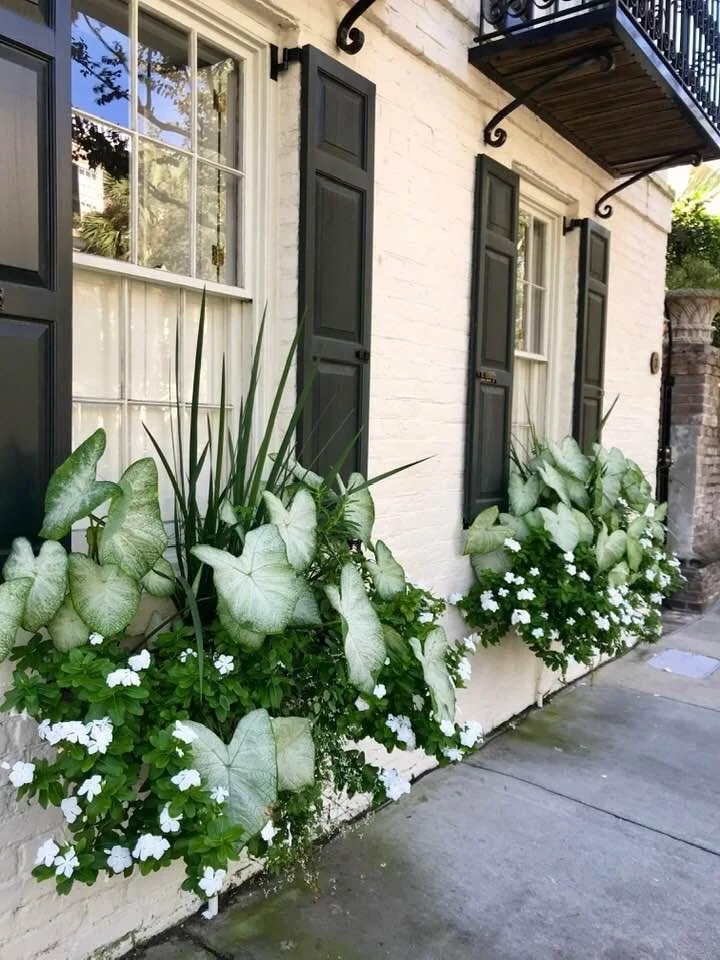
September 1, 2026
33+ Mocha Brown Nail Ideas: The Ultimate Chocolate Fall Manicure Trend You Need to Try in 2026
August 31, 2026
33+ Mocha Brown Nail Ideas: The Ultimate Chocolate Fall Manicure Trend You Need to Try in 2026
August 31, 2026
Read more →
August 31, 2026
30 blissful things to do to romanticize your fall.jpg
August 31, 2026
Fall Bucket List: 30 blissful things to do this Fall
August 31, 2026
Read more →
August 31, 2026
15 best spiritual books every woman must read.jpg
August 26, 2026
My 15 Favorite Spiritual Awakening Books for Women Who Are Evolving
August 26, 2026
Read more →
August 26, 2026
the ultimate guide to caring for orhids and how to make them last.jpg
August 13, 2026
The Ultimate Guide to Orchid Care: How to Grow Orchids Indoors & Keep Them Blooming
August 13, 2026
Read more →
August 13, 2026
how to take better notes to become a better thinker.jpg
August 11, 2026
How to Take Better Notes: A simple habit that will make you think better & why it matters for women
August 11, 2026
Read more →
August 11, 2026
35 COZY + ROMANTIC AT HOME DATE NIGHT IDEAS TO DO THIS FALL.jpg
August 10, 2026
40 Cozy + Romantic At-Home Fall Date Night Ideas for Couples (2026 Guide)
August 10, 2026
Read more →
August 10, 2026
how to make your energy expensive.jpg
August 10, 2026
How to Make Your Energy Expensive: 7 Ways to Practice the Joy of Missing Out {podcast ep. 395}
August 10, 2026
Read more →
August 10, 2026
everything you need to know about lions gate portal.jpg
August 8, 2026
The Hot Girl's Guide to the Lion's Gate Portal: Everything You Need to Know
August 8, 2026
Read more →
August 8, 2026
ARE YOU MANIFESTING FROM FEAR OR FAITH.jpg
August 5, 2026
Are You Manifesting From Fear or Faith? Here's How to Tell {podcast ep. 394}
August 5, 2026
Read more →
August 5, 2026
the ultimate guide to morning pages.jpg
August 5, 2026
Morning Pages: The Complete Guide to This Life-Changing Journaling Habit (+ How to Actually Stick With It)
August 5, 2026
Read more →
August 5, 2026
How to plan a DIY wellness retreat
August 3, 2026
How to Plan an Affordable Wellness Retreat at Home Step-By-Step
August 3, 2026
Read more →
August 3, 2026
23+ cozy fall inspired living room ideas you can recreate effortlessly.jpg
July 21, 2026
23 Cozy Fall inspired living room decorating ideas for a small home
July 21, 2026
Read more →
July 21, 2026
how to create a cozy bedroom tips for better sleep.jpg
July 21, 2026
Cozy Bedroom Sleep Sanctuary: 21 Budget Friendly Essentials for Better Sleep After 40
July 21, 2026
Read more →
July 21, 2026
how to find your online business niche when you have too many interests.jpg
July 16, 2026
How to Find Your Online Business Niche When You Have Too Many Interests {podcast ep. 391}
July 16, 2026
Read more →
July 16, 2026
55 everyday items to bedazzle that make life better.jpg
July 14, 2026
55 Random Things to Bedazzle: Easy DIY Guide & Genius Ideas for Everyday Items
July 14, 2026
Read more →
July 14, 2026
23+ STYLISH FALL OUTFIT IDEAS WITH HATS copy.jpg
July 14, 2026
23+ Effortless Fall Fashion Outfit Ideas With Hats
July 14, 2026
Read more →
July 14, 2026
19 charming french cottage bathroom decor ideas.png
July 13, 2026
French Cottage Bathroom Ideas: 19 Charming Ways to Get the Look (Even on a Budget)
July 13, 2026
Read more →
July 13, 2026
Guide to Leo season .jpg
July 13, 2026
Leo Season: The Hot Girls Guide to Thriving With Fire, Confidence & Creativity for all 12 signs
July 13, 2026
Read more →
July 13, 2026
20 walking essentials that make 10k steps so much easier
July 12, 2026
How I Fell in Love With Walking After 40 (+ 20 Essentials That Make 10,000 Steps So Much Easier)
July 12, 2026
Read more →
July 12, 2026
HOW TO SCRIPT AND MANIFEST WITH SCRIPTING.jpg
July 11, 2026
The Ultimate Guide to Scripting for Manifestation: Write Your Dream Reality Into Existence
July 11, 2026
Read more →
July 11, 2026
20 genius small laundry room decorating ideas.jpg
July 10, 2026
20+ Genius Small Laundry Room Decor & Organization Ideas
July 10, 2026
Read more →
July 10, 2026
12 best books on manifesting money and expanding wealth for women.jpg
July 8, 2026
The 12 Best Books on Manifesting Money + Expanding Wealth for Women
July 8, 2026
Read more →
July 8, 2026
12 DELICIOUS HIGH PROTEIN BREAKFAST IDEAS FOR WOMEN.jpg
July 7, 2026
12 Most Delicious High-Protein, Low-Calorie Breakfast Ideas for Women I found on Pinterest
July 7, 2026
Read more →
July 7, 2026
35+ BEAUTIFUL FRONT DOOR PLANTER IDEAS YOU WILL WANT TO RECREATE.jpg
July 7, 2026
35+ Stunning Front Door Planter Ideas (Genius Tips, Tricks & DIY Know-How)
July 7, 2026
Read more →
July 7, 2026
35+ Inspiring Halloween Entryway Decorating Ideas You Will Want To Copy
July 1, 2026
35+ Inspiring Halloween Entryway Decorating Ideas You Will Want To Copy
July 1, 2026
Read more →
July 1, 2026
How to host the ultimate stress-free Friendsgiving dinner party (20+ brilliant ideas)
June 30, 2026
How to host the ultimate stress-free Friendsgiving dinner party (20+ brilliant ideas)
June 30, 2026
Read more →
June 30, 2026
21+ delicious friendsgiving food ideas that are crowdpleasers.jpg
June 28, 2026
21 Easy & Crowd-Pleasing Friendsgiving Food Ideas Everyone Will Love
June 28, 2026
Read more →
June 28, 2026
19+ creative wall above the sofa decor ideas.jpg
June 25, 2026
How to decorate the wall above your sofa ( 19+ Chic & Creative Ideas You Must See )
June 25, 2026
Read more →
June 25, 2026
50+ beautiful beach vacation nail ideas you will want to screenshot.jpg
June 24, 2026
50+ Beautiful Beach Vacation Nail Ideas You'll Want to Screenshot
June 24, 2026
Read more →
June 24, 2026
35 STUNNING FRONT DOOR PLANTER IDEAS TO RECREATE ASAP.jpg
In interior design, interior decorating Tags front door decor, gardening, plants
Comment
  • Blog
  • Older
  • Newer

ASHLINA KAPOSTA

… A creative, work from home, mom-entrepreneur who is passionate about all things blissful living. Here you’ll find musings on decorating, slow living, self-development, health & wellness, manifestation, femininity, mindset & entrepreneurship.

Pour yourself a cup of tea and stay a while…


GET MY FREE WEEKLY LOVE LETTERS:

RECENT POSTS…

Featured
45+ budget friendly DIY halloween decorating ideas.jpg
September 1, 2026
45+ Easy and Budget Friendly DIY Halloween Decorating Ideas
September 1, 2026
Read more →
September 1, 2026
33+ Mocha Brown Nail Ideas: The Ultimate Chocolate Fall Manicure Trend You Need to Try in 2026
August 31, 2026
33+ Mocha Brown Nail Ideas: The Ultimate Chocolate Fall Manicure Trend You Need to Try in 2026
August 31, 2026
Read more →
August 31, 2026
30 blissful things to do to romanticize your fall.jpg
August 31, 2026
Fall Bucket List: 30 blissful things to do this Fall
August 31, 2026
Read more →
August 31, 2026
15 best spiritual books every woman must read.jpg
August 26, 2026
My 15 Favorite Spiritual Awakening Books for Women Who Are Evolving
August 26, 2026
Read more →
August 26, 2026
the ultimate guide to caring for orhids and how to make them last.jpg
August 13, 2026
The Ultimate Guide to Orchid Care: How to Grow Orchids Indoors & Keep Them Blooming
August 13, 2026
Read more →
August 13, 2026
how to take better notes to become a better thinker.jpg
August 11, 2026
How to Take Better Notes: A simple habit that will make you think better & why it matters for women
August 11, 2026
Read more →
August 11, 2026
35 COZY + ROMANTIC AT HOME DATE NIGHT IDEAS TO DO THIS FALL.jpg
August 10, 2026
40 Cozy + Romantic At-Home Fall Date Night Ideas for Couples (2026 Guide)
August 10, 2026
Read more →
August 10, 2026
how to make your energy expensive.jpg
August 10, 2026
How to Make Your Energy Expensive: 7 Ways to Practice the Joy of Missing Out {podcast ep. 395}
August 10, 2026
Read more →
August 10, 2026

LISTEN TO THE PODCAST:

Products I love:

The ultimate planner for women

My stacked Gold tennis bracelets

The best hair oil for shiny hair

Best Liquid vitamins for women

Wall mounted sconces

What I wear golfing

JOIN THE MEMBERSHIP:

learn how to manifest

learn how here

grab my NEWest E-BOOK:

CLICK HERE to read

Follow me on Houzz

SHOP MY STYLE:

BUY MY JOURNAL. . .

click here to purchase

premiere sponsors

This website is a participant in the Amazon Services LLC Associates Program, an affiliate program designed to provide a means for sites to earn advertising fees by advertising and linking to Amazon.com.

pinterest youtube-unauth facebook-unauth instagram-unauth

CREATE A BEAUTIFUL SITE LIKE THIS ONE

About us

Privacy Policy

ASHLINA KAPOSTA

Interiors. Lifestyle. Blissful Living.

Ashlina - Blissful Living, a lifestyle blog. Mindset, wellness, organization, decorating, spirituality, femininity

pinterest youtube-unauth facebook-unauth instagram-unauth