Everything you need to know about caring for orchids indoors, from watering and sunlight to repotting, fertilizing, troubleshooting, and even the meaning of orchids in your home.
Orchids have always been one of my favorite flowers.
There is just something about an orchid that makes a home feel instantly more beautiful. They have this effortless, elegant quality that makes even the simplest room feel a little more special.
I have always loved having orchids around my home, but I'll admit something:
I have always loved orchids more than I actually knew how to care for them.
That changed recently when family of mine gave me six stunning orchids.
They had been taking over their home, and they were getting a little tired of caring for them, so they asked if I wanted to take them. Of course I said yes.
Now I suddenly have six orchids living throughout my home, and several of them are clearly outgrowing the pots they're in.
Which means I have officially entered my orchid-mom era.
The only problem?
I realized very quickly that I didn't actually know as much about orchid care as I thought I did. So I decided to learn.
I've been researching how to properly water orchids, how much light they need, what those crazy roots growing outside the pots actually mean, when to repot them, how to get them to bloom again, and how to keep them healthy long-term.
And because I know I'm probably not the only person who has brought home a gorgeous orchid and then immediately thought, Okay...now what?, I decided to put everything I'm learning into one place.
This is my ultimate beginner's guide to orchid care.
I'll be updating this post as my six orchids grow, get repotted, and hopefully start blooming again.
And because I love thinking about our homes as more than just beautiful spaces, I've also included something I find fascinating toward the end of this guide:
the symbolism of orchids and how orchids can be used in Feng Shui.Because apparently these beautiful little plants aren't just pretty.They're meaningful, too.
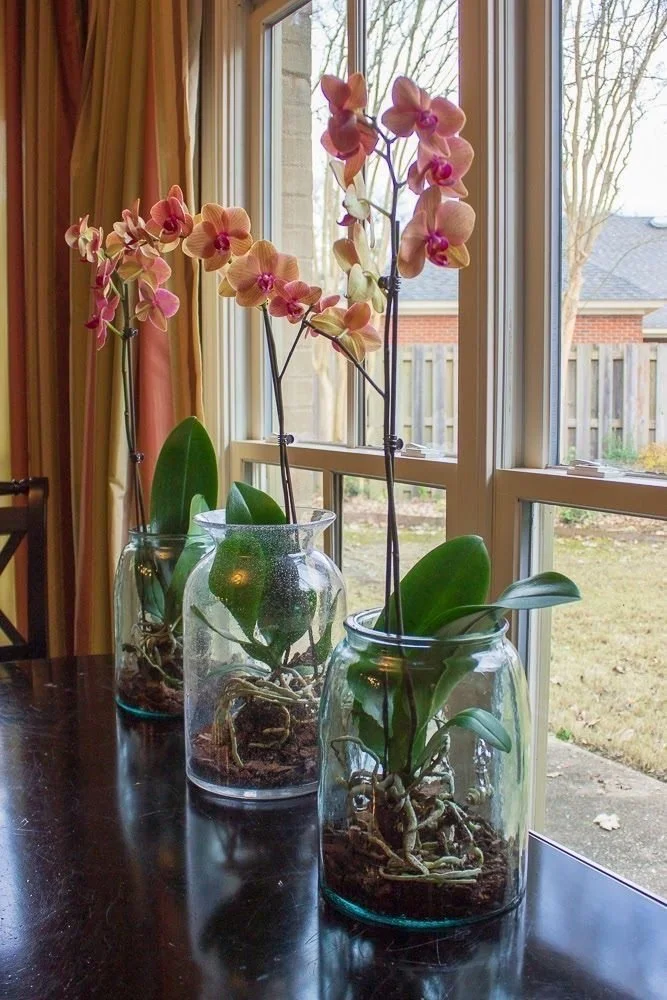
Table of Contents
My Story: How I Ended Up With Six Orchids
What Kind of Orchid Do You Have?
How to Care for Orchids Indoors
How Much Light Do Orchids Need?
How Often Should You Water an Orchid?
How to Tell When Your Orchid Needs Water
Should You Mist an Orchid?
How Much Humidity Do Orchids Need?
What Kind of Pot Does an Orchid Need?
Understanding Orchid Roots
When Should You Repot an Orchid?
How to Repot an Orchid
What Kind of Soil Does an Orchid Need?
How Do You Know If Orchid Roots Are Healthy?
How to Fertilize Orchids
How Do You Get an Orchid to Bloom Again?
Why Are My Orchid Leaves Turning Yellow?
Why Are My Orchid Leaves Wrinkled?
Why Are My Orchid Roots Turning Brown?
Common Orchid Problems & What They Mean
Should You Cut Orchid Roots?
Can You Put an Orchid in a Decorative Pot?
How Long Do Orchids Live?
Orchid Care Through the Seasons
The Meaning of Orchids: What Orchids Symbolize
Orchids & Feng Shui: Where to Place Orchids in Your Home
1. My Story: How I Ended Up With Six Orchids
Let's start with the reason I'm writing this guide in the first place. My in-laws had six orchids that had basically taken over their home. Rather than continue trying to keep up with them, they decided to give them to me. And since orchids are one of my favorite flowers, I happily took all six. I brought them home and started looking around at them more closely. And several were clearly becoming too large for the containers they were in.
That's when I realized that loving orchids and actually knowing how to care for orchids are two very different things.
So I decided to learn. And honestly, the more I've learned about orchids, the more fascinated I've become.
They aren't quite like other houseplants like my monsteras, their roots behave differently, their watering needs are different. They don't necessarily need to be planted in traditional soil. And when their flowers fall off, it doesn't mean the plant is dying.
In fact, an orchid without flowers can still be incredibly healthy.
So now I'm on a little mission to see what happens when I give these six orchids the right environment and a little more attention.
I'm going to repot the ones that need it, move them around my home to find their ideal spots, and hopefully watch them all bloom again.
I'll be documenting the process here because I think there's something really fun about learning alongside your plants.
And if you're also learning how to care for orchids, you're invited to learn with me.
2. What Kind of Orchid Do You Have?
Before you start caring for your orchid, it's helpful to know what kind you actually have.
There are thousands of orchid species and hybrids, and their growing requirements can be very different.
But if you've purchased an orchid from a grocery store, garden center, florist, or big-box store, there's a good chance you have a Phalaenopsis orchid, commonly called a moth orchid.
Phalaenopsis orchids are one of the most popular orchids for growing indoors and are generally considered one of the more beginner-friendly types.
They typically have:
Broad, glossy green leaves
Long flower spikes
Large, butterfly-shaped flowers
Thick roots
Long-lasting blooms
If you have the classic orchid that you see everywhere around Valentine's Day, Mother's Day, and in grocery-store floral departments, there's a good chance it's a Phalaenopsis.
That's the type of orchid this guide primarily focuses on.
If you have a Cattleya, Dendrobium, Oncidium, Vanda, Paphiopedilum, or another variety, some of the advice here may need to be adjusted for that specific orchid.
3. How to Care for Orchids Indoors
The good news is that orchid care isn't nearly as complicated as it looks.
For a typical indoor Phalaenopsis orchid, the basics come down to:
Light + water + humidity + airflow + proper potting medium + occasional fertilizer.
The biggest mistake beginners make is treating an orchid like an ordinary houseplant.
Orchids don't generally want to sit in traditional potting soil with wet roots.
Many commonly grown orchids are epiphytes, meaning they naturally grow on trees rather than in the ground.
Their roots are designed to receive both moisture and air.
So your goal isn't simply to keep your orchid "wet."
Your goal is to create an environment where the roots receive the right amount of moisture without staying waterlogged.
Once you understand that, orchid care starts to make much more sense.
4. How Much Light Do Orchids Need?
Light is one of the most important parts of orchid care.
Phalaenopsis orchids generally prefer bright, indirect light.
An east-facing window is often an excellent location because it provides bright morning light without the harshest afternoon sun.
A shaded south- or west-facing window can also work.
Think:
Bright room. Filtered light. No scorching afternoon sun.
Good locations include:
Near an east-facing window
A few feet from a bright south-facing window
Near a west-facing window with filtered light
A bright kitchen
A sunny bathroom
A bright living room
Avoid putting an orchid directly against extremely hot glass where intense afternoon sunlight can scorch the leaves.
How can you tell if your orchid is getting enough light?
Look at the leaves.
Healthy Phalaenopsis leaves are generally a medium to light green. Very dark green leaves can indicate insufficient light. Yellowing, bleached, or scorched-looking leaves can indicate too much intense light or another problem.
And if your orchid produces beautiful leaves but refuses to bloom, inadequate light is one of the first things I'd investigate.
5. How Often Should You Water an Orchid?
This is probably the biggest orchid-care question of all.
And the answer isn't, "Every Sunday." There isn't one universal watering schedule that works for every orchid.
How quickly an orchid dries depends on:
Temperature
Humidity
Light
Air circulation
Pot size
Potting medium
Season
The plant itself
Instead of watering according to the calendar, learn to read your orchid. For Phalaenopsis, you want to water thoroughly and then allow the growing medium to become nearly dry before watering again.
Don't keep the roots constantly soaking wet. But don't allow the plant to stay completely bone-dry for extended periods either. Your home environment will determine how frequently that balance occurs.
6. How to Tell When Your Orchid Needs Water
There are several easy ways to tell.
Look at the roots
This is one of the best things about growing orchids in clear pots.
You can actually see what's happening underneath the plant.
Healthy, hydrated roots are often green.
Roots that have dried out can appear silvery or gray.
Roots that are brown, black, soft, or mushy may be damaged or rotting.
Feel the pot
Pick up the orchid.
A freshly watered orchid will feel heavier. As the growing medium dries, the pot becomes lighter. Eventually, you'll start recognizing the difference without even thinking about it.
Check the growing medium
Look at the bark or moss.
Does it still look damp?
Does it feel moist?
Is it beginning to dry?
You can also use a wooden skewer or chopstick to help check moisture deeper inside the pot.
The biggest lesson:
Don't water your orchid simply because it's Tuesday.
Water because your orchid actually needs water.
7. Should You Mist an Orchid?
Misting is one of those orchid-care topics that can get confusing.
Yes, misting can temporarily increase moisture around the plant. But misting isn't a replacement for properly watering the roots. Orchids absorb most of their water through their roots, so the roots need to be your primary focus.
If your home is dry, increasing the humidity of the room can be more effective than constantly misting the leaves. And there's one thing I would be especially careful about:
Don't allow water to sit in the crown of the orchid.
The crown is the central area where the leaves emerge. Water trapped there can increase the risk of crown rot. If water gets into the crown, gently remove it.
8. How Much Humidity Do Orchids Need?
Orchids generally appreciate humidity because many come from tropical or subtropical environments.
For Phalaenopsis, a humidity level around 50–80% is commonly recommended. But you don't necessarily need to turn your house into a greenhouse.
If your orchid is growing well, producing healthy leaves and roots, and the growing medium is drying appropriately, you may not need to do anything special.
If your home is especially dry, a humidifier can help.
A small humidity tray can also be used, but make sure the orchid itself isn't sitting directly in water.
And remember:
Humidity and airflow need to work together.
A humid room with stagnant air isn't ideal. Good air movement helps keep foliage dry and can reduce the conditions that contribute to fungal and bacterial problems.
9. What Kind of Pot Does an Orchid Need?
Have you ever wondered why orchids are so often sold in clear plastic pots? It's not just because they are cheap. There's actually a very practical reason. Clear pots allow you to see the roots and with orchids, the roots tell you a lot.
A good orchid pot should have:
Excellent drainage
Plenty of airflow
Appropriate space for the root system
A potting medium designed for orchids
You can absolutely put that functional nursery pot inside a beautiful decorative planter.
That's actually one of my favorite ways to display orchids.
You get the healthy growing environment of a practical orchid pot while still getting the beautiful interior-design moment of a decorative planter.
10. Understanding Orchid Roots
If you're new to orchids, the roots might be the strangest thing about them.
They can grow:
Down into the pot
Up through the potting medium
Over the edge
Around the outside
Completely outside the pot
And that's okay.
Orchid roots are not supposed to look like the roots of a typical houseplant. Many orchids naturally grow attached to trees, so their roots are adapted to being exposed to the air. Those roots growing outside the pot are called aerial roots. And unless they're dead or diseased, you generally don't need to cut them.
In fact, I think one of the most important mindset shifts when caring for orchids is this: Stop trying to make your orchid look like a conventional houseplant. Let it be an orchid.
11. When Should You Repot an Orchid?
This is especially relevant to me right now because several of my six orchids are clearly outgrowing their pots.
But here's something important:
An orchid doesn't necessarily need a new pot just because roots are growing outside of it.
Aerial roots are normal. Instead, look at the entire plant.
You may want to repot when:
The potting medium is breaking down
The bark has decomposed
The growing medium stays wet for too long
The plant has become unstable
There are many damaged or rotting roots
The root system has genuinely outgrown the container
The plant needs fresh growing medium
Phalaenopsis are commonly repotted about every one to three years, depending on the condition of the growing medium and the plant.
If the orchid is in bloom and otherwise healthy, you can often wait until after flowering unless there's an urgent problem with the roots or medium.
12. How to Repot an Orchid
Repotting an orchid looks intimidating the first time.
But once you understand what you're doing, it's surprisingly straightforward.
What you'll need:
A clean orchid pot
Fresh orchid potting medium
Clean scissors or pruning shears
Your orchid
A clean work surface
Step 1: Remove the orchid
Gently remove the orchid from its existing container.
If the roots are attached to the pot, don't yank them.
Work slowly.
Step 2: Remove the old growing medium
Gently loosen the bark, moss, or other growing medium from around the roots.
This is your opportunity to inspect what's actually happening inside the pot.
Step 3: Inspect the roots
Look for healthy, firm roots.
Remove roots that are:
Soft
Mushy
Collapsed
Completely dead
Severely damaged
Always use clean cutting tools.
Step 4: Choose the new pot
Don't automatically choose the biggest pot you can find.
An appropriately sized pot is usually better than giving the orchid a huge amount of extra space.
Step 5: Add fresh orchid medium
Put a small amount of fresh orchid mix into the bottom of the pot.
Step 6: Position the orchid
Place the orchid into the pot and gently arrange the healthy roots.
Step 7: Add more growing medium
Gently work the new medium around the roots.
Don't pack it down like traditional soil.
The roots need airflow.
Step 8: Keep the crown above the medium
The central stem where the leaves emerge should remain above the growing medium.
Don't bury the crown.
And then you're done.
Your orchid has a fresh home.
13. What Kind of Soil Does an Orchid Need?
The short answer:
Usually, not regular soil.
This is one of the biggest beginner orchid-care mistakes.
Orchids such as Phalaenopsis are commonly grown in a porous, airy medium rather than ordinary houseplant soil.
Common orchid mixes can contain:
Orchid bark
Sphagnum moss
Perlite
Other coarse materials
The exact mixture can vary based on your environment and watering habits.
The goal is to create a growing environment that provides moisture while still allowing air to reach the roots.
Think:
Moist, but not suffocated.
14. How Do You Know If Orchid Roots Are Healthy?
Learning to read orchid roots will make you a much more confident orchid owner.
Green roots
Often indicate hydrated, active roots.
Silver or gray roots
Often indicate that the roots have dried and are ready for water.
Brown or black roots
May indicate dead or damaged roots, particularly if they are soft or mushy.
Firm roots
Generally indicate healthier tissue.
Soft, mushy roots
Are a warning sign and may indicate rot.
One of the most important things to remember is that a sad-looking orchid isn't necessarily thirsty.
Sometimes a plant has wrinkled leaves because its roots have been damaged and can no longer absorb water properly.
So before you simply give it more water:
Look at the roots.
15. How to Fertilize Orchids
Orchids benefit from regular nutrition during active growth.
Use an orchid fertilizer or another appropriate balanced fertilizer, and always follow the dilution instructions on the product.
Many orchid growers prefer a diluted fertilizer applied regularly rather than extremely strong applications.
The important thing is not to overdo it.
More fertilizer does not automatically mean more flowers.
Your priorities should be:
Healthy roots
Appropriate light
Proper watering
Good growing medium
Appropriate nutrition
Fertilizer is there to support healthy growth — not compensate for poor growing conditions.
16. How Do You Get an Orchid to Bloom Again?
This is the part everyone wants to know.
You bought an orchid.
It was covered in gorgeous flowers.
Then the flowers fell off.
And suddenly you're staring at a green plant wondering:
Is it dead?
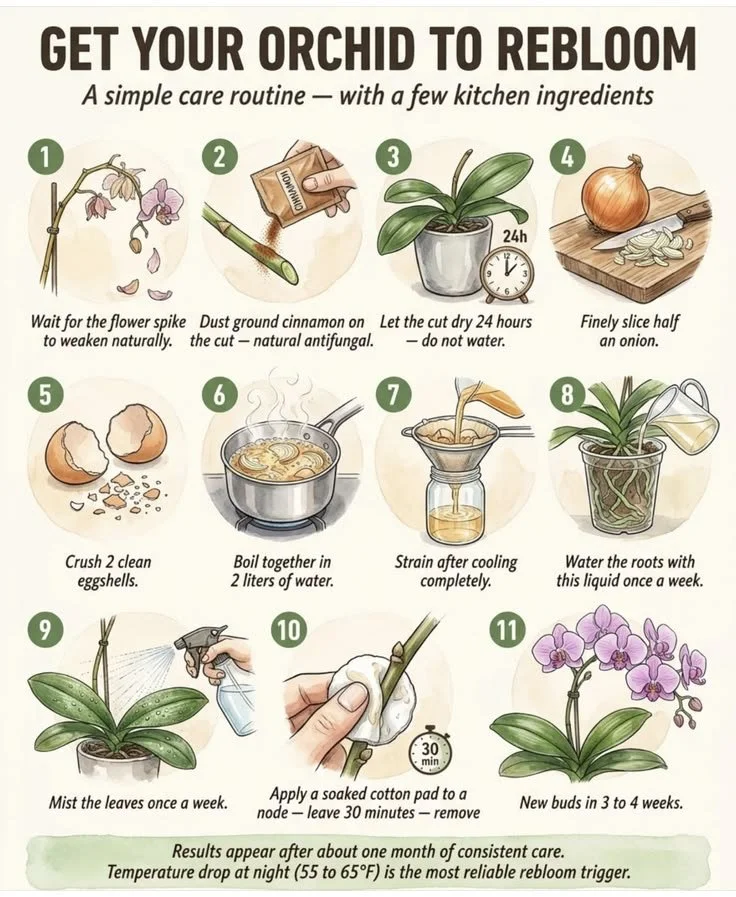
No. Please don't throw it away.The flowers falling off is often simply the end of that particular flowering cycle. Your orchid is still alive.
To encourage future blooming, focus on the basics:
Give it adequate light
Keep the roots healthy
Water appropriately
Fertilize appropriately
Maintain suitable temperatures
Give it time
Some Phalaenopsis orchids can rebloom from existing flower spikes, while others may produce a new spike.
If a flower spike is still green, you don't necessarily need to cut it off immediately.
If it has completely turned brown and dried out, it can be removed.
A flowerless orchid is still an orchid.
The leaves and roots you're growing today may be what eventually produces tomorrow's flowers.
17. Why Are My Orchid Leaves Turning Yellow?
One yellow leaf isn't automatically an emergency. Older leaves naturally age and eventually turn yellow. But if several leaves are suddenly yellowing, it's worth investigating.
Possible causes include:
Overwatering
Root problems
Too much intense sunlight
Too little light
Nutritional issues
Natural aging
Start by looking at the roots.
Then evaluate how wet the growing medium is staying and how much light the orchid receives. Don't automatically assume that yellow leaves mean you need to add more water.
18. Why Are My Orchid Leaves Wrinkled?
Wrinkled or limp leaves can indicate that the plant isn't receiving enough usable water. But again, don't immediately grab the watering can. Check the roots first.
If the roots are healthy but the plant is drying too quickly, it may need more consistent watering or a better humidity environment.
If the roots are damaged or rotting, the orchid may not be able to absorb enough water even if the pot is wet.
This is why orchid care is so much about observation. The symptom isn't always the cause.
19. Why Are My Orchid Roots Turning Brown?
Brown roots can mean different things depending on their texture and condition. The bigger warning sign is soft, mushy, collapsing tissue. That's when you should suspect root rot or severe root damage.
If you discover rotten roots during repotting, remove the damaged sections using clean scissors and repot the orchid into fresh, appropriate growing medium.
The goal is to preserve the healthy roots and give them a clean environment in which to recover.
20. Common Orchid Problems & What They Mean
Yellow leaves
Possible causes: Aging, overwatering, root problems, excessive light, or other environmental stress.
Check: Roots, moisture, and light.
Wrinkled leaves
Possible causes: Dehydration or damaged roots.
Check: Root health before increasing watering.
Brown or mushy roots
Possible cause: Root rot.
Check: Remove damaged roots and repot into fresh, airy medium.
No flowers
Possible causes: Insufficient light, stress, normal time between flowering cycles, or immature growth.
Check: Light, roots, watering, nutrition, and patience.
Flowers falling off
Possible causes: Normal end of bloom, environmental changes, temperature fluctuations, or plant stress.
Check: Continue normal care and observe the plant.
Roots growing outside the pot
Possible cause: Normal orchid growth.
Check: Usually nothing. Healthy aerial roots don't need to be cut simply because they're outside the pot.
Water collecting in the crown
Potential problem: Crown rot.
Check: Gently remove standing water and avoid leaving the crown wet.
21. Should You Cut Orchid Roots?
Only cut roots that are dead, damaged, or rotting.
Don't cut a healthy aerial root just because it looks strange.
I know this can be difficult when you're trying to make your orchid look neat and pretty.
But orchids aren't meant to be perfectly contained.
Those wild roots are part of the plant.
Let them grow.
In fact, I think they're one of the most beautiful parts of an orchid once you understand what you're looking at.
22. Can You Put an Orchid in a Decorative Pot?
Absolutely.
And this is one of my favorite ways to style orchids around the house.
Keep the orchid in a functional nursery or orchid pot with proper drainage, then place that container inside a decorative pot.
That way you can have:
Healthy roots + beautiful home decor.
Just remember to empty any water that collects in the decorative container after watering.
You never want the orchid sitting in standing water.
And this is where orchids really shine as decor.
They can sit on:
Coffee tables
Nightstands
Bathroom counters
Kitchen islands
Entryway tables
Bookshelves
Home office desks
Dining tables
They're living decor.
And unlike a bouquet of cut flowers, the plant can continue growing long after the original flowers are gone.
23. How Long Do Orchids Live?
With proper care, orchids can live for many years.
That is one of the reasons I think they're such a wonderful houseplant.
They're not meant to be enjoyed for a few weeks and then discarded when the flowers disappear.
The flowers are only one part of the life of the plant.
An orchid can spend one season blooming, another season growing roots and leaves, and another preparing to bloom again.
Which means your orchid can become something you care for and watch change over time.
And I love that.
24. Orchid Care Through the Seasons
Your orchid's needs can change throughout the year.
Spring Orchid Care
Spring is a great time to:
Inspect the roots
Evaluate the growing medium
Repot if necessary
Increase watering as growth increases
Begin or increase fertilizing
Reevaluate the amount of light your orchid receives
Summer Orchid Care
In warmer months, your orchid may dry out more quickly.
Pay attention to:
Watering frequency
Humidity
Air movement
Heat
Direct sunlight
A bright, hot window can be much more intense during summer.
Fall Orchid Care
As temperatures and daylight change, watch how quickly the orchid dries.
Your watering frequency may need to change.
Fall can also be an important time for some Phalaenopsis orchids because cooler nighttime temperatures can help initiate flower spikes.
Winter Orchid Care
Indoor heating can make the air significantly drier.
Watch the roots and potting medium rather than sticking to a rigid watering schedule.
And don't panic if growth slows down.
Your orchid doesn't have to bloom constantly to be healthy.
25. The Meaning of Orchids: What Orchids Symbolize
This is where my orchid obsession gets a little more interesting.
Because orchids aren't just beautiful.
They have a long history of symbolism across different cultures.
Orchids are commonly associated with:
Beauty
Love
Grace
Elegance
Refinement
Fertility
Friendship
Patience
Longevity
Strength
Abundance
In Chinese culture, the orchid is one of the Four Gentlemen of traditional art and symbolism, alongside the plum blossom, bamboo, and chrysanthemum.
These plants have historically been associated with virtues and qualities of cultivated character.
And I think the symbolism of the orchid is particularly beautiful.
Because orchids don't bloom constantly.
They have seasons.
They require patience.
Their growth isn't always obvious.
Sometimes you're looking at nothing but roots and leaves.
And then suddenly...
they bloom.
Maybe that's part of why I love them so much.
They feel like a little reminder that just because you aren't visibly blooming doesn't mean nothing is happening.
Sometimes you're growing roots.
Sometimes you're strengthening.
Sometimes you're preparing.
And sometimes, after a season of quiet growth, you bloom again.
What Different Orchid Colors Symbolize
While meanings vary by tradition, color is often given additional symbolic significance.
Purple orchids are commonly associated with admiration, refinement, luxury, and abundance.
Pink orchids are often connected with love, romance, femininity, and affection.
Yellow orchids can symbolize friendship, happiness, warmth, and joy.
Red orchids are associated with passion, desire, vitality, and strength.
White orchids are often associated with beauty, elegance, innocence, and purity.
I love the idea of choosing an orchid not just because you love its color, but because you love what that color represents to you.
Maybe you choose a pink orchid for your bedroom because you want to cultivate more romance.
Maybe you choose purple for your office because you're creating a season of expansion and abundance.
Maybe you choose white because you're creating a calm, beautiful sanctuary.
The meaning becomes part of the ritual.
26. Orchids & Feng Shui: Where to Place Orchids in Your Home
If you love Feng Shui, orchids are especially interesting because they're associated with beauty, harmony, growth, and positive energy.
In Feng Shui, living plants are often used to bring the energy of nature and growth into a home.
And an orchid brings something particularly beautiful to that idea because it combines living growth with flowers.
It's not just green.
It blooms.
It's not just decorative.
It's alive.
And that makes an orchid a beautiful symbolic addition to a home where you're intentionally creating a particular energy.
Orchids for Love & Relationships
Orchids are traditionally associated with love, beauty, fertility, and relationships.
In the traditional Feng Shui bagua, the southwest area is associated with relationships and partnership.
That makes an orchid a beautiful symbolic choice for this area if you're intentionally working with traditional Feng Shui principles.
You can also place orchids in a bedroom or another space that feels connected to love, romance, intimacy, or partnership.
And I especially love the idea of placing a beautiful pink orchid somewhere you get ready each morning.
It turns the plant into a reminder:
Beauty isn't something you wait to experience. It's something you create.
Orchids for Abundance & Success
Purple orchids are especially beautiful when you're thinking about abundance, admiration, refinement, and success.
A purple orchid can make a gorgeous addition to:
A home office
A creative workspace
A reading area
A place where you journal or plan
A room dedicated to your work or business
And there's something beautiful about having a living plant near your workspace.
It becomes a visual reminder of growth.
Orchids in the Bedroom
The bedroom is one of my favorite places for an orchid because orchids naturally bring a sense of beauty and softness to the room.
A pink or white orchid can be especially beautiful here.
Think of it less as "I'm putting a plant in my bedroom for a specific magical outcome" and more as:
I'm intentionally surrounding myself with symbols of love, beauty, and growth.
That's the part of Feng Shui I find most beautiful.
Your environment becomes a reflection of what you're cultivating.
Orchids in the Bathroom
Bathrooms can be wonderful places for orchids if they receive enough natural light.
The humidity can also be helpful.
A beautiful orchid beside a bathtub, on a bathroom vanity, or near a bright window can make the entire room feel like a little spa.
And symbolically, I love the combination of:
orchid + water + beauty ritual.
It's a natural fit for a space where you're already caring for yourself.
Orchids in the Entryway
An orchid can also make a beautiful statement in an entryway.
It's the first thing you see when you walk into your home.
Instead of simply decorating the entryway, you can think about what you want to feel when you arrive home.
Peace.
Beauty.
Abundance.
Warmth.
Love.
Choose an orchid that represents the energy you want to welcome.
The Most Important Feng Shui Orchid Rule
Here's something I think is even more important than the exact location:
Keep your orchid healthy.
A vibrant, thriving plant represents growth and vitality.
A neglected, dying plant doesn't create the same feeling.
So before worrying about whether your orchid is in the "perfect" Feng Shui corner, take care of the plant.
Water it.
Give it light.
Repot it when it needs it.
Remove dead growth.
Pay attention.
In other words:
The best Feng Shui orchid is a healthy orchid.
And maybe that's the perfect connection between Feng Shui and everything we've talked about in this guide.
You don't create a beautiful home simply by putting beautiful things in it.
You create a beautiful home by caring for what lives inside it.
My Six-Orchid Experiment
Now comes the part I'm most excited about.
I have six orchids.
And I'm going to see what happens when I really learn how to care for them.
I'm going to experiment with their placement around my home.
I'm going to repot the ones that need it.
I'm going to learn how each one grows.
I'm going to photograph the roots.
I'm going to watch for new leaves and flower spikes.
And I'm hoping to eventually see all six of them blooming again.
I'm especially curious about how different rooms in my home affect them.
Maybe one will love a bright window.
Maybe another will thrive in the humidity of the bathroom.
Maybe one will become the centerpiece of my dining room.
And maybe I'll discover that one particular orchid has a completely different personality from the others.
I'll be documenting the process here, so consider this the beginning of my orchid experiment.
And if you've been thinking about buying an orchid but have been intimidated by them, I hope this makes you feel a little more confident.
Because I'm learning right alongside you.
My Simple Orchid Care Routine
Now that I have six orchids, I don't want caring for them to become complicated.
My goal is to make orchid care something I naturally incorporate into my home routine.
Once a week, I check:
The leaves
The roots
The potting medium
The weight of the pot
The amount of light
New growth
Flower spikes
Signs of pests or disease
When the orchid needs water:
I water it thoroughly and allow the excess water to drain completely.
Every few weeks:
I take a closer look at the roots, leaves, and overall condition of the plant.
When necessary:
I repot, prune damaged roots, refresh the growing medium, or adjust its location.
And that's it.
I don't want to obsess over them.
I just want to pay attention.
Because the more I've learned about orchids, the more I've realized that successful orchid care isn't necessarily about doing more.
It's about noticing more.
Frequently Asked Questions About Orchid Care
How often should you water an orchid?
There isn't one universal schedule. Water when the growing medium is approaching dryness, then water thoroughly and allow excess water to drain.
How much sunlight does an orchid need?
Phalaenopsis orchids generally prefer bright, indirect light. An east-facing window is often ideal, while shaded south- or west-facing windows can also work.
Can orchids grow indoors?
Yes. Phalaenopsis orchids are particularly well suited to indoor environments when given adequate light, appropriate watering, good drainage, humidity, and airflow.
Should orchids be planted in soil?
Most commonly grown epiphytic orchids should not be planted in ordinary houseplant soil. They need a porous, airy orchid-growing medium.
Why are my orchid roots growing outside the pot?
Those are aerial roots, and they are a normal part of orchid growth. Healthy aerial roots generally don't need to be cut.
How do I get my orchid to bloom again?
Give it adequate light, maintain healthy roots, water appropriately, provide appropriate nutrition, and be patient. Orchids often need time between flowering cycles.
Should I cut the orchid stem after the flowers fall?
Not necessarily. A green flower spike may continue producing growth. A completely brown and dried flower spike can be removed.
What is the best pot for an orchid?
A pot with excellent drainage and good airflow is ideal. Clear plastic pots are especially useful because they allow you to monitor the roots.
How often should I repot an orchid?
Phalaenopsis are commonly repotted approximately every one to three years, depending on the condition of the growing medium and the plant's roots.
How long do orchids live?
With proper care, orchids can live for many years and may flower repeatedly throughout their lives.
Can I keep an orchid in a decorative pot?
Yes. Keep the orchid in a pot with appropriate drainage and use the decorative pot as an outer container. Don't allow water to collect around the roots.
Are orchids good Feng Shui plants?
Orchids are commonly used symbolically in Feng Shui and are associated with beauty, harmony, growth, love, and abundance. The most important thing is to keep the plant healthy and thriving.
Final Thoughts
When I first brought home my six orchids, I thought my biggest challenge was going to be figuring out how to keep them alive.
Now I'm realizing that the more interesting part is learning how to understand them.
The roots tell a story.
The leaves tell a story.
The flowers tell a story.
Even the periods when there are no flowers tell a story.
And maybe that's why orchids have become even more meaningful to me now that I'm actually learning how to care for them.
They remind me that growth isn't always visible.
Sometimes you're blooming.
Sometimes you're growing roots.
Sometimes you're resting.
And sometimes you're preparing for your next season.
You don't have to be in bloom all the time to be growing.
So yes, I'm going to do my best to keep these six orchids alive.
I'm going to repot them, move them around my home, learn their rhythms, and hopefully watch them bloom again.
But I'm also going to enjoy the process.
Because maybe that's what having plants in your home is really about.
Not just decorating your space.
Caring for something. Watching something grow. And creating a home that feels alive.
And if my six orchids have taught me anything already, it's that sometimes the most beautiful blooms come after a season of simply growing roots.
you may also like:
🌹 The Ultimate Guide to Caring for and Growing Your Monstera Deliciosa
🌹 44 things to do on a Sunday for a great week
🌹 How to start an herb garden at home
🌹 21 small backyard flower garden ideas
Please feel free to email me at ashlina@thedecorista.com if you have any questions! I’m always happy to help with decorating, life advice or even picking out a specific perfume! Have an amazing day!!
Also, check out my Amazon shop HERE to shop all my favorite things, tips and tricks. You can also download the free LIKETOKNOW.IT app and follow me HERE.
STAY IN THE KNOW: Don’t forget to sign up for my exclusive Love Letters for STYLE TIPS, LIFE ADVICE, COSMIC TEA, AND MUCH MORE!
As always, thank you so much for stopping by today, I truly appreciate all of you! xo, Ashlina
FOLLOW ALONG: Instagram | Pinterest | Shop Amazon | You Tube