
Feng Shui Basics: The Essential Principles You Need to Design a Balanced, High-Vibe Home
What Is Feng Shui? and Why Does It Matter in Modern Life?
Several years ago, I began to notice something subtle but persistent in my home. It was beautiful. It was curated. It reflected my aesthetic. And yet, despite the effort I had put into styling every corner, the space did not feel fully supportive. I found myself productive but fatigued, creative but scattered, accomplished but not entirely grounded.
As an interior decorator, I also noticed that some of my client’s were seeking my help not because the space was terrible looking but more because something about the space felt…off.
That experience led me deeper into studying feng shui—not the surface-level decorating tips that circulate on Pinterest, but the classical principles that have guided architectural placement and spatial harmony for thousands of years.
As I studied and began applying those principles intentionally—adjusting my bed into the commanding position, balancing elemental energies in the kitchen, clearing stagnant corners where energy had quietly accumulated—I began to notice measurable shifts. My nervous system felt calmer. My focus sharpened. My creative output became more fluid and less forced.
I also noticed that once I enhanced and activated my Feng Shui money corner, clients began pouring in. My work with my clients became even that much more fulfilling and successful for creating spaces that felt more harmonious and improved their lives, not just looked prettier.
Feng shui, when practiced correctly, is not about superstition or rigid rules. It is about understanding how your environment influences your mental clarity, emotional regulation, and even your financial momentum. In this comprehensive guide, I will walk you through the foundational principles of feng shui, the five elements system, the bagua map, commanding position placement, and room-by-room strategies for creating a home that genuinely supports your life.
Because the truth is simple: your environment is never neutral. It is either strengthening you or quietly draining you.
What Is Feng Shui?
Feng shui (pronounced “fung shway”) translates to “wind” and “water,” two natural forces that symbolize movement and flow. Rooted in Taoist philosophy and developed over 3,000 to 6,000 years ago in China, feng shui is the practice of arranging physical spaces in a way that harmonizes individuals with their surrounding environment.
Historically, feng shui was used to determine the placement of entire villages, imperial palaces, burial grounds, and cities. The practice was never about decor trends; it was about survival, prosperity, and alignment with natural forces. Ancient practitioners observed how landforms, orientation, sunlight, water sources, and spatial positioning influenced the health and longevity of communities.
At the heart of feng shui is the concept of Chi (also spelled Qi), which refers to life-force energy. This energy flows through landscapes, buildings, and rooms in much the same way that blood flows through the body. When Chi moves freely and smoothly, occupants experience clarity, vitality, and forward momentum. When it becomes blocked or stagnant, people often report feeling stuck, fatigued, or unsettled.
In modern Western homes, feng shui has been simplified into aesthetic adjustments, but its deeper application integrates spatial psychology, elemental balance, directional mapping, and energetic flow. When understood properly, feng shui becomes less about rules and more about awareness—how layout, light, materials, and placement shape your internal state.
What Are the Core Principles of Feng Shui?
Before diving into specific decorating strategies, it is important to understand the foundational principles that govern feng shui practice. These principles create the framework for every adjustment you make in your home.
What Is Chi Energy and How Does It Move Through Your Home?
Chi is the animating life force that flows through all environments. In the context of your home, Chi enters primarily through the front door and circulates through hallways, doorways, and open areas before settling into rooms.
You can often sense the condition of Chi intuitively. A cluttered room tends to feel heavy and stagnant. A well-lit, thoughtfully arranged space feels open and breathable. Narrow pathways blocked by furniture can create subtle tension, while wide, clear walkways encourage ease and movement.
To support healthy Chi flow, furniture should not obstruct entrances or major pathways. Broken items should be repaired or removed, as they symbolically—and psychologically—represent stuck energy. Regular cleaning, decluttering, and natural light are among the simplest and most effective ways to keep Chi circulating.
When energy flows smoothly through your space, your thinking often becomes clearer and your actions more decisive.
What Is Yin and Yang and Why Does Balance Matter?
Yin and yang describe complementary forces that exist in all environments. Yin represents softness, darkness, stillness, and receptivity. Yang represents brightness, activity, movement, and stimulation. Neither is inherently better; harmony depends on balance.
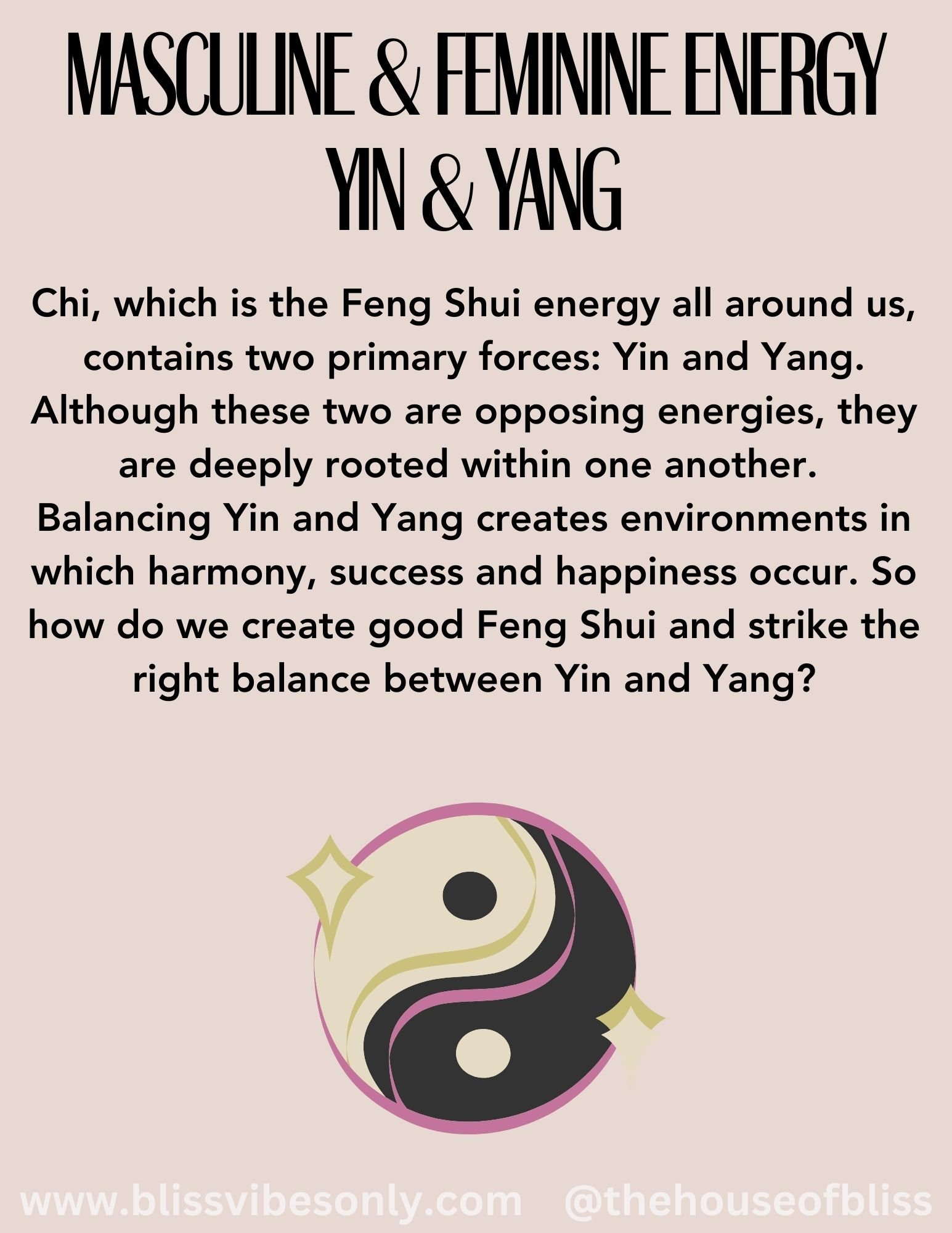
For example, a bedroom benefits from predominantly yin energy, which supports rest and intimacy. Soft lighting, calming colors, and layered textiles contribute to this effect. In contrast, a home office requires more yang energy to support productivity and mental alertness, which can be achieved through brighter lighting, upright furniture, and structured organization.
When a space contains too much yin, it can feel lethargic or heavy. When it contains too much yang, it may feel overstimulating or chaotic. Adjusting lighting, texture, color, and layout can restore equilibrium.
Balanced environments regulate your nervous system more effectively than extreme ones.
What Are the Five Elements and Why Are They So Powerful?
The five elements form one of the most important frameworks in feng shui. They represent five distinct types of energy that exist in nature and within your home: Wood, Fire, Earth, Metal, and Water. Each element carries specific qualities, colors, shapes, and materials that influence the emotional tone of a space.
Wood represents growth, vitality, and expansion. It is associated with the energy of spring and is often expressed through adding plants, vertical shapes, and natural wood materials.
Fire symbolizes passion, visibility, and transformation. It connects to summer energy and appears in lighting, candles, warm tones, and triangular forms.
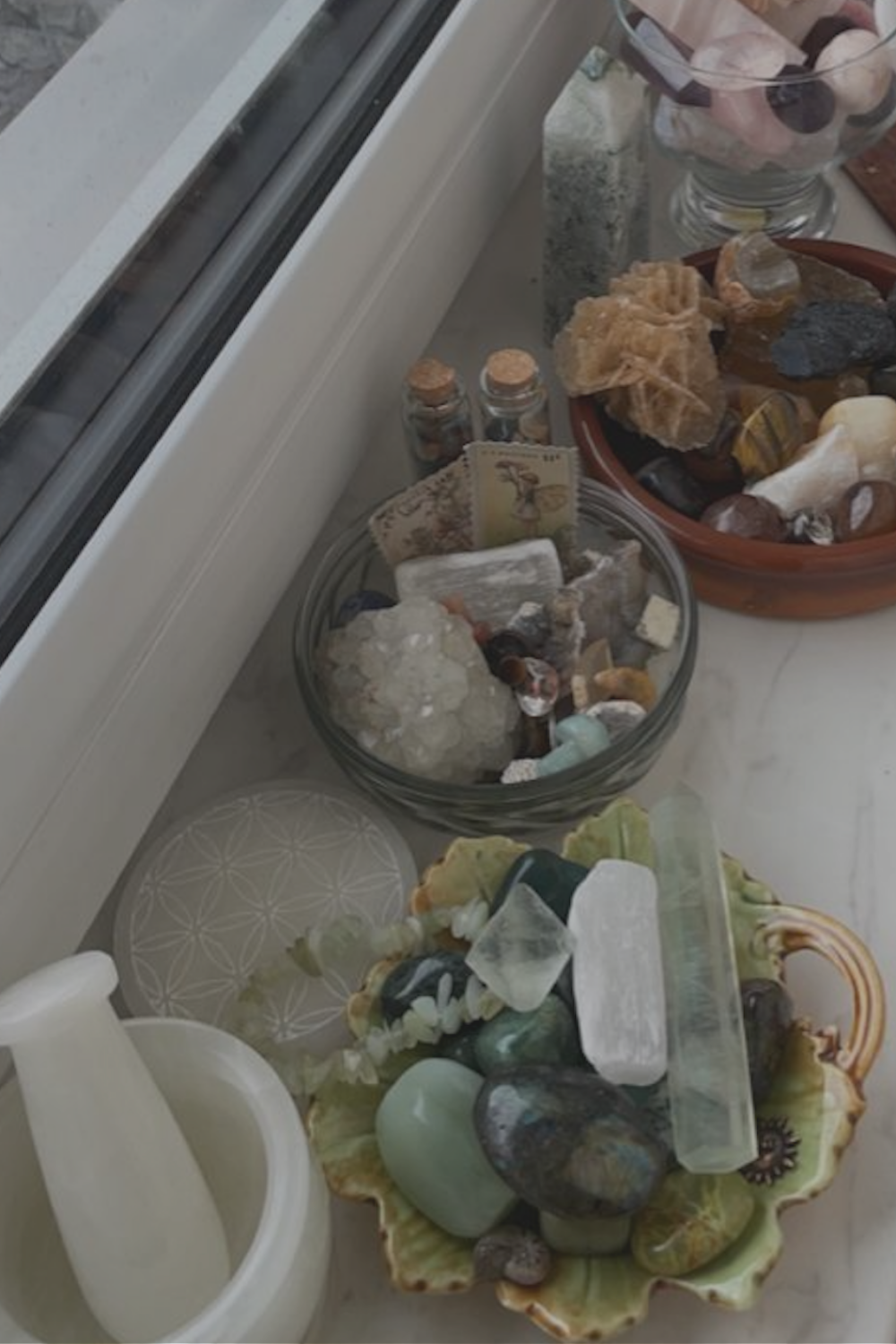
Earth embodies stability, nourishment, and grounding. This element is expressed through ceramics, stone, square shapes, and neutral palettes.
Metal reflects clarity, precision, and structure. It is linked to autumn and is often incorporated through metallic finishes, circular shapes, and minimalist design.
Water represents intuition, wisdom, and flow. Associated with winter, it appears in mirrors, reflective surfaces, darker hues, and fluid shapes.
These elements interact through both supportive (creative) and controlling (destructive) cycles. When used intentionally, they help you strengthen areas of your life that feel weak and soften areas that feel excessive.
The five elements are powerful because they provide a systematic way to diagnose imbalance in a room and restore harmony without guesswork.
Related Reading: How to find your Feng Shui birth element

How Do You Balance The 5 Elements and How Do You Use Them Intentionally?
Every room already contains elements. The question is whether they are balanced.
When one element dominates excessively, it can subtly affect mood, focus, relationships, and even decision-making. When elements are layered thoughtfully, the room begins to feel calm, intentional, and quietly powerful.
Here is how to understand and use each one properly.
What Is the Wood Element and How Does It Influence Growth?
Wood energy represents expansion, vitality, creativity, and forward movement. It is the energy of spring — growth after dormancy.
You’ll often feel wood energy in rooms that feel fresh, upward, and alive.
Wood is associated with:
Colors: Green, teal, blue-green
Shapes: Tall, vertical lines
Materials: Natural wood, plants, bamboo
Direction: East (family), Southeast (wealth)
Wood supports:
Business growth
Creative momentum
New beginnings
Health and vitality
To incorporate wood intentionally:
Add living plants (healthy, never dying)
Use light or medium-toned wood furniture
Display botanical or landscape art
Choose vertical shelving or tall lighting fixtures
If a room feels stagnant or uninspired, it often needs more wood energy.
If it feels chaotic or overgrown, it may need metal to refine it.
What Is the Fire Element and How Does It Affect Visibility?
Fire energy represents passion, recognition, and transformation. It is dynamic, expressive, and energizing.
Fire is associated with:
Colors: Red, coral, magenta, deep orange
Shapes: Triangles, pointed forms
Materials: Candles, lighting, electronics
Direction: South (fame & reputation)
Fire supports:
Confidence
Visibility
Public presence
Motivation
To strengthen fire energy:
Add warm lighting instead of harsh overhead lights
Incorporate candles intentionally
Hang bold, expressive artwork
Introduce subtle red or berry accents
Too much fire can feel overwhelming, anxious, or overstimulating. In that case, add earth tones to ground the space.
Fire should energize — not exhaust.
What Is the Earth Element and Why Does It Feel Grounding?
Earth energy provides stability, nourishment, and support. It is steady and centering.
Earth is associated with:
Colors: Beige, sand, terracotta, warm neutrals
Shapes: Square, low, flat forms
Materials: Ceramics, clay, stone
Directions: Southwest (relationships), Northeast (knowledge), Center (health)
Earth supports:
Emotional regulation
Financial stability
Strong relationships
Physical grounding
To incorporate earth:
Layer rugs and textured textiles
Use ceramic vases or pottery
Choose grounded, low-profile furniture
Add desert or landscape art in earthy tones
If a room feels chaotic or anxious, it likely needs more earth.
If it feels heavy or dull, introduce wood for growth.
What Is the Metal Element and How Does It Bring Clarity?
Metal energy is structured, refined, and focused. It cuts through distraction and encourages precision.
Metal is associated with:
Colors: White, gray, metallic tones
Shapes: Circular, rounded
Materials: Metal finishes, glass
Directions: West (creativity), Northwest (helpful people)
Metal supports:
Productivity
Clear decision-making
Organization
Communication
To increase metal energy:
Declutter ruthlessly
Introduce metallic accents
Use black-and-white photography
Create symmetry in layout
Too much metal can feel cold or sterile. In that case, soften it with fire or earth.
Metal is not about minimalism for aesthetic reasons — it is about mental clarity.
What Is the Water Element and How Does It Influence Flow?
Water energy governs intuition, depth, and career flow. It is reflective and intelligent.
Water is associated with:
Colors: Navy, black, deep blue
Shapes: Wavy, fluid forms
Materials: Mirrors, glass, fountains
Direction: North (career & life path)
Water supports:
Creativity
Emotional intelligence
Career direction
Inner wisdom
To incorporate water:
Add mirrors thoughtfully (never directly facing your bed)
Use fluid abstract art
Introduce darker accent tones
Keep surfaces clean and reflective
Too much water can create indecision or emotional heaviness. Earth balances it.
Water should feel calm and deep — not overwhelming.
What Is the Bagua Map and How Do You Use It as a Blueprint?
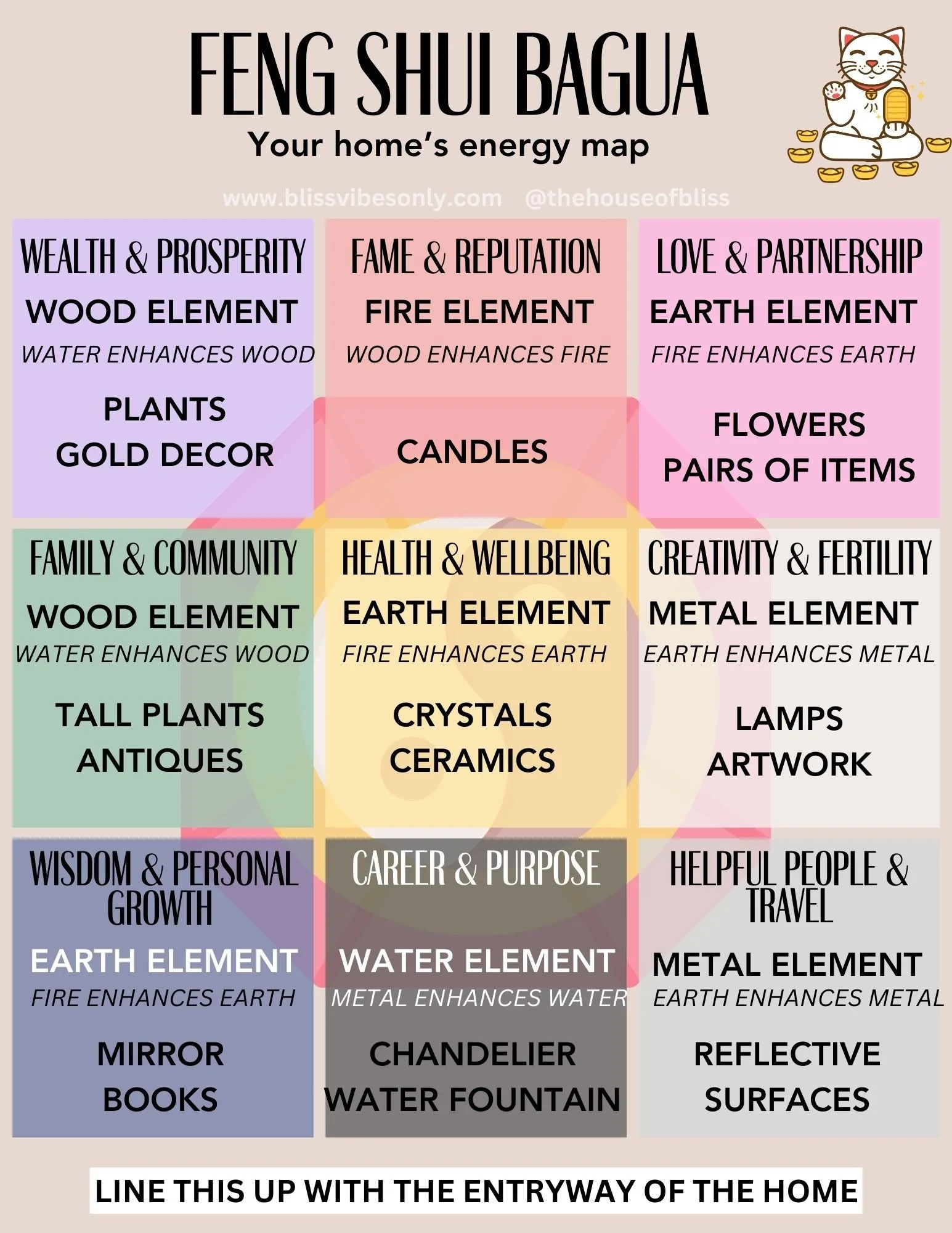
The bagua map is the energetic blueprint of feng shui. It divides your home into nine life areas, each connected to specific themes and elements.
The nine areas are:
Wealth & Prosperity
Fame & Reputation
Love & Relationships
Family & New Beginnings
Health (Center)
Children & Creativity
Knowledge & Self-Cultivation
Career & Life Path
Helpful People & Travel
To use the bagua map:
Stand at your front door facing inward.
Overlay the nine-grid map onto your floor plan.
Align the bottom row of the grid with your entrance wall.
Each section of your home now corresponds to a life category.
For example:
If your wealth corner (back left from entrance) is cluttered or dim, you may experience financial stagnation.
If your relationship corner is chaotic or filled with solo imagery, it may subtly reinforce independence rather than partnership.
You do not need to redecorate everything overnight. Awareness alone begins the shift.
(And yes — this is where your downloadable bagua map becomes a brilliant lead magnet.)
What Is the Commanding Position and Why Does It Matter?
The commanding position is one of the most psychologically powerful feng shui principles.
It refers to placing key furniture — especially your bed, desk, and stove — in a position where you can see the door without being directly in line with it.
Why it matters:
When you cannot see the door, your nervous system remains slightly on alert. Subconsciously, your body does not feel fully secure.
When you can see the entrance while being diagonally positioned, you feel supported and in control.
For your bed:
See the door
Avoid direct alignment with the doorway
Use a solid headboard
Avoid placing the bed directly under a window
For your desk:
Face the door if possible
Avoid sitting with your back to the room
Place a solid wall behind you for support
Small placement changes often create noticeable psychological shifts.
How Do You Apply Feng Shui Room by Room?
Feng shui becomes powerful when it moves beyond theory and into physical placement. Each room in your home governs different aspects of your life, and small, strategic adjustments can dramatically change how that space feels and functions.
You do not need a full renovation. You need awareness and intentional shifts.
Let’s walk through it room by room.
How Should You Feng Shui Your Entryway or Front Door?
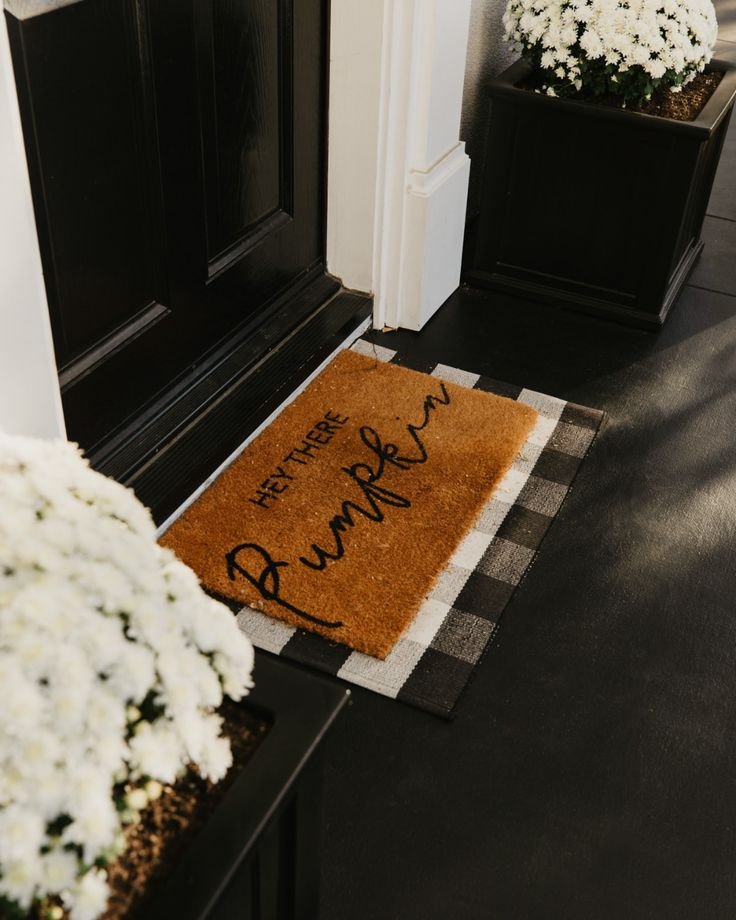
Your front door is known as the “mouth of Chi.” It is where energy enters your home, which means it influences everything that follows.
If the entry feels cluttered, dark, or chaotic, the energy entering your life mirrors that condition. If it feels open, clean, and welcoming, opportunities tend to flow more smoothly.
Focus on these essentials:
Keep the pathway to your door clear
Repair chipped paint or broken hardware
Ensure the door opens fully without obstruction
Add warm lighting
Avoid clutter directly behind the door
Color also matters. In classical feng shui, door colors can correspond to directional energy, but the most important factor is that the door feels intentional and well-maintained.
Your entry should feel like an invitation, not an afterthought.
How Should You Arrange Your Living Room for Better Energy?
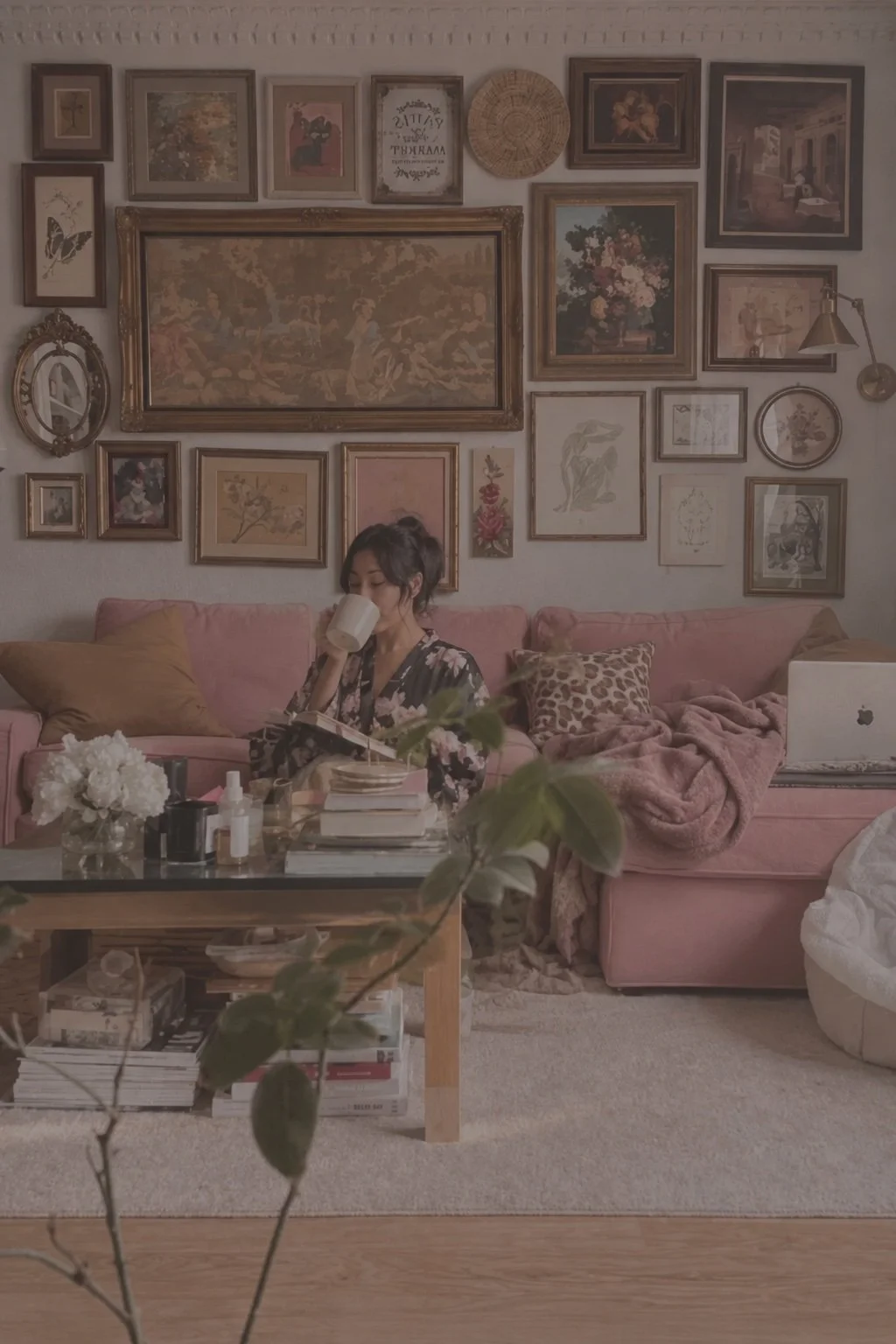
The living room governs social energy, connection, and how supported you feel in your daily life. Furniture placement is more important than decor styling here.
Start with layout.
Seat primary furniture in a commanding position
Avoid placing sofas with backs directly facing the entrance
Ensure there is space for conversation flow
Avoid pushing every piece flat against the wall if it feels disconnected
Next, consider elemental balance. Many modern living rooms lean heavily into one element — often metal (minimalist, neutral) or fire (bold, bright).
To balance:
Add plants if the room feels rigid
Add texture if it feels cold
Add lighting if it feels dim
Remove excess clutter if it feels overwhelming
A harmonious living room should feel welcoming, not staged.
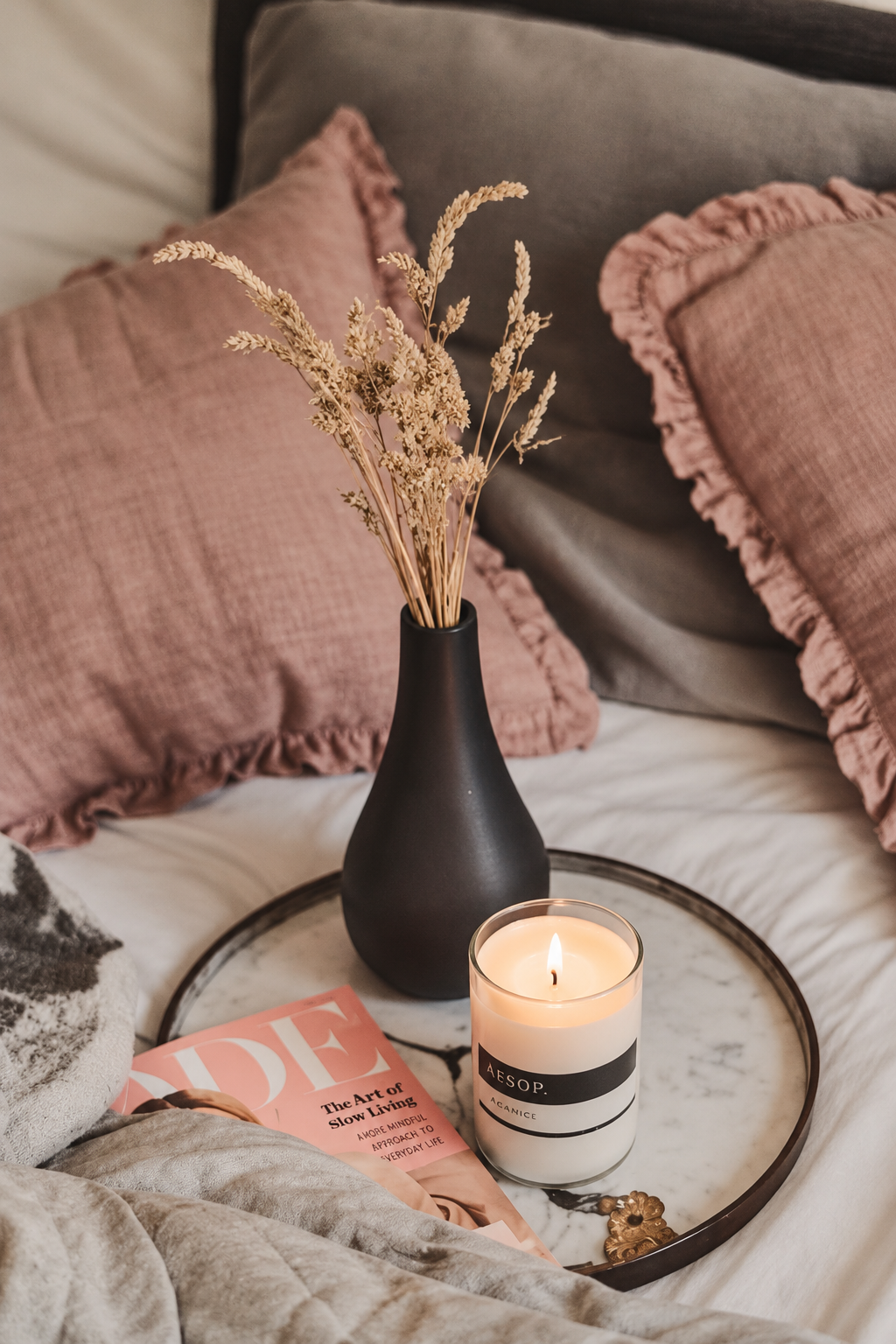
How Should You Feng Shui Your Bedroom for Rest and Romance?
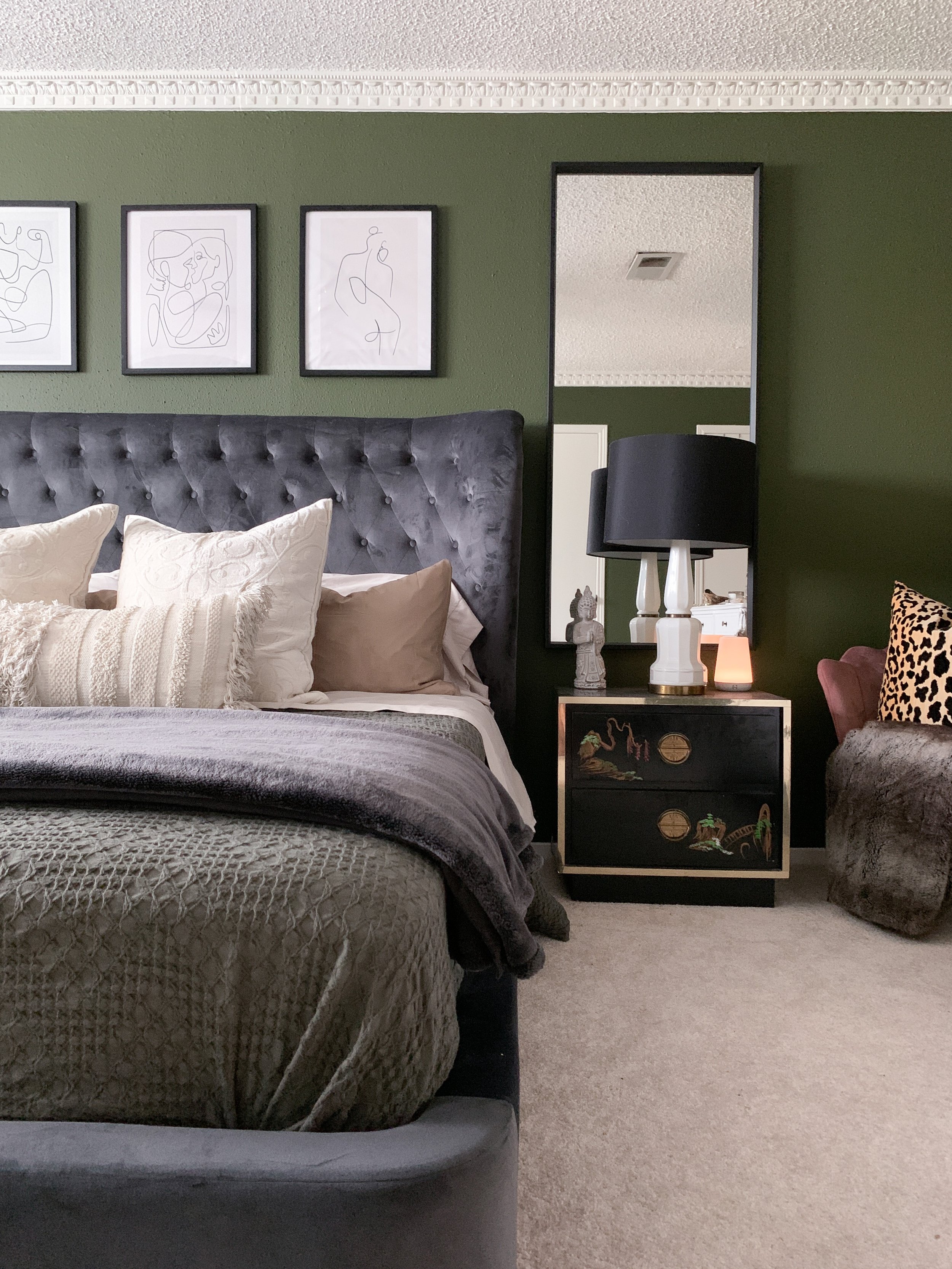
Your bedroom is one of the most sensitive rooms in feng shui because it governs rest, intimacy, and emotional regulation.
The first rule is placement.
Position the bed in the commanding position
Use a solid headboard for stability
Avoid placing the bed directly in line with the door
Avoid placing the bed directly under a window
Next, eliminate disturbances.
Remove excessive electronics
Avoid mirrors directly facing the bed
Clear clutter under the bed
Avoid storage that feels chaotic overhead
Color matters in the bedroom. Softer, yin tones support rest. This does not mean everything must be beige, but the overall feeling should be calming rather than stimulating.
The bedroom should feel like a retreat, not a workspace.
💛 How to activate your Feng Shui wealth corner
💛 5 simple ways to feng shui your home
💛 10 simple yet effective tips to feng shui your home office

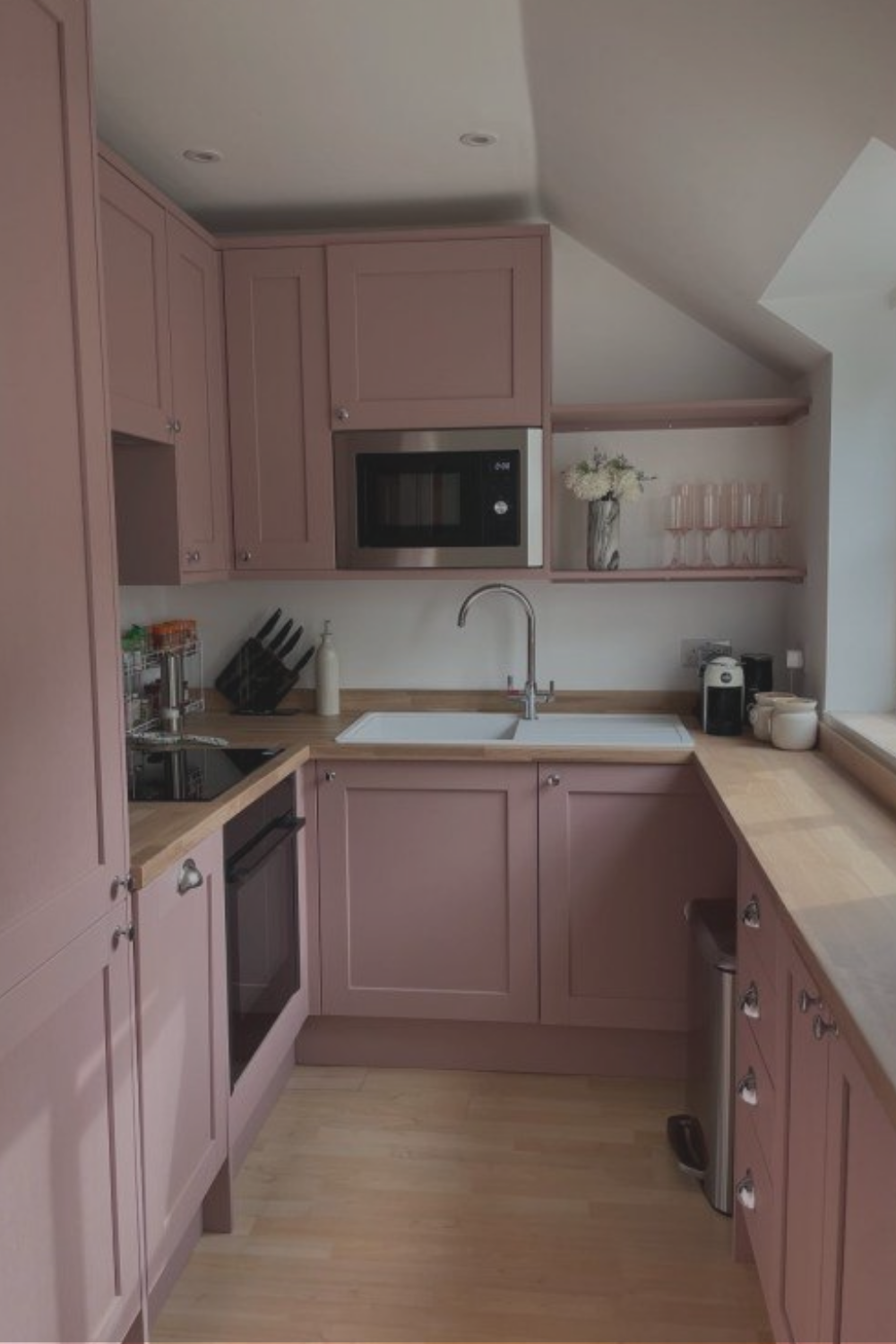
How Should You Feng Shui Your Kitchen for Nourishment and Wealth?
In feng shui, the kitchen symbolizes nourishment and financial stability. The stove represents your wealth potential because it governs how you are “fed.” Creating a calm and nourishing kitchen is important for your wealth flow.
Pay attention to:
Keeping the stove clean and fully functional
Using all burners occasionally (symbolizes multiple income streams)
Avoiding direct opposition between stove (fire) and sink (water)
If your stove and sink are directly facing each other, introduce earth energy between them:
A ceramic bowl
A small plant
Keep countertops clear, not sterile, but uncluttered. The kitchen should feel alive and nourishing.
Broken appliances in the kitchen often symbolize stalled resources.
How Should You Feng Shui Your Bathroom to Prevent Energy Drain?
Bathrooms are associated with water and drainage, which symbolically represents energy leaving the home.
While you do not need to fear your bathroom, you should manage it intentionally.
Focus on:
Keeping toilet lids closed
Fixing leaking faucets immediately
Using earth tones to stabilize excess water energy
Maintaining bright lighting
Keeping drains clean
Add grounding elements like:
Natural stone
Warm neutral textiles
A clean, bright bathroom feels controlled. A neglected one feels draining.
How Should You Feng Shui Your Home Office for Productivity?
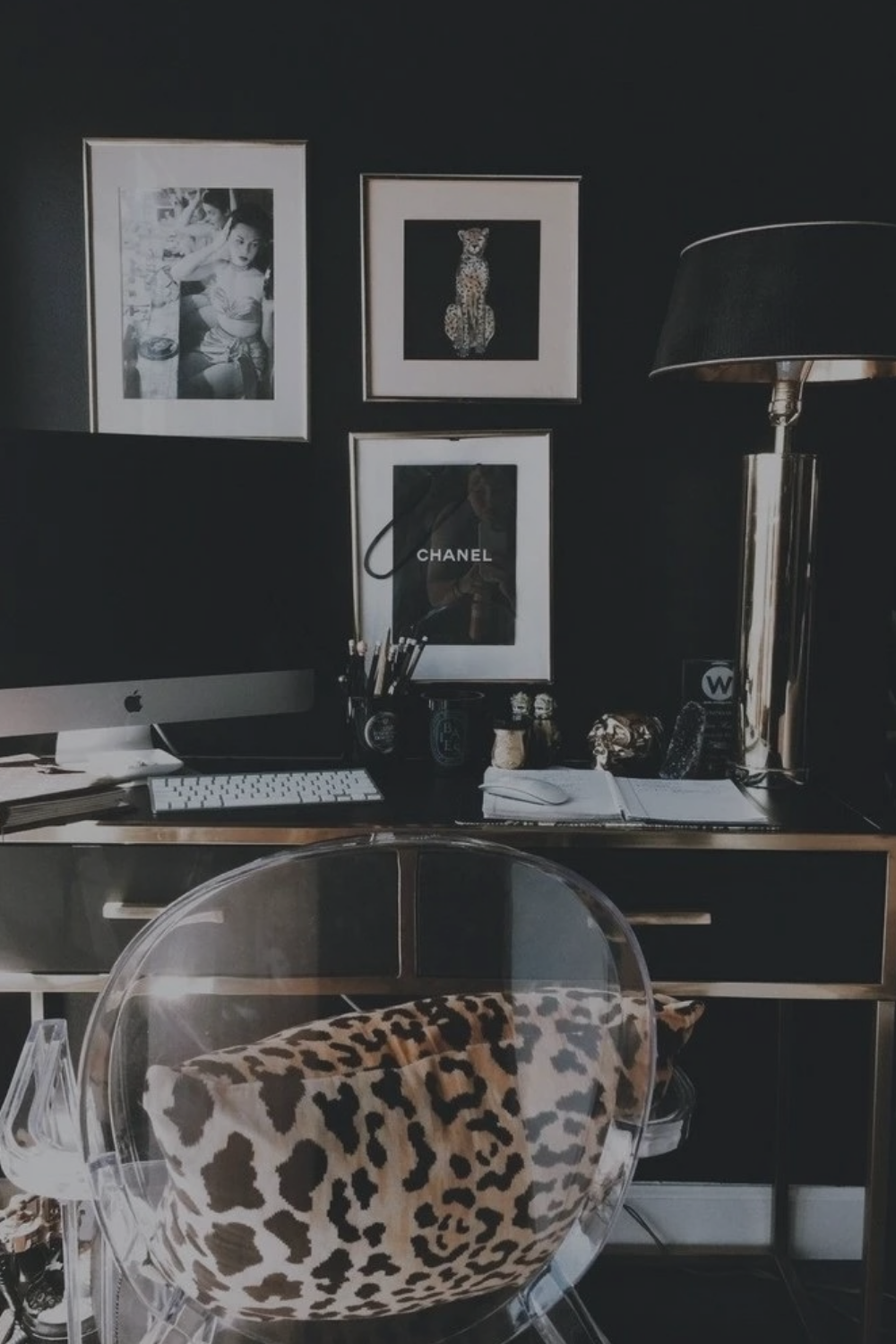
Your workspace governs focus, income, and long-term direction.
Desk placement is everything.
Position your desk in commanding position
Avoid sitting with your back to the door
Avoid facing directly into a wall
If you must face a wall, hang inspiring art or create visual depth so the space does not feel mentally restrictive.
Keep the desk surface clear except for:
A lamp (fire energy for activation)
A plant (wood for growth)
A small grounding object (earth for stability)
Too many decorative objects create distraction. Too little personality creates sterility. Read my top 10 tips to Feng Shui your home office.
Aim for focused energy with warmth.
How Should You Feng Shui Children's Rooms for Balance?
Children’s rooms require more flexibility because they serve multiple functions — rest, study, and play.
Separate zones whenever possible:
A defined sleep area
A clear study area
A designated play zone
Use color intentionally. Overstimulating bright tones can increase hyperactivity, while overly muted tones may feel dull.
Balance through:
Soft bedding (yin for sleep)
Upright desk and good lighting (yang for study)
Organized toy storage
Clutter accumulation in children's rooms often reflects scattered energy, so organization systems matter more than aesthetic perfection.
What Are the Most Common Feng Shui Mistakes (and How Do You Fix Them)?
Even beautifully styled homes can contain subtle energy blocks.
Here are the most common issues:
Excess clutter, especially in corners
Sharp corners pointing toward seating (known as “poison arrows”)
Blocked doorways or pathways
Mirror directly facing the bed
Toilet lids left open
Dead plants or dried flowers
Broken decor or damaged items
Bed placed directly under a window
Desk facing a blank wall
Most fixes are simple:
Move the furniture slightly
Add a plant to soften sharp edges
Repair or remove broken objects
Introduce grounding elements
Feng shui is often about small adjustments rather than dramatic redesigns.
How Do You Practice Feng Shui in Small Spaces or Apartments?
Small spaces can absolutely benefit from feng shui. In fact, they often respond more quickly to adjustments because the energy shift is concentrated.
Prioritize:
Decluttering vertically and horizontally
Keeping pathways clear
Using mirrors strategically (never directly facing the bed)
Defining zones within multi-use rooms
Maintaining strong front-door energy
If you cannot apply every principle, focus on:
Commanding position
Clutter removal
Element balance
Even small shifts in studio apartments can create noticeable changes in how the space feels.
Frequently Asked Questions About Feng Shui
Do I Need to Follow Every Feng Shui Rule Perfectly?
No. Feng shui is not about rigid perfection; it is about awareness and intention.
The goal is not to create anxiety around placement but to remove friction where it exists. If a principle is impossible to implement structurally—such as moving a door or relocating a bathroom—you can often balance the energy through elements, lighting, or layout adjustments.
Feng shui works best when applied thoughtfully, not obsessively.
What Is the Fastest Feng Shui Fix for Better Energy?
Decluttering.
Clutter is stagnant Chi. It blocks flow, limits clarity, and creates subtle stress. Removing unused, broken, or unnecessary items often creates an immediate psychological shift.
After decluttering, focus on:
Placing your bed or desk in commanding position
Clearing your entryway
Repairing anything broken
These three actions alone can noticeably improve how a space feels.
Can Feng Shui Work with Any Decorating Style?
Absolutely.
Feng shui is not a decorating aesthetic. It is an energetic framework that can be applied to minimalist, traditional, eclectic, modern, Mediterranean, or bohemian homes.
The principles guide placement, balance, and flow. The aesthetic expression remains personal.
You can have a neutral, organic modern home and still apply fire energy through lighting. You can have a maximalist home and still maintain strong Chi flow through layout clarity.
Feng shui enhances style; it does not replace it.
Is Feng Shui Religious or Spiritual?
Feng shui is philosophical, not religious.
It emerged from Taoist cosmology, but it does not require spiritual belief to be effective. Many of its principles overlap with environmental psychology, design theory, and nervous system regulation.
At its simplest level, feng shui recognizes that environment influences behavior and mood. That observation alone makes it universally applicable.
How Long Does It Take to See Results from Feng Shui?
Some adjustments create immediate psychological relief—such as clearing clutter or repositioning a desk. Other shifts unfold gradually as new habits and patterns develop within the improved environment.
Feng shui is cumulative. Small changes compound over time.
It is less about instant manifestation and more about creating conditions that consistently support your growth.
What Should I Never Keep in My Home?
Certain items tend to disrupt energy flow:
Broken objects
Dead or dying plants
Items tied to painful memories
Excess clutter under the bed
Sharp objects pointing toward seating areas
If an object evokes heaviness, resentment, or stagnation, it likely holds stagnant energy.
Your home should contain items that either serve a purpose or elevate your emotional state.
How Do I Neutralize Negative Energy (Sha Chi)?
Sha Chi refers to sharp, aggressive energy often caused by harsh lines, clutter, or obstructed pathways.
To soften it:
Add plants to soften sharp corners
Introduce curved shapes
Improve lighting in dark areas
Clear blockages around doors
Add grounding earth tones to overstimulating spaces
The solution is almost always softening, balancing, or clearing—not adding complexity.
What Is the First Step to Designing a Feng Shui Home That Truly Supports You?
Feng shui can feel expansive, but it does not require perfection or dramatic renovation. It requires intention.
Start with awareness.
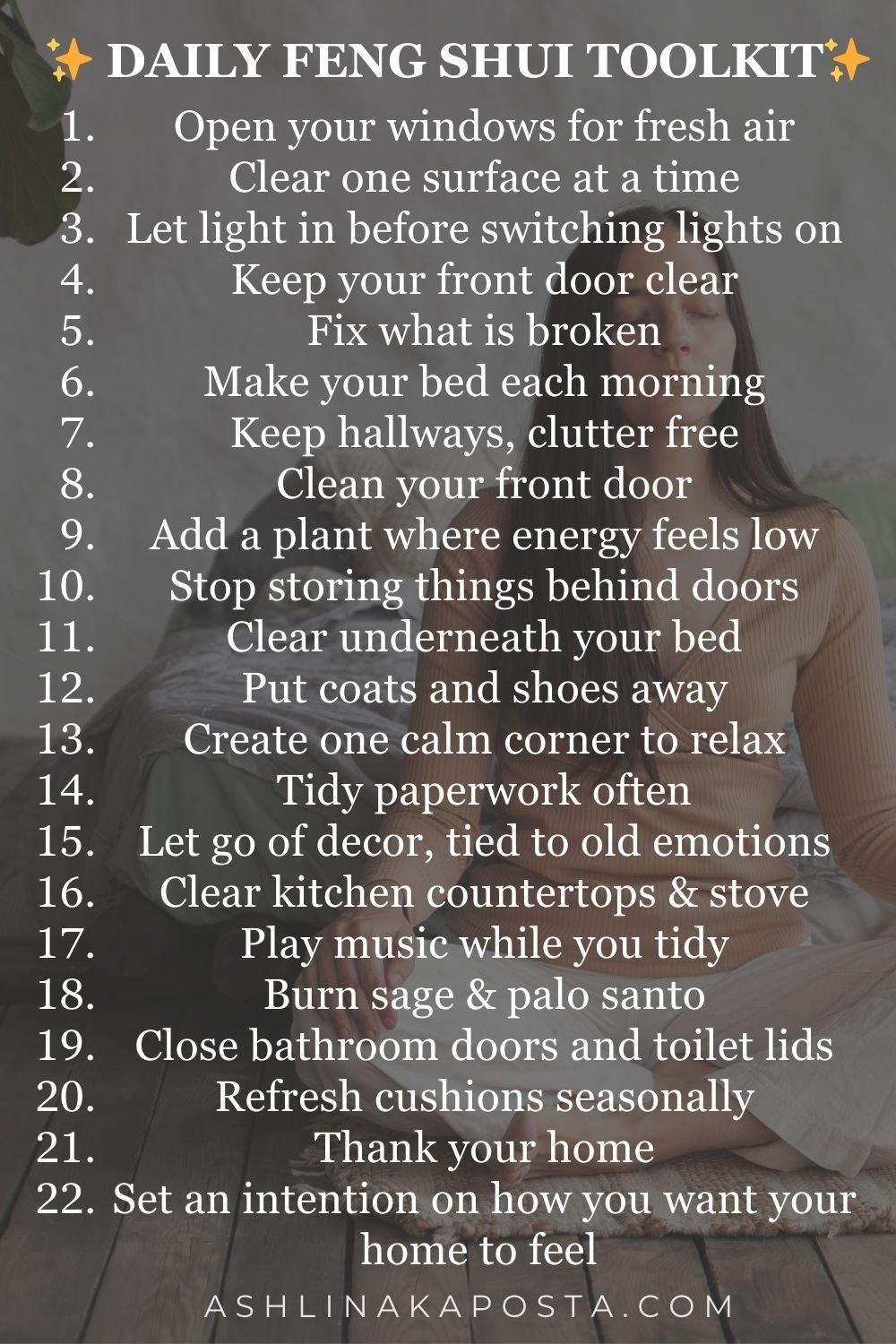
Walk through your home slowly. Notice where energy feels stagnant, where you feel tense, and where you feel calm. Adjust what you can. Clear what you no longer need. Reposition what feels subtly misaligned.
Your home does not need to look different overnight. It needs to feel supportive.
Feng shui is not about chasing luck. It is about creating conditions where clarity, stability, and growth are easier to access.
If you would like guided support in applying these principles step by step, I created a free 5-Day Feng Shui Reset delivered straight to your inbox. Over five days, I walk you through the foundational adjustments that create the most noticeable shifts—without overwhelm.
Because your environment is never neutral.
It is either quietly draining you or quietly strengthening you.
And once you understand the basics of feng shui, you will never look at your home the same way again.
You may also like:
💛 10 best plants for your Feng Shui money corner
💛 Feng Shui hack: How moving 27 things can open up new opportunities
💛 7 best Feng Shui books every woman should read
💛 How to activate your Feng Shui wealth corner
💛 5 simple ways to feng shui your home
💛 10 simple yet effective tips to feng shui your home office
Download my FREE Manifestation Mindset Makeover workbook here.
Please feel free to email me at ashlina@thedecorista.com if you have any questions! I’m always happy to help with decorating, life advice or even picking out a specific perfume! Have an amazing day!!
Also, check out my Amazon shop HERE to shop all my favorite things, tips and tricks. You can also download the free LIKETOKNOW.IT app and follow me HERE.
STAY IN THE KNOW: Don’t forget to sign up for my exclusive Love Letters for STYLE TIPS, LIFE ADVICE, COSMIC TEA, AND MUCH MORE!
As always, thank you so much for stopping by today, I truly appreciate all of you! xo, Ashlina