Lately, I’ve been spending more time in solitude, romanticising my daily pleasures so that I can more clearly from God. As a woman who knows just how important it is to be living in alignment with your purpose, I was guided to talk a bit about what that actually looks like for the modern day woman.
Listen to the full podcast episode here:
For years, culture told us that being "in demand" meant saying yes to everything. Answering every text immediately. Showing up to every event. Chasing every opportunity before someone else could take it. Staying visible, available, and in the loop — because missing out felt like losing.
But somewhere along the way, a lot of us got tired. Not tired from doing too little — tired from doing too much of what never actually mattered to us in the first place.
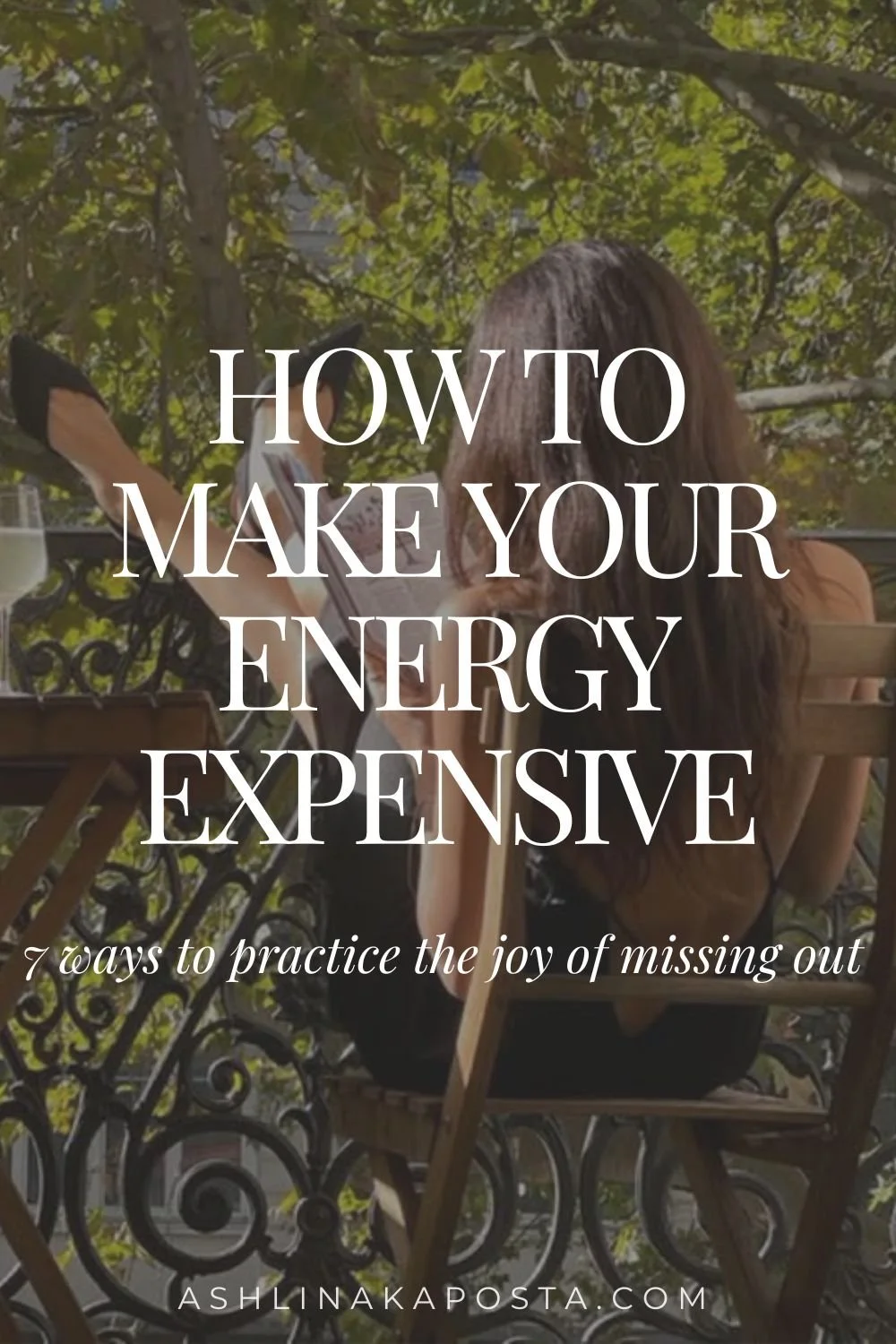
That's where this idea comes in: making your energy expensive.
Expensive energy doesn't mean you're unavailable, cold, or hard to reach. It means you've stopped handing yourself out simply because something — or someone — is available to you. It means your time, attention, and presence have a price, and that price is discernment.
This is the foundation of JOMO: the Joy of Missing Out.
FOMO vs. JOMO: A Complete Mindset Shift
For most of our lives, we've been fluent in one language: FOMO, the fear of missing out. It sounds like:
What if I miss something?
What if everyone else is having more fun, making more money, moving faster than me?
What if I say no and the opportunity never comes back around?
FOMO keeps you reactive. It keeps you scrolling, comparing, saying yes before you've even checked in with yourself. It's exhausting because it's built on scarcity — the belief that there isn't enough opportunity, enough time, enough love, enough abundance to go around, so you'd better grab everything you can, just in case.
JOMO asks a completely different question:
What if I don't need everything?
That single reframe changes everything. JOMO isn't about isolation or withdrawing from life. It's not about missing out on purpose to prove a point. It's about recognizing that your energy is finite, valuable, and worthy of protection — and that saying no to the wrong things is what makes room for the right ones.
When you stop giving your energy away simply because it's requested, expected, or convenient for someone else, your energy becomes expensive. Not unattainable. Not guarded out of fear. Expensive in the way anything valuable is expensive — because it's limited, intentional, and reserved for what actually deserves it. It’s definitely a feminine energy mindset practice.
Here's why this matters more right now than it ever has before.
We are living in the most connected, most "available" era in human history. Every notification, every open tab, every group chat is a small request for a piece of you. Individually, none of them seem like much. Collectively, they add up to a life spent responding instead of choosing — reacting to what's in front of you instead of building the thing you actually want.
Expensive energy is the correction. It's not a trend, and it's not a phase of coldness before you go back to old habits. It's a permanent recalibration of how you decide what deserves you.

7 WAYS TO PROTECT YOUR ENERGY
1. Stop Saying Yes Out of Fear
Most of the yeses we regret weren't really yeses at all. They were fear wearing the costume of opportunity.
Underneath a fear-based yes, you'll usually find one of these:
Fear of missing an opportunity that might not come again
Fear of being left out of something everyone else is part of
Fear of falling behind people you're quietly comparing yourself to
Fear that if you don't take it, someone else will get what you secretly wanted
None of these are really about the opportunity itself. They're about a story running underneath it — a story that says if you don't grab this right now, you'll lose your place in line for your own life.
The problem is that a fear-based yes rarely feels good even when it works out. You get the job, the invite, the relationship, the deal — and instead of relief, you feel depleted. That's the tell. A genuine yes energizes you, even when it's hard. A fear-based yes just quiets the anxiety for a moment before the resentment sets in.
Practice: Before you say yes to anything, pause and ask yourself:
Would I still want this if nobody else knew I was doing it?
Strip away the audience. Strip away the fear of being left out. Strip away the comparison. If what's left is still a genuine want, that's a real yes. If what's left is silence, or relief at the idea of not doing it, that's your answer too.
This single question filters out an enormous amount of noise. It won't make every decision easy, but it will make most of them honest.
2. Stop Chasing What Doesn't Feel Aligned
Not everything that looks good is good for you. This is one of the hardest lessons to actually live by, because so much of what we chase is objectively impressive.
It could be:
The opportunity that looks incredible on paper but drains you every time you think about it
The relationship that photographs well but leaves you smaller in real life
The trend everyone's doing that has nothing to do with who you actually are
The business strategy that's working for someone else but fights against your natural rhythm
The lifestyle that looks aspirational from the outside but would cost you your peace on the inside
Alignment doesn't always look exciting from the outside. Sometimes the aligned choice is the quiet one, the slower one, the one that doesn't get any applause. And misalignment doesn't always look bad — sometimes it looks like the best offer you've ever received, timed perfectly to test whether you actually trust yourself.
Practice: Learn to tell the difference between "I want this" and "I think I should want this."
"I should want this" is usually inherited — from culture, from comparison, from an old version of you that needed external proof of worth. "I want this" comes from somewhere quieter and more stable. It doesn't need to be justified to anyone.
This is where intuitive living becomes essential. Intuition doesn't shout. It doesn't compete with fear, hype, or urgency — which means if you're only listening to the loudest voice in the room, you'll miss it every time. Slowing down enough to hear the difference is, in itself, an act of making your energy expensive.
3. Protect Your Attention
Your attention is one of the most valuable forms of currency you have — arguably more valuable than your money, because you can always make more money, but you cannot get back the hours, days, and years you spend absorbed in things that don't matter.
And yet most of us spend our attention the way we'd never spend our money: carelessly, automatically, without ever checking the receipt.
Making your energy expensive means becoming ruthless — kindly ruthless — about where your attention goes.
Stop consuming everything just because it's in front of you.
Stop checking everyone's lives like it's your job to stay updated on people who don't actually add to yours.
Stop comparing timelines, as if there's one universal schedule everyone is supposed to be following.
Stop letting other people's priorities silently become your own, just because they were louder about theirs.
Every time you open an app, agree to a conversation, or let your mind circle back to something that doesn't serve you, you're making a withdrawal. Multiply that by a day, a week, a year, and it's not hard to see why so many capable, intelligent women feel like they have nothing left by the end of the day — not because they aren't doing enough, but because their attention has been leaking out in a hundred directions they never consciously chose.
Practice: Be intentional about what you allow into your mental and emotional space. Before you consume something, ask what it's costing you, not just what it's offering you.
Your attention is an investment. Spend it accordingly.
4. Let Yourself Be Unavailable
Somewhere along the way, many of us absorbed the belief that being a good, kind, reliable person means being infinitely accessible. That any hesitation, delay, or boundary is a character flaw.
It isn't. You don't have to be accessible to everyone, all the time — and the people who genuinely respect you were never asking you to be.
Unavailability, practiced with grace, looks like:
Not answering immediately, just because you technically could
Not attending everything you're invited to, even things that would be "fine"
Not explaining every no in painstaking detail, as if your boundary needs a legal defense
Not participating in every conversation, debate, or group chat simply because you were included
The instinct to over-explain a no usually comes from the same fear that drives a fear-based yes — the fear that if you don't justify yourself, you'll be seen as difficult, cold, or ungrateful. But a boundary that requires a full explanation to be valid isn't really a boundary. It's a negotiation.
Practice: Create more space between the invitation and your answer. You don't owe anyone an instant response. A pause is not rudeness — it's respect for yourself.
You are allowed to pause. You are allowed to sit with a request before you decide what it deserves from you.
5. Stop Performing Your Life
This might be the practice that hits closest to home, because it's the one most quietly reinforced by the world we live in.
So much of modern life has become a performance of a life, rather than the actual living of one. And the pressure isn't always to lie — it's to constantly prove, in real time, that you're:
Successful
Happy
Busy
Desirable
Interesting
Productive
Living your best life
When you're performing, even good moments get filtered through the question: how will this look? That question quietly hijacks decisions that should be yours alone. You don't take the trip because you want the trip — you take it because you want to be seen taking it. You don't pursue the relationship because it feels right — you pursue it because it looks right.
Expensive energy doesn't perform, because performance is, by definition, giving your energy to an audience rather than reserving it for yourself.
Practice: Do things because you love them — not because they photograph well or validate your identity. Ask yourself honestly, for the things you're currently chasing: would I still want this if I could never post about it, mention it, or tell anyone?
A beautiful life doesn't need an audience. The version of your life that's actually worth living is usually the one nobody sees the best parts of — because you were too present living them to document them.
6. Trust That There Is Enough
Underneath almost every fear-based yes, every chase, every bit of performed success, there's a single quiet belief driving the whole thing: there isn't enough, so I have to grab what I can, while I can.
Scarcity has a voice, and it's convincing. It says:
"I have to grab this now. If I don't, it's gone."
Trust says something different:
"What's meant for me will not require me to abandon myself."
This is a deeply spiritual shift as much as a practical one. You don't need every opportunity that crosses your path. You don't need to compete with every other woman for a seat that was never yours to fight for. You don't need to chase every open door just because it happened to be open.
Some doors are open because they're meant for you. Others are open simply because they were left unlocked — and walking through them anyway, out of fear that this is your only shot, is how so many of us end up somewhere that was never actually ours.
Trust doesn't mean passivity. It doesn't mean sitting back and hoping things land in your lap. It means releasing the frantic energy of now or never, and replacing it with the steadier energy of right things, right timing.
Practice: When something doesn't feel right, let it pass without assuming you've missed your chance. What's actually meant for you was never going to require you to override your own knowing to get it.
7. Choose Your Life
Everything before this practice has been about subtraction — saying no, protecting attention, releasing fear, letting go of performance. This last one is where it all comes together, because the ultimate goal of JOMO was never really about missing out at all.
It's about choosing in.
Choosing:
Your priorities
Your values
Your season
Your relationships
Your work
Your home
Your peace
Your vision
Every no you practice in the six steps before this one exists to protect your capacity to say a full, wholehearted yes to the life that's actually yours. JOMO isn't the art of missing out on life. It's the art of stopping the habit of missing your own life because you were too busy watching, comparing, and reacting to everyone else's.
Practice: Ask yourself —
What would I choose if I stopped worrying about what everyone else was choosing?
Sit with that question honestly, without immediately jumping to justify or explain the answer to anyone. Because the goal was never to miss out on life. The goal is to stop missing your own life because you're so busy watching everyone else live theirs.
The Expensive Energy Checklist
Save this. Screenshot it. Keep it somewhere you'll actually see it before your next big (or small) decision.
Before you say yes, ask:
☐ Do I actually want this?
☐ Am I choosing this from desire or fear?
☐ Does this support the life I'm building?
☐ Does this require me to abandon myself?
☐ Would I choose this if nobody else knew about it?
If it isn't a hell yes, you're allowed to let it pass.
Frequently Asked Questions About JOMO and Expensive Energy
What does "making your energy expensive" actually mean?
It means you no longer give your time, attention, and presence to people or opportunities simply because they're available to you. Instead, you choose what gets access to you based on alignment, not fear, urgency, or obligation. It's not about becoming unavailable — it's about becoming intentional.
Is JOMO the opposite of FOMO?
Yes, in the sense that FOMO is driven by fear and scarcity — the worry that you'll lose out if you don't say yes to everything — while JOMO is driven by trust and sufficiency, the belief that you don't need everything in order to be okay. But JOMO isn't simply "doing nothing." It's choosing what you actually want, on purpose, instead of reacting to what's in front of you.
Doesn't practicing JOMO mean missing real opportunities?
Not the ones meant for you. The practice isn't about rejecting everything — it's about slowing down enough to tell the difference between a genuine opportunity and a fear-based impulse. Opportunities that are truly aligned with your path tend not to require you to abandon your peace, values, or intuition to take them.
How do I stop feeling guilty about saying no?
Guilt around saying no is often inherited from a belief that your worth is tied to your availability. Practicing small, low-stakes "no's" builds the muscle. Over time, you'll notice that the people who matter respect your boundaries, and the discomfort of disappointing others gets easier to sit with than the exhaustion of constantly saying yes.
How is this different from just being lazy or checked out?
JOMO is not about disengaging from life — it's about engaging more deeply with less. A person practicing expensive energy is often more present, more focused, and more fulfilled in the things they do choose, precisely because they aren't spread across a hundred obligations that never mattered to them.
Can I practice this and still be ambitious?
Absolutely. Expensive energy isn't anti-ambition — it's anti-scattered. Protecting your attention and choosing aligned opportunities over every available one actually creates more capacity to pursue big goals, because you're not depleting yourself on things that don't move you closer to the life you want.
Where do I start if this feels overwhelming?
Start with the Expensive Energy Checklist above and apply it to just one decision this week — something small, like an invitation or a request on your time. Notice how it feels to pause before answering. That single pause is the entire practice in miniature.
How long does it take to actually feel the shift?
Most people notice a difference within a few weeks of consistent practice — not because the outer circumstances change immediately, but because the internal relationship with decision-making changes first. You start to feel steadier before you say yes, and lighter after you say no. The outer results — more aligned relationships, more focused work, more genuine rest — tend to follow once the internal pattern is established.
What if the people around me don't understand this shift?
Not everyone will, and that's expected. People who benefited from your unlimited availability may initially push back when you start protecting your energy. This isn't a sign you're doing it wrong — it's often a sign you're doing it right. The relationships and opportunities that are actually meant for this season of your life will adjust and often deepen. The ones that only worked because you never said no were likely costing you more than you realized.
Making Your Energy Expensive Isn't About Becoming Cold
It's easy to hear a practice like this and assume it means becoming distant, unavailable, or hard to reach. It doesn't.
Making your energy expensive isn't about becoming cold, unavailable, or difficult to access. It's about becoming a woman who knows her energy has value.
You stop giving your attention to everything. You stop saying yes to everything. You stop chasing everything. You stop comparing yourself to everyone.
And in the space that opens up, you start becoming deeply intentional about what gets your time, your attention, your presence, and your heart.
Because maybe you're not missing out.
Maybe you're finally choosing your life.
You may also like:
🌹 How to finally become a securely attached woman
🌹 How to balance your masculine & feminine energy
🌹 12 feminine energy books every woman should read
🌹How to reconnect with your feminine energy and find yourself again
Please feel free to email me at ashlina@thedecorista.com if you have any questions! I’m always happy to help with decorating, life advice or even picking out a specific perfume! Have an amazing day!!
Also, check out my Amazon shop HERE to shop all my favorite things, tips and tricks. You can also download the free LIKETOKNOW.IT app and follow me HERE.
STAY IN THE KNOW: Don’t forget to sign up for my exclusive Love Letters for STYLE TIPS, LIFE ADVICE, COSMIC TEA, AND MUCH MORE!
As always, thank you so much for stopping by today, I truly appreciate all of you! xo, Ashlina